

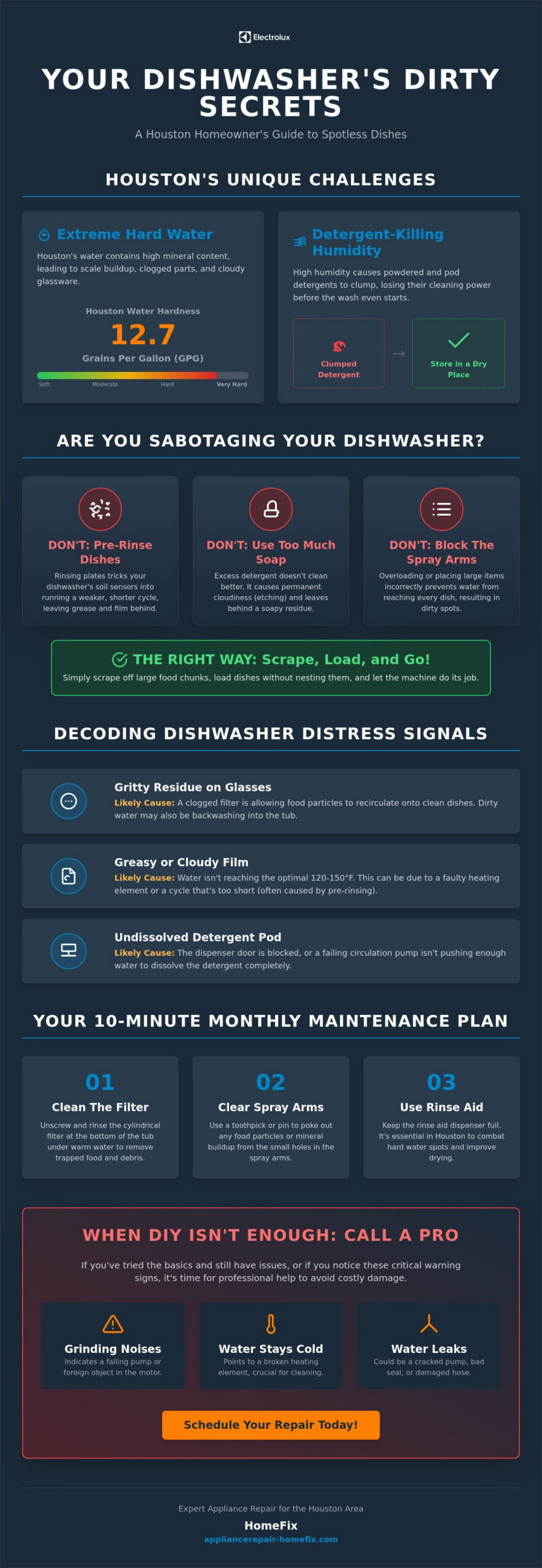
Scrubbing your plates before they hit the rack might actually be the reason your dishwasher is leaving them dirty. It sounds backwards, but modern sensors need that grime to calibrate the wash cycle correctly. If you’re dealing with a dishwasher not cleaning Houston area homes often face, the problem usually isn’t a total mechanical failure. It’s often a combination of your pre-wash habits and the high mineral content in our local water, which can reach levels as high as 12.7 Grains Per Gallon.
It’s exhausting to spend your evening hand-washing “clean” dishes just because they came out with cloudy spots or stuck-on food. You bought an appliance to save time, not to double your workload. You deserve glassware that shines and plates that are actually sanitized. We’ll help you stop hand-washing twice. Discover the hidden reasons your dishwasher is failing and how to fix it today. We will look at how Houston’s hard water creates scale buildup, why your loading pattern matters, and when a professional repair is the smartest financial move. You can get your kitchen back on track without the fear of high repair costs.
Key Takeaways
- Stop pre-rinsing your plates. Modern sensors actually need food particles to calibrate the wash cycle for the best results.
- Clean your cylindrical filter and spray arm ports monthly. These simple steps prevent common blockages and improve water circulation.
- Use rinse aid to fight Houston’s hard water. It breaks surface tension to prevent the calcium spots and cloudy glassware common in our area.
- Fix a dishwasher not cleaning Houston homes often struggle with by reducing your detergent. Too much soap causes etching and permanent filming.
- Know when to call a specialist. Grinding noises or cold water usually indicate a failing pump or heating element that requires professional attention.
Why Your Dishwasher Isn’t Cleaning Properly in Houston
Poor cleaning is rarely a mystery. It shows up as a gritty residue on your favorite glasses, a white film across your bowls, or a half-melted detergent pod sitting at the bottom of the tub. To fix the problem, you have to understand the mechanics. The circulation pump acts as the heart of the system. It draws water from the bottom of the tub and forces it through the spray arms to scrub your dishes. If this pump weakens or the spray ports clog, water pressure drops. Understanding how a dishwasher works helps you see why even a small blockage can ruin an entire load.
Many homeowners dealing with a dishwasher not cleaning Houston kitchens effectively are using outdated habits on modern machines. Newer units are built differently. They use less water and lower heat to meet strict environmental guidelines. These machines rely on enzymes in the detergent to “eat” food particles rather than using raw water force. If your dishes are coming out dirty, it’s often because the machine’s sensors or spray paths are being disrupted by local environmental factors or simple maintenance oversights.
Common Symptoms of a Failing Cycle
You can often diagnose the issue just by looking at what’s left behind on your plates. Different types of residue point to different mechanical or habit-based failures. Watch for these specific signs:
- Gritty residue: Tiny, sand-like particles on top-rack glasses usually mean your filter is clogged or the drain check valve is allowing dirty water to backwash onto clean dishes.
- Greasy film: If plastic containers feel oily or “tacky” after a cycle, the water likely isn’t reaching the 120 to 150 degrees Fahrenheit required to melt animal fats and oils.
- Undissolved detergent: A solid pod left in the dispenser or at the bottom of the tub indicates a blocked dispenser door or a failing circulation pump that isn’t moving enough water to dissolve the soap.
The Houston Environment Factor
Our local climate plays a bigger role in kitchen performance than most people realize. Houston’s high humidity is a primary enemy of detergent. If you store powdered soap or pods in a cabinet under the sink, moisture can cause the chemicals to clump and lose their effectiveness before they even enter the machine. This leads to poor cleaning results regardless of the appliance’s age.
Water quality is the other major hurdle. Houston’s water hardness can reach levels as high as 12.7 Grains Per Gallon, which is classified as “very hard.” These minerals create scale buildup inside the pump and spray arms. Under 2026 energy standards, dishwasher efficiency is measured by the ability to clean maximum loads with minimal water, making these mineral deposits even more disruptive to modern, high-efficiency cycles. If basic cleaning doesn’t restore your results, you likely need professional dishwasher repair to clear internal blockages or replace failing sensors.
Busting Common Myths: Why Pre-Rinsing and Extra Soap Are Killing Your Results
Many Houstonians think they’re helping their machine by scrubbing plates in the sink before loading them. In reality, this habit often causes the very problem you’re trying to avoid. If you find your dishwasher not cleaning Houston tap water residue effectively, the culprit might be your own sink habits. Modern appliances are designed to handle soil. When you remove it all beforehand, you’re essentially “tricking” the machine into doing a worse job.
Loading habits also play a massive role in performance. If you nest spoons together or block the spray arm with a large platter, the water simply cannot reach every surface. This leads to “clean” dishes that still have stuck-on debris. Efficient cleaning requires a clear path for water to travel from the pump to the plate. If you have adjusted your habits and still see poor results, you might need professional dishwasher repair to check for internal spray arm blockages.
The Science of Soil Sensors
Modern dishwashers use turbidity sensors to “see” how dirty your dishes are. These sensors measure the clarity of the water during the initial rinse. If the water is clear because you pre-rinsed everything, the machine assumes the load is light. It then shortens the cycle and uses less heat, which often leaves behind a greasy film. Detergent enzymes are designed to latch onto food proteins; without them, the chemicals have nothing to target but your glassware. By leaving the “dirt” on the dishes, you give the detergent a job to do and allow the sensors to run a full, high-heat cycle.
Detergent Dilemmas: Pods vs. Gel
More soap does not mean cleaner dishes. In fact, using too much detergent in the presence of Houston’s mineral-heavy water can lead to permanent etching. This looks like a cloudy film, but it’s actually tiny scratches on the surface of your glass. According to research on hard water effects, the balance between mineral content and detergent concentration is delicate. If you use a high-efficiency pod on a “Quick Wash” cycle, the pod often won’t dissolve fully. This leaves a sticky residue in the tub and on your plates.
Pods are generally superior for most local homes because they contain a pre-measured amount of detergent and rinse aid. However, they require the heat of a “Normal” or “Heavy” cycle to break down. If your pods aren’t dissolving or your dishes remain dirty after following these tips, it’s time to consider a dishwasher repair Houston specialist to investigate your heating element or dispenser door. Most mechanical issues won’t fix themselves and only lead to higher utility bills over time.
The 10-Minute Maintenance Routine Every Houston Homeowner Needs
Preventative maintenance is the best way to avoid a dishwasher not cleaning Houston households effectively. You don’t need special tools or hours of free time. Most common issues stem from simple blockages that you can clear yourself in about ten minutes. This routine focuses on the areas where food debris and mineral scale tend to hide. Follow these steps once a month to keep your machine performing like new.
Start by wiping down the door gasket. Use a damp cloth and a mild vinegar solution to clean the rubber seal around the door. This prevents leaks and stops mold from growing in the crevices. Next, check your drainage setup. Ensure the air gap on your sink is clear of debris. If your sink doesn’t have an air gap, verify that the drain hose has a “high loop” under the counter. This prevents dirty sink water from backflowing into your clean machine. Finally, run a monthly cleaning cycle using a dedicated descaler to combat the heavy mineral buildup common in local water.
Deep Cleaning the Filter System
The cylindrical filter at the base of your tub is your first line of defense. Twist the filter to unlock it and pull it out. You’ll likely find a collection of food particles, grease, or even small pieces of plastic. Rinse the assembly under hot water. Use a soft brush, like an old toothbrush, to gently scrub the mesh. Look closely for any tears or holes in the screen. A damaged filter allows debris to enter the circulation pump, which can lead to a dishwasher not draining Houston homeowners then have to fix. Always ensure the filter clicks back into place securely before running the next load.
Unclogging Spray Arms for Maximum Pressure
Spray arms are often the hidden reason for dirty dishes. Inspect the small ports along the top and bottom of each arm. Lemon seeds, toothpick fragments, or hard water deposits can easily plug these holes. Use a simple toothpick to poke through each opening and clear the obstruction. You can often flush the arms by pouring water through the center hub while holding them over the sink. When lower spray arm pressure is compromised by clogs, the water diverted to the top rack drops significantly, leaving upper glasses dirty. If you find that your spray arms are cracked or the hub is loose, you may need professional dishwasher repair to restore full pressure to the system.
Hard Water and Heat: Houston-Specific Factors Affecting Your Clean
Houston’s environment presents unique challenges for kitchen appliances. If you’re struggling with a dishwasher not cleaning Houston tap water minerals effectively, you’re likely seeing white, chalky spots on your glasses. This is calcium carbonate. Our local water hardness ranges from 7.9 to 12.7 Grains Per Gallon, which is high enough to interfere with the chemical reactions in your detergent. Over time, these minerals bond to the interior of your tub and the surface of your dishes, making them look dirty even after a full cycle.
One effective way to fight this buildup is the citric acid trick. Place a small bowl filled with 2 to 3 ounces of citric acid crystals on the top rack of an empty dishwasher. Run a heavy-duty cycle. The acid breaks down the mineral scale that standard detergents can’t touch. This simple step can restore the factory shine to a stainless steel tub in about an hour. If your tub remains dull or gritty after this treatment, you may need to schedule a professional inspection to check for deeper internal scaling within the pump and hoses.
The Necessity of Rinse Aid in Texas
In our high-humidity climate, dishes don’t dry efficiently through evaporation alone. Rinse aid is essential. It acts as a surfactant, breaking the surface tension of the water so it “sheets” off the plates rather than forming droplets. If your glasses come out cloudy or covered in spots, your rinse aid dispenser is likely empty or clogged. Check the optical window on the dispenser door; it should be dark if full. Most modern machines have adjustable settings for rinse aid. In Houston, set your dispenser to a higher level, usually 3 or 4, to compensate for the very hard water. This ensures enough surfactant is released to neutralize the mineral content during the final rinse.
Verifying Your Water Temperature
Your dishwasher relies on heat to activate detergent enzymes and melt grease. Most detergents require a minimum temperature of 120°F to work correctly. If the water enters the machine cold, the cycle won’t be effective. You can test this easily at home. Run the hot water at your kitchen sink for 60 seconds, then fill a glass and check it with a meat thermometer. If it’s below 120°F, your home’s water heater may be set too low. However, if the water at the sink is hot but the dishes still feel greasy, you likely have a faulty heating element or a broken thermostat. In these cases, you will need professional service to replace the internal heating components and restore your machine’s cleaning power.
When DIY Isn’t Enough: Professional Dishwasher Repair in Houston
Some kitchen problems require more than a quick scrub. If you’ve already cleared the filter and adjusted your detergent but still face a dishwasher not cleaning Houston glassware properly, the issue is likely internal. Grinding or buzzing noises often signal a failing circulation pump. If the tub remains cold during the cycle, your heating element has likely failed. These mechanical and electrical components require specialized tools and training to test safely. Trying to force a failing machine to run only wastes water and risks a kitchen flood.
In 2026, repairing your current appliance is the most sustainable and cost-effective choice. Manufacturing and shipping a new dishwasher creates a significant environmental footprint. Most professional repairs cost a fraction of a new machine’s price, and a well-maintained unit can last for years. We provide expert dishwasher repair across the region. Our technicians are frequently in Katy, Memorial, and The Woodlands, ensuring local families don’t have to wait days for a solution.
What to Expect from a HomeFix Technician
We value your time and your schedule. Our team offers 3-hour arrival windows so you aren’t stuck waiting all day. We often have same-day availability for urgent disruptions. During the visit, the technician performs a thorough diagnostic. They check for electrical faults, sensor accuracy, and mechanical wear. We believe in transparent pricing. We apply the diagnostic fee directly toward the total cost of your repair. Our specialists have deep expertise with all major brands, including Whirlpool and KitchenAid systems. You’ll get a clear explanation of the problem before any work begins.
Long-Term Protection for Houston Appliances
Reliability shouldn’t be a guessing game. We stand behind our work with a 1-year warranty on parts and a 3-month warranty on labor. Regular professional maintenance catches small leaks or mineral deposits before they cause a total system shutdown. This proactive approach ensures your dishwasher continues to handle Houston’s hard water without failing. It protects your investment and keeps your utility bills low. Don’t spend another night hand-washing dishes that should already be clean. Schedule your HomeFix diagnostic now and get your kitchen back to peak efficiency.
Restore Your Kitchen’s Efficiency Today
Solving the problem of a dishwasher not cleaning Houston homes effectively often starts with simple habit changes. Stop pre-rinsing your plates and let the modern sensors calibrate correctly. Regular maintenance of your filter and spray arms prevents most residue issues. Always use rinse aid to fight the high mineral content in our local water. If these steps don’t restore the shine to your glassware, you likely have a mechanical failure that requires technical expertise.
Don’t spend another night hand-washing dishes. HomeFix offers steady reliability and professional standing to get your appliance back in top shape. We provide 3-hour arrival windows to respect your time. Our diagnostic fee is always applied toward your repair, and we back our work with a 1-year parts warranty. Book Your Houston Dishwasher Repair Diagnostic Today. You deserve a kitchen that works as hard as you do, and we’re here to make that happen.
Frequently Asked Questions
Is it worth repairing a dishwasher that isn’t cleaning well?
Repairing a machine is almost always more cost-effective than buying a new one. Modern units are built to be serviced, and most cleaning issues involve simple part replacements like pumps or valves. Choosing professional repair saves you the high cost of a new appliance and the hassle of a new installation. It is a faster way to get your kitchen back to normal.
Can hard water in Houston cause my dishwasher to leave a white film?
Houston’s hard water is a primary cause of white filming. With a dishwasher not cleaning Houston area glassware, these minerals bond to your dishes during the drying cycle. Hardness levels in our region reach 12.7 Grains Per Gallon. Using a high-quality rinse aid is essential to break surface tension and prevent these spots. This keeps your glasses clear even with local water conditions.
How much does a dishwasher diagnostic fee cost in Houston?
Diagnostic fees vary by provider but are standard across the local industry. Many specialists apply this initial cost toward the final repair price if you proceed with the fix. This ensures you get a professional evaluation of the electrical and mechanical systems without paying extra for the visit itself. It is a transparent way to identify the exact cause of a failing machine.
What happens if my dishwasher is not getting the water hot enough?
If the water doesn’t reach at least 120°F, detergent enzymes won’t activate and grease won’t melt. This often stems from a failing heating element or a faulty thermostat. You’ll notice greasy residue or undissolved soap pods at the end of the cycle. A technician can test these components with professional tools to find the exact failure point and restore heat.
Can I use vinegar to clean my dishwasher in Houston?
Vinegar is a useful mild acid for removing light scale, but it can damage rubber gaskets over time. For the heavy mineral buildup common in a dishwasher not cleaning Houston tap water deposits, a dedicated citric acid cleaner is more effective. These specialized cleaners are designed to be safe for the machine’s internal seals while dissolving tough mineral scale.
How often should I clean the filter in my Houston dishwasher?
You should clean your filter at least once a month. In households that run the dishwasher daily, checking it every two weeks is even better. Removing food debris and grease buildup prevents clogs that lead to poor drainage. This simple task stops the machine from re-washing dirty water over your clean plates during the final rinse. It only takes a few minutes.
Is it better to use pods or liquid detergent for cleaning performance?
Pods are generally superior because they contain pre-measured amounts of detergent, enzymes, and rinse aid. Liquid gels often lead to over-sudsing or etching if you use too much. However, pods require the heat of a full cycle to dissolve properly. Avoid using them on quick wash settings to prevent half-melted soap residue from sticking to your dishes or the tub walls.
Why does my dishwasher smell bad even after a cycle?
Foul odors usually come from rotting food trapped in the filter, the drain hose, or the door gasket. Clean these areas thoroughly with a soft brush and soapy water. If the smell persists, you may have a partial clog in the drain line or a failing drain pump. A professional can clear the line to ensure dirty water exits the tub completely.


