The U.S. Fire Administration reports that failure to clean lint is the leading cause of approximately 2,900 home dryer fires every year. This hidden danger often starts with a simple, frustrating symptom: your dryer takes two cycles to dry a single load of clothes. When you find yourself restarting the machine for the second or third time, you aren’t just losing hours of your day. You’re also watching your energy bills climb while your home’s safety is potentially at risk.
We understand how stressful a malfunctioning appliance can be for a busy household. You want laundry day to be predictable and efficient, not a source of worry. The good news is that most drying delays aren’t caused by a broken heating element. They’re usually the result of restricted airflow that you can fix with the right approach. Discover the most common causes of long drying times and learn step-by-step how to restore your dryer’s efficiency. This guide covers everything from lint trap maintenance to vent obstructions. Follow these steps to get back to drying clothes in one cycle with total peace of mind.
Key Takeaways
- Understand the critical role of airflow and why heat alone cannot dry your laundry efficiently.
- Identify the specific vent obstructions that explain why your dryer takes two cycles to dry.
- Learn how to detect invisible waxy buildup on your lint screen caused by fabric softeners.
- Recognize mechanical warning signs like failing heating elements and residue-coated moisture sensors.
- Determine when a professional diagnostic is necessary to protect your home and restore peak performance.
Why Your Dryer Takes Two Cycles to Dry: The Airflow Equation
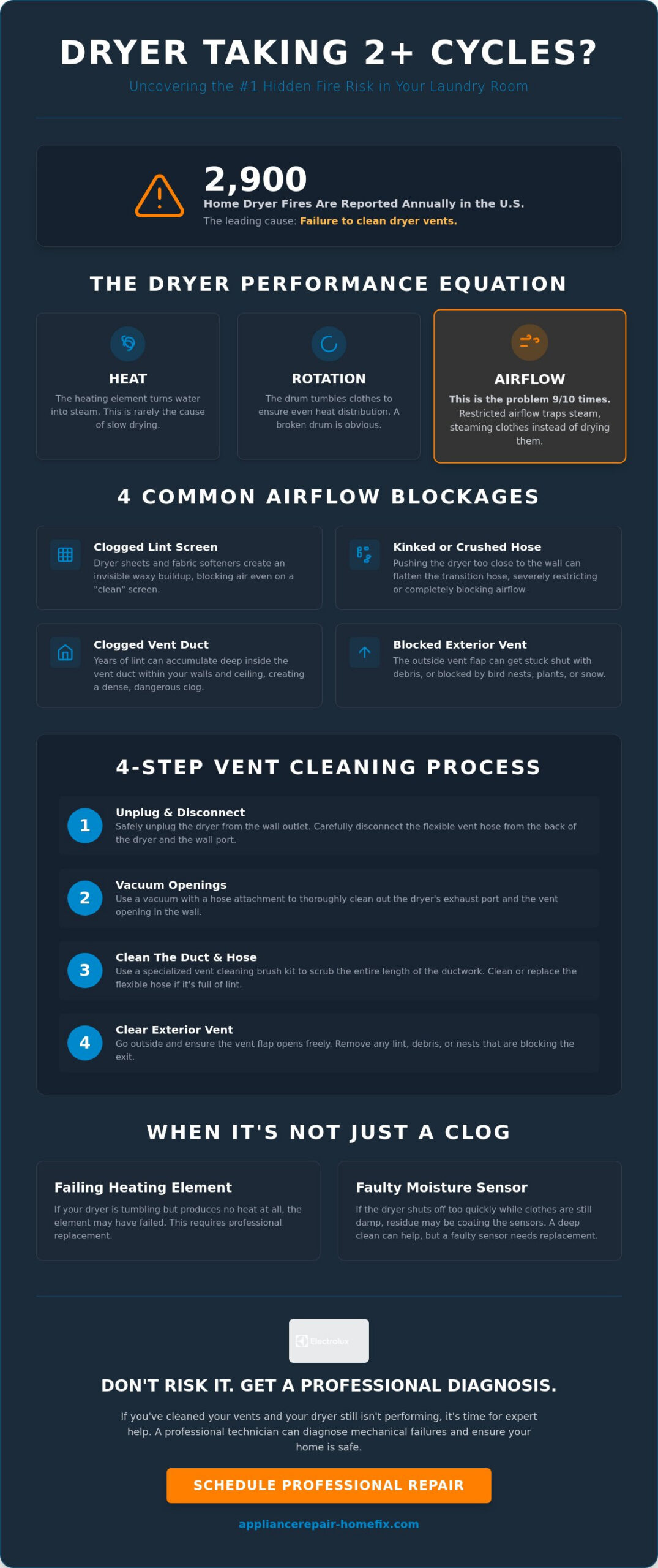
Every dryer relies on a simple balance of heat, drum rotation, and massive airflow. If one of these elements fails, your laundry routine grinds to a halt. Most homeowners assume the heating element is broken when their clothes stay damp, but that is rarely the case. In reality, airflow is almost always the culprit. When your dryer takes two cycles to dry, you are likely facing a physics problem rather than a total mechanical breakdown.
Understanding how clothes dryers work helps clarify the issue. Heat turns the water in your fabrics into steam. The rotating drum keeps the laundry moving so the heat can reach every fiber. However, that steam must be physically pushed out of the machine. If the air cannot escape, the moisture stays trapped inside the drum. Your clothes end up steaming in a hot, wet box instead of drying.
Running multiple cycles to compensate for this failure is a costly mistake. It puts double the stress on your motor and heating element, leading to expensive repairs down the road. If you find yourself restarting the machine constantly, it is time to look at the vent system before you need professional dryer repair.
How Airflow Affects Drying Time
Think of your dryer as a high-speed exhaust fan. It pulls in cool air, heats it up, and blasts it through your clothes to carry away evaporated water. When the vent is clear, this process is fast and efficient. If a “backlog” of air occurs due to a clog, the fan cannot push the wet air out. This creates a cycle of stagnant, humid air that prevents evaporation. Airflow restriction is the primary cause of damp clothes after a full cycle.
The Impact of Houston Humidity
Living near the Gulf Coast presents unique challenges for home appliances. High Houston humidity means the air is already saturated with moisture, making it harder for your dryer to dissipate wet air. This environmental factor often causes outdoor vent flaps to stick or corrode over time. Salt air and constant moisture can lead to rust on metal components or a sticky grime on plastic vents.
Check for mold or dampness on the walls around your laundry room. If the air cannot exit the house quickly, it may leak back into your home, causing localized humidity issues. You should also verify if your outdoor vent flap is blocked by debris, bird nests, or local vegetation. In our climate, vines and shrubs grow quickly and can easily cover an exhaust port, forcing your dryer to work twice as hard to push air through the obstruction.
Step 1: Inspecting and Cleaning Your Dryer Vent System
Start your inspection at the back of the machine. The transition hose is the flexible duct that connects your appliance to the wall. If your dryer takes two cycles to dry, this hose is often the first place where airflow fails. Lint collects in the ridges of flexible ducts, eventually creating a thick wall of debris. You must check the entire length of the vent pipe from the laundry room to the exterior wall of your home. Any blockage along this path forces the dryer to work harder, wasting your time and increasing your utility costs.
Cleaning your vents is the most effective solution when your dryer takes two cycles to dry. Use a high-powered vacuum or a specialized vent cleaning brush kit for a deep clean. These kits include flexible rods that can reach deep into the wall to pull out hidden clogs. Don’t forget to check the exterior hood. It’s common for lint to get stuck in the louvers or for small birds to build nests inside the vent opening during the spring months.
Checking for Kinked or Crushed Hoses
Pull the dryer away from the wall to inspect the condition of the duct. In tight laundry rooms, it’s easy to push the machine back too far, which crushes the hose and cuts off the air supply. If you still have an old plastic “slinky” duct, replace it immediately. These are significant fire hazards and trap lint much faster than metal alternatives. Rigid or semi-rigid metal ducts provide better safety and superior airflow. Following professional dryer safety and maintenance guidelines is the best way to prevent household fires and keep your machine running efficiently.
A Step-by-Step Vent Cleaning Process
Follow these steps to clear your system and restore performance:
- Step 1: Unplug the dryer and disconnect the vent hose from both the machine and the wall.
- Step 2: Vacuum out the back of the dryer cabinet and the wall entry point to remove immediate buildup.
- Step 3: Clear the exterior vent using a leaf blower or a specialized brush kit to remove clogs from the other end.
- Step 4: Reconnect the system, push the dryer back carefully to avoid kinks, and test for strong airflow at the exit point.
If you find that the vent pipe runs through a crawlspace, attic, or roofline that you cannot safely reach, it’s time to call in a specialist. You can schedule a professional diagnostic to ensure your entire vent system is clear and safe for use.
Step 2: Troubleshooting the Lint Screen and Washer Performance
Even a lint screen that looks spotless can be the reason your dryer takes two cycles to dry. Most people clear the visible lint after every load, but they ignore the invisible barrier building up on the mesh. Dryer sheets and liquid fabric softeners contain fats and waxes that coat the screen over time. This waxy film can block up to 50% of the airflow, forcing your machine to work harder and longer. Following Consumer Reports’ dryer safety tips, you should treat your lint filter as a critical component of your maintenance routine. Scrubbing it once a month ensures your dryer doesn’t overheat or waste energy.
Overloading the drum is another common mistake that kills efficiency. If you pack the drum too tight, air cannot circulate between the garments. The heated air needs space to move around the fabric to carry moisture away. Keep your loads to about three-quarters of the drum’s capacity for the best results. This allows the laundry to tumble freely and dry in a single cycle.
The Lint Screen Water Test
If you aren’t sure if your screen is clogged, try the water test. This is a quick DIY diagnostic that reveals hidden residue. Take the filter to your kitchen sink and run warm water over the mesh. In a clean screen, the water will pass through instantly. If the water beads up, pools on the surface, or runs off the sides, you have a waxy buildup. Use a soft brush and warm, soapy water to scrub the mesh until the water flows through freely. Dry the screen completely before sliding it back into the dryer. This simple fix often solves the problem when your dryer takes two cycles to dry without requiring any tools.
Is Your Washer the Real Problem?
Sometimes the dryer isn’t the issue at all. If your clothes are dripping wet when you move them to the dryer, your washer is failing its primary job. The washer’s spin cycle is the dryer’s best friend. It should extract the majority of the water before the tumbling begins. A faulty washer drain pump or a worn-out drive belt can prevent the machine from reaching high spin speeds. When the washer doesn’t extract enough water, it can add 30 minutes or more to your drying time. Check your settings to ensure you are using the correct spin speed for heavy items like towels or bedding. If the load feels unusually heavy or soggy, you likely need a professional to look at your washing machine’s drainage system.
Mechanical Failures: When It Is Not Just a Clog
If cleaning the vent and lint screen didn’t solve the problem, you are likely dealing with a mechanical failure. Many homeowners assume a heating element is either working or completely broken. This is a mistake. Heating elements can partially fail or short out against the heater housing. When this happens, the dryer produces some heat, but not enough to evaporate moisture efficiently. This weak heat is a primary reason a dryer takes two cycles to dry. Instead of high temperatures, your clothes only get lukewarm air that cannot finish the job.
Gas dryers have their own set of unique mechanical issues. They use solenoids to open the gas valves. These coils can weaken over time. They might work for the first ten minutes of a load but fail once they get hot. This causes the burner to shut off mid-cycle while the drum continues to tumble cold clothes. Thermal fuses and thermostats also play a role. These components regulate internal temperatures. If a cycling thermostat is out of calibration, it may cut the heat too early, leaving your laundry damp and cold.
Testing the Heating Element and Thermostats
Understanding the difference between “no heat” and “low heat” is key to your diagnosis. If the dryer is completely cold, check the thermal fuse. A blown fuse stops all heating immediately to prevent a fire. To test the heating element itself, you need a multimeter. Disconnect the power and check for continuity across the element terminals. If there is no continuity, the coil is broken and needs replacement. A reading that shows a “short to ground” means the element is touching the metal casing. This is a major safety risk that requires immediate attention.
Cleaning the Moisture Sensor Bars
Most modern dryers use moisture sensors to determine when a cycle is finished. You can find these two thin metal bars inside the drum, usually near the lint trap housing. Just like your lint screen, these bars get coated in a waxy residue from dryer sheets and fabric softeners. This film acts as an insulator. It prevents the sensors from detecting the actual moisture level in your clothes. The dryer then assumes the load is dry and ends the cycle prematurely. This is why your dryer takes two cycles to dry even when the heating element is perfectly fine.
Cleaning them is simple. Dip a cotton swab in rubbing alcohol and rub the length of both metal bars. This removes the invisible film and restores the sensor’s accuracy. These sensors tell the dryer when to stop, so keeping them clean is essential for one-cycle drying. If these DIY steps don’t fix the issue, you may have a failed control board or damaged internal wiring.
You don’t have to guess which internal part is failing. Book a professional dryer repair today to get an expert diagnostic and restore your machine’s efficiency.
Professional Dryer Repair in Houston and Katy
When DIY maintenance fails to solve the problem, you’ve reached the limit of home troubleshooting. Internal components like failing control boards or weak gas valves require specialized tools and technical expertise to diagnose safely. If your dryer takes two cycles to dry after you have cleaned the vents and the lint screen, it is time for a professional inspection. HomeFix provides reliable dryer repair across the entire Houston metro area. We serve local neighborhoods in Katy, Memorial, and Sugar Land with speed and precision.
Our team specializes in Whirlpool dryer repair along with all other major high-end brands. We understand that a malfunctioning appliance disrupts your household’s rhythm and increases your energy costs. We offer same-day or next-day appointments to ensure you don’t have to wait a week for dry clothes. Our pricing is transparent and competitive, focusing on getting your machine back to peak performance without the guesswork.
Why Choose HomeFix for Your Dryer Repair?
We pride ourselves on being the dependable local specialists you can trust. Our technicians are fully certified to work on both gas and electric models, ensuring a safe repair process for your home. We use only high-quality OEM parts to maintain the integrity of your appliance. To give you total peace of mind, every repair we perform comes with a 1-year warranty on parts and labor. We also offer a $69 service fee, which we apply directly toward the total cost of your repair. This ensures you get a professional diagnostic at a fair price.
Book Your Service in the Houston Metro Area
We value your time and your schedule. Our team provides convenient 3-hour arrival windows for busy professionals, so you never have to spend an entire day waiting for a technician. We serve a wide range of local communities, from Cypress down to Pearland and everywhere in between. Our goal is to provide a no-nonsense solution that gets your laundry done in a single cycle once again.
Stop wasting hours on multiple laundry cycles and watching your utility bills rise. Schedule your dryer repair now and let our experts restore your machine’s efficiency today. We are ready to help you regain your peace of mind and a functional home.
Restore Your Dryer’s Efficiency Today
Solving a long drying time usually starts with mastering the airflow equation. From clearing clogged exterior vents to performing the water test on your lint screen, most issues have a straightforward solution. If you’ve tried these maintenance steps and your dryer takes two cycles to dry, the problem is likely an internal mechanical failure. A weak heating element or a coated moisture sensor will continue to waste your time and drive up energy bills until it’s replaced by a professional.
HomeFix has provided expert service to the Houston and Katy communities since 2016. Our technicians are factory-certified for major brands like LG, Samsung, and Whirlpool. We back every repair with a 1-year parts warranty to ensure your peace of mind. You don’t have to settle for damp clothes or high utility costs any longer. Book Your Dryer Repair in Houston Today to restore your machine’s peak performance. Let’s get your laundry routine back on track with a fast, professional fix that keeps your home safe and efficient.
Frequently Asked Questions
Why does my dryer take two cycles but it feels hot?
Airflow blockage is the primary reason a hot dryer still leaves clothes damp. Even if your heating element works perfectly, the moisture cannot escape if the vent is clogged. This is a common reason a dryer takes two cycles to dry. The hot air simply recirculates the humidity inside the drum. This creates a steaming effect rather than a drying effect. You should inspect your exterior vent hood immediately.
How often should I clean my dryer vent in Houston?
You should clean your dryer vent at least once every year to maintain safety and efficiency. In the Houston area, high humidity can cause lint to clump together more quickly inside the pipes. If you have a large family and run multiple loads daily, you might need a cleaning every six months. Regular inspections prevent the restricted airflow that leads to long drying times and potential fire hazards.
Can a bad heating element cause a dryer to take two cycles?
A partially failed heating element can definitely cause long drying times. Most people think these parts either work or they don’t, but they can short to the housing and produce only a fraction of their normal heat. This weak performance is a major reason a dryer takes two cycles to dry a standard load. A professional technician can test the element’s continuity to see if it needs replacement.
Is it safe to keep using a dryer that takes two cycles?
It is not safe to continue using a dryer that requires multiple cycles. This symptom is often the first warning sign of a dangerous lint blockage. According to the U.S. Fire Administration, failure to clean lint is the leading cause of thousands of home fires annually. Running extra cycles also puts extreme stress on the motor and drum belt. This can lead to a more expensive mechanical breakdown.
Why are my clothes still damp even though the dryer says it is done?
Waxy residue on your moisture sensor bars is usually why a dryer stops while clothes are still damp. These small metal bars inside the drum detect moisture through electrical conductivity. When dryer sheets leave a film on them, the sensors lose their ability to read the laundry’s true dryness level. The machine then shuts off prematurely. Scrubbing the bars with a cotton swab and rubbing alcohol usually fixes this problem.
How much does it cost to have a dryer vent professionally cleaned?
Professional vent cleaning costs vary based on the length of the vent and its location in your home. Roof-mounted vents or long runs through crawlspaces typically require more labor than a simple wall-exit setup. While some homeowners try to use DIY kits, a professional has the high-powered vacuum equipment needed to clear the entire line. It is a vital investment for home safety and lower energy consumption throughout the year.
Does a dryer take longer to dry if it is overloaded?
Overloading your dryer significantly increases drying time because it prevents proper air circulation. Laundry needs to tumble freely so that heated air can reach the surface of every garment. When the drum is packed too tight, the clothes just clump together and trap moisture in the center of the load. Keep your loads at about three-quarters capacity to ensure everything dries thoroughly in a single cycle without extra wear.
Can dryer sheets actually damage my dryer?
Dryer sheets don’t break the machine’s hardware, but they do leave a waxy coating that reduces performance. This invisible film clogs the fine mesh of your lint screen and coats the moisture sensors. Over time, this buildup restricts airflow and causes the sensors to misread the laundry. To prevent this, wash your lint screen with soapy water once a month and clean the sensor bars with rubbing alcohol regularly.