

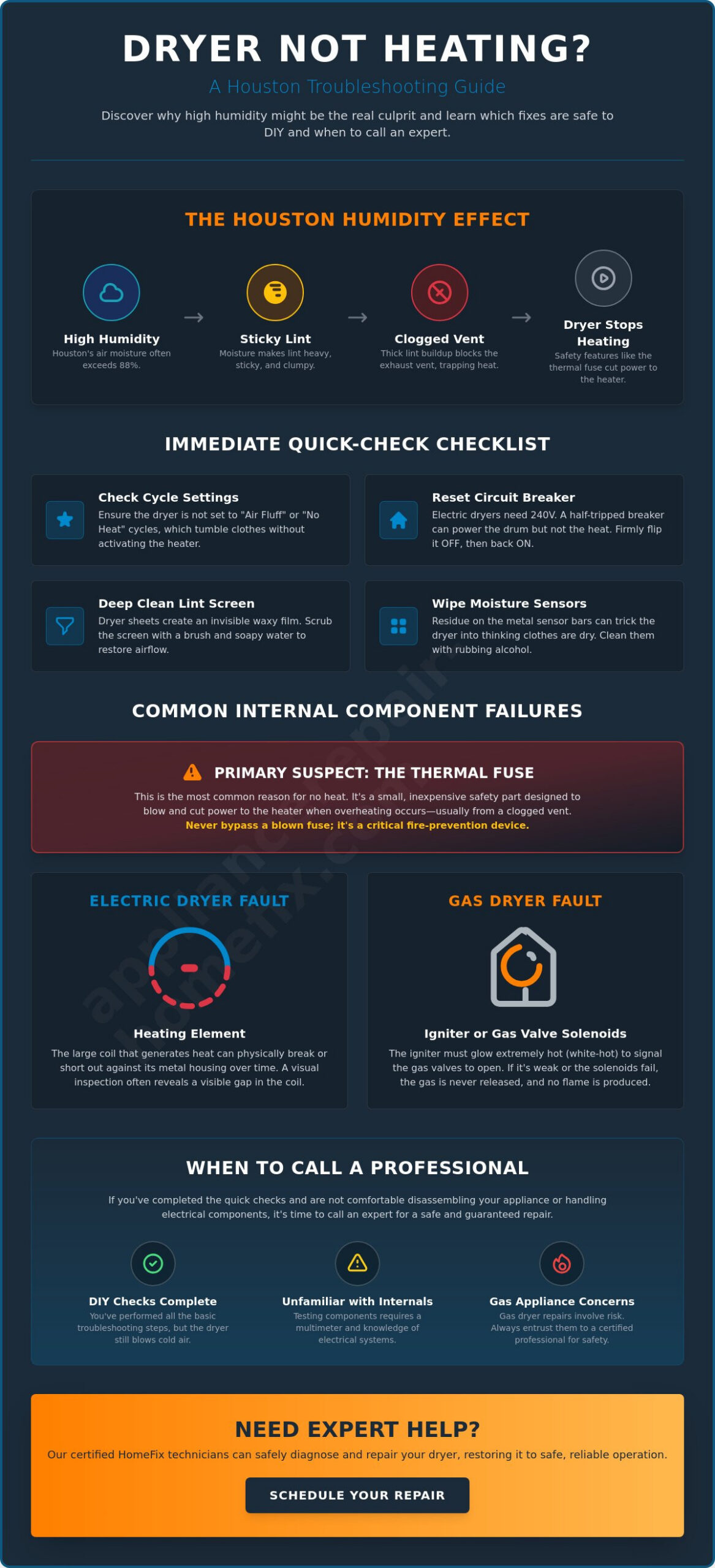
That broken heating element you’re worried about might be perfectly functional. In a city where relative humidity often hits 88% in June, the real culprit is frequently restricted airflow caused by moisture-heavy lint. If you’re currently dealing with a dryer not heating Houston laundry loads effectively, you’re likely facing piles of damp clothes and climbing energy bills. It’s a stressful disruption that makes your daily routine feel disorganized and raises genuine concerns about fire risks.
We know you want your home running smoothly again without the anxiety of a malfunctioning appliance. You deserve a dryer that works safely and dries every load in a single cycle. This guide provides a clear troubleshooting checklist to help you identify the specific fault. You’ll learn exactly which fixes you can handle yourself and when it’s necessary to bring in a local expert for a professional repair. We’ll cover everything from thermal fuses to gas valve solenoids so you can restore your appliance to safe, reliable operation.
Key Takeaways
- Check your power source and cycle settings first to rule out simple user errors before reaching for your tools.
- Identify common mechanical failures like blown thermal fuses or shorted heating elements that cause a dryer not heating Houston laundry loads to blow cold air.
- Understand how high local humidity creates thick lint buildup that restricts airflow and forces your machine to run multiple cycles.
- Learn the specific diagnostic differences between gas and electric models, including how to verify gas supply and heating element continuity.
- Recognize the clear signs that a repair requires specialized equipment and professional expertise to ensure the safe operation of your appliance.
Immediate Quick-Check Checklist: Before You Call a Pro
Start with the simplest explanations first. Check your dryer settings before you assume a major part has failed. It’s easy for a family member to accidentally switch the machine to “Air Fluff” or “No Heat.” These cycles tumble your clothes without engaging the heating element at all. This is a frequent cause of a dryer not heating Houston laundry loads, especially in homes with multiple users. Understanding how clothes dryers work helps you see that the drum motor and the heating system often rely on different electrical paths.
Inspect your lint screen for more than just fuzz. If you use dryer sheets or liquid fabric softener, a waxy film can build up on the mesh. This invisible barrier restricts airflow. When air can’t move freely, the dryer’s internal safety sensors will shut down the heater to prevent a fire. Take the screen to your sink. Scrub it with a toothbrush and warm, soapy water. If the water doesn’t flow through the mesh easily, the wax is likely your problem. Also, verify that the door switch is fully engaging. You should hear a crisp click when you press it manually. If the switch is loose or bent, the dryer might spin but refuse to activate the heat.
Power Supply and Breaker Basics
Electric dryers are high-demand appliances. They require two separate 120-volt circuits to provide the 240 volts needed for the heating element. Sometimes, a circuit breaker “half-trips” in your Houston home panel. One leg of power stays active, allowing the drum to spin and the lights to stay on. However, the second leg that powers the heater fails. Go to your breaker box. Flip the dryer breaker completely to “Off” and then firmly back to “On” to reset both sides. Never use extension cords for these machines. Standard cords cannot handle the high-voltage load and create an immediate fire hazard in your laundry room.
Setting and Sensor Errors
Modern “Eco” modes are designed to save money, but they can be misleading. These settings often use lower heat or shorter bursts of energy at the start of a cycle. If your clothes feel damp, try a “Timed Dry” setting on high heat to test the machine’s performance. Moisture sensors inside the drum can also cause issues. These small metal bars detect dampness to end the cycle automatically. If they’re coated in residue from laundry products, they lose accuracy. A dirty sensor prevents heat activation by incorrectly reporting that clothes are already dry. Wipe these sensors with a cotton swab and rubbing alcohol to keep them functioning. If these steps don’t solve the issue, you may need a professional dryer repair near me to diagnose internal component failures.
Common Component Failures: Why Dryers Stop Heating
Internal mechanical failures often require more than a simple reset. When your dryer tumbles but the air stays cold, several key parts might be the culprit. These components act as a chain. If one link breaks, the heat stops to protect your home from damage. Most of these failures occur due to wear or environmental stress over years of regular use.
The Thermal Fuse Checklist
The thermal fuse is a small, heat-sensitive strip. It’s designed to blow and break the electrical circuit if the dryer cabinet gets too hot. A blown fuse is the most common reason for a dryer not heating Houston homes after a heavy weekend of laundry. If the dryer tumbles and the motor runs but the air remains cold, the fuse is the first part to test. Never bypass a thermal fuse with a wire or a “jumper” for a temporary fix. This fuse is a critical safety device meant to prevent house fires. In Texas, lint clogs are the primary reason these fuses blow. High humidity makes lint sticky, causing it to trap heat inside the machine cabinet rather than venting it outside.
Heating Elements and Igniters
Electric dryers use a heating element that looks like a large toaster coil. Over time, these coils can snap or short out against the heater housing. You can often see the break visually if you inspect the element. In gas models, the process is different. The igniter must glow white-hot to trigger the gas valves. If the igniter is weak or the radiant sensor is faulty, the valves won’t open. You might see a brief glow through the inspection port that fades without a flame ever starting. For more detailed steps on testing these specific parts, Whirlpool’s dryer troubleshooting guide offers excellent technical diagrams of these assemblies.
Dryers also use two types of thermostats. The cycling thermostat maintains a steady temperature during the run. The high-limit thermostat acts as a backup safety if the cycling one fails. If either stops working, the heat circuit stays open. Occasionally, the timer or the main control board fails. These are the “brains” of the machine. If the board doesn’t send a signal to the heater, your clothes will stay damp. If you suspect a control board issue, it’s often best to consult a professional technician to avoid misdiagnosing an expensive part. Identifying the root cause ensures you don’t just replace a fuse only to have it blow again during the next load.
The Houston Factor: Humidity, Airflow, and Venting
Houston’s weather doesn’t just affect your comfort. It directly impacts how your appliances breathe. With average relative humidity reaching up to 88% in the summer, the air your dryer pulls in is already heavily saturated. This moisture mixes with lint to create a thick, wet paste inside your exhaust lines. Unlike dry lint that blows away easily, this “paste” clings to the walls of your ductwork. This buildup is a unique challenge for a dryer not heating Houston homes effectively, as it creates a stubborn blockage that standard airflow cannot clear.
Many homeowners assume a heating element is broken because clothes remain damp after a full hour. This is the “Two-Cycle Dry” symptom. The air inside the drum is hot, but it has nowhere to go. If the moisture cannot escape, it simply recirculates. Check your external vent hood regularly. In the Gulf Coast region, mud daubers, wasps, and birds frequently build nests in these openings. If the louvers don’t open fully when the dryer is running, the moist air stays trapped inside the machine. Also, be careful when sliding your machine back into place. Pushing it too close to the wall can crush the transition duct, creating a bottleneck that forces the heater to work twice as hard. If your machine consistently needs more than one run to finish a load, our detailed guide on what to do when your dryer takes two cycles to dry walks you through every step to diagnose and resolve the problem.
Identifying Restricted Airflow
Restricted airflow is the primary cause of component overheating and premature failure. It’s the most common reason thermal fuses blow. Try the “Back-of-Dryer” test to verify your airflow. Run a cycle for ten minutes and feel the top or back of the cabinet. If the metal is too hot to touch comfortably, your vent is likely blocked. High humidity slows the evaporation process by saturating the air inside the drum with moisture. When this saturated air can’t exit the home, your clothes will never reach a bone-dry state regardless of how hot the element gets.
Venting Maintenance for Gulf Coast Homes
Switch to rigid metal ducting whenever possible. Flexible foil or plastic vents have internal ridges that act like a trap for wet, heavy lint. For large families in Houston, we recommend a professional vent cleaning every six to twelve months. This prevents the heat buildup that leads to the dryer not heating Houston residents often report. If you notice your laundry room getting unusually humid or “steamy” during a cycle, your vent system is failing. Residents can rely on specialized dryer repair in Katy to clear deep clogs and inspect the entire exhaust path for safety. Proper venting ensures your dryer operates efficiently and reduces the risk of a lint-related fire.
Gas vs. Electric Dryer Troubleshooting Guide
The path to a fix depends entirely on how your machine generates heat. While both types tumble similarly, their internal heating systems are worlds apart. Troubleshooting a dryer not heating Houston loads requires understanding these distinct mechanical languages. Safety is the priority here. Dealing with high-voltage electricity or combustible gas requires a methodical approach to avoid accidents.
Electric Dryer Specifics
Electric models rely on heavy-duty power delivery. Sometimes the motor runs but the heater fails because of a burnt power cord plug. Inspect the prongs on your dryer cord. If you see black scorch marks or melted plastic, the connection is failing. This often happens at the terminal block where the cord connects to the dryer’s internal wiring. Loose nuts on this block cause electrical arcing. This generates intense heat that can destroy the connection and even melt the plastic housing. If you have a multimeter, you can test for continuity in the heating element. A broken coil will show no continuity, meaning the electrical loop is physically snapped. For homeowners with specific brands, our Whirlpool dryer repair Houston team can pinpoint these electrical faults quickly.
Gas Dryer Specifics
Gas dryers use a complex ignition sequence involving an igniter, a radiant sensor, and solenoid coils. A classic symptom of solenoid failure is a dryer that heats for five minutes and then goes cold. The coils become weak when they get hot. They eventually lose the magnetic strength needed to hold the gas valves open. If you hear a click but no flame follows, your gas supply might be off or the coils have failed. Ensure the manual gas valve behind the dryer is turned to the on position, parallel to the pipe. For a deeper look at these components and the necessary safety standards, see our guide on gas dryer repair Houston for expert advice.
Safety protocols are non-negotiable. If you smell rotten eggs, shut off the gas valve and leave the room immediately. Never hunt for a gas leak with a lighter or match. For electric units, always unplug the machine before opening any panels. An electrical short can energize the entire metal cabinet of the dryer. This poses a severe shock risk to anyone who touches it. If you are uncomfortable testing live voltage or gas lines, book a professional diagnostic today to ensure your home stays safe. We handle the technical risks so you don’t have to. Our technicians identify the root cause to prevent recurring failures and high energy bills.
Professional Solutions: When to Call HomeFix Houston
Homeowners often reach a point where basic checks aren’t enough. If you’ve cleaned the lint and reset the breaker but still face a dryer not heating Houston clothes, internal electrical testing is the next step. Troubleshooting live circuits or disassembling gas burner assemblies requires specialized tools and technical training. We bring the right equipment, such as multimeters and thermal sensors, to find the root cause. We don’t just swap parts. We check the entire system to ensure the fix lasts. For example, replacing a blown fuse without identifying the underlying vent blockage is only a temporary patch. We find the blockage first to prevent the new part from failing. Our approach to expert dryer repair Houston homeowners depend on means diagnosing the full system, not just the symptom.
Our team serves neighborhoods across the region, including Memorial, Cypress, and Sugar Land. Choosing professional repair is often smarter than buying a new machine. Modern dryers are expensive investments. A targeted repair restores your current appliance for a fraction of the cost of a replacement. It also keeps bulky machinery out of Texas landfills. A malfunctioning dryer not heating Houston laundry effectively is often a solvable problem that doesn’t require a brand-new purchase.
What to Expect During Your Service Visit
We value your time. We provide a clear three-hour arrival window so you aren’t waiting all day. Same-day availability is often an option when you need your laundry back on track immediately. Our diagnostic fee is transparent. If you choose to proceed with the repair, we apply that fee toward your final bill. This ensures you only pay for the solution, not just the visit. Our technicians have extensive experience with LG appliance repair and all other major brands. We carry common parts on our trucks to finish most jobs in a single trip. We focus on getting the job done right the first time.
Scheduling Your Houston Dryer Repair
Don’t let damp laundry pile up any longer. You can Schedule Now through our online booking portal. As your dependable local specialist, we focus on practical results and clear communication. Professional maintenance stops heat loss and prevents the high energy bills caused by inefficient, multiple cycles. We ensure your dryer operates at peak performance. This gives you the peace of mind that comes with a safe and functional home. Trust the experts to handle the technical details while you get back to your routine. We are ready to help you restore order to your household today.
Restore Your Laundry Routine Today
You now have the checklist needed to distinguish between a simple settings error and a complex mechanical failure. Remember that Houston’s heavy humidity makes vent maintenance a non-negotiable part of appliance care. Identifying the root cause is the only way to ensure a permanent fix for a dryer not heating Houston loads effectively. Whether you are dealing with a blown thermal fuse or a scorched heating element, solving the problem correctly protects your home from fire risks and high energy bills.
Our expert technicians provide specialized service for Samsung, LG, and Whirlpool appliances. We proudly serve homeowners in Houston, Katy, and Sugar Land with transparent, reliable repairs. We apply your diagnostic fee directly to the final repair cost, ensuring you get the best value for your service. Don’t wait for the damp laundry to pile up even higher. Book Your Same-Day Dryer Repair in Houston Now. We are ready to get your appliance back to peak performance so you can focus on what matters most.
Frequently Asked Questions
Why is my dryer running but not getting hot?
A running dryer without heat usually points to a blown thermal fuse, a broken heating element, or a half-tripped circuit breaker. If you find your dryer not heating Houston laundry loads, check your breaker panel first. Electric models use two separate power legs; if one trips, the motor will spin and the lights will stay on, but the air remains cold. Verify your power source before opening the machine cabinet.
How do I reset my dryer heater?
You reset a dryer’s heating system by cycling the circuit breaker at your main electrical panel. Turn the breaker completely off and then firmly back to the on position. While some older models have a small red reset button on the thermostat, most modern units require you to replace the thermal fuse once it has been triggered. If the breaker trips again immediately, you likely have a grounded heating element.
Is it worth repairing a 10-year-old dryer in Houston?
Repairing a 10-year-old dryer is typically a smart investment because these machines are durable and simpler to fix than newer, computerized models. A professional repair can extend the life of your appliance for several years at a fraction of the cost of a replacement. If the drum, motor, and cabinet are in good condition, replacing a specific heating component is the most logical and cost-effective choice.
Can a clogged lint vent cause a dryer to stop heating?
A clogged vent is the most common reason a dryer stops heating. When lint blocks the airflow, the internal temperature rises until it trips the thermal fuse. This safety feature cuts power to the burner or element to prevent a house fire. Regular vent cleaning is the best way to avoid these heat failures and ensure your machine operates at peak efficiency during humid Texas summers.
How much does it cost to replace a dryer heating element in Houston?
The cost to replace a heating element depends on your dryer’s brand and the complexity of the disassembly required. Prices vary for parts and professional labor based on the specific model of your appliance. We apply our diagnostic fee toward the total cost of your repair, making it a practical way to restore your machine without the high expense of purchasing a brand-new unit.
What are the signs of a blown thermal fuse?
The primary sign of a blown thermal fuse is a dryer that tumbles normally while the air remains completely cold. This part is a one-time safety device that breaks the electrical circuit when the machine overheats. If you are dealing with a dryer not heating Houston laundry after a heavy weekend of use, testing this fuse with a multimeter is the standard first step in a professional diagnostic.
Why does my dryer take two cycles to dry my clothes?
Taking two cycles to dry is a classic sign of restricted airflow rather than a failing heater. If the humid air cannot escape the vent, your clothes will stay damp regardless of how hot the element gets. Inspect your exhaust duct for kinks or heavy lint buildup. Clearing these blockages usually returns the machine to drying clothes in a single cycle and lowers your monthly energy bills. For a complete step-by-step solution, read our full guide on why your dryer takes two cycles to dry and how to fix it.
How can I tell if my gas dryer igniter is bad?
You can check the igniter by looking through the small observation hole near the bottom of the dryer cabinet. When the cycle starts, the igniter should glow white-hot to light the gas burner. If the igniter stays dark or glows briefly and then clicks off without producing a flame, it is likely faulty. This component requires a professional replacement to ensure the gas system remains safe and functional.


