Houston’s hard water can slash your washing machine’s lifespan by up to 50 percent. When you find your washer not spinning Houston’s mineral-heavy water might be the silent culprit behind that mountain of wet laundry. It’s frustrating to open the lid and find a pool of soapy water and heavy, soaked clothes. You have a busy schedule. A broken appliance brings your household routine to a grinding halt while you worry about hidden repair costs and finding a reliable technician who can arrive today.
You can get your machine back in action without the stress. We’ll help you understand why your drum stopped rotating and how to get it moving again using expert local insights. This article covers common mechanical triggers, the impact of our local water conditions, and how to secure a fast, transparent repair. We also preview how upcoming Texas “Right to Repair” laws and local licensing requirements affect your service. You’ll learn how to diagnose the issue quickly so you can return to your normal routine with a fully functional appliance.
Key Takeaways
- Learn to distinguish between a “no spin” and a “no drain” issue to pinpoint the exact cause of your machine’s failure.
- Identify the mechanical signs of a snapped drive belt or a broken motor coupler before calling for professional help.
- Discover why local environmental conditions like Gulf Coast humidity and hard water contribute to a washer not spinning Houston laundry loads.
- Find out how to secure a fast, expert repair with a diagnostic credit that applies directly to your final service cost.
Common Reasons Your Washer is Not Spinning in Houston Homes
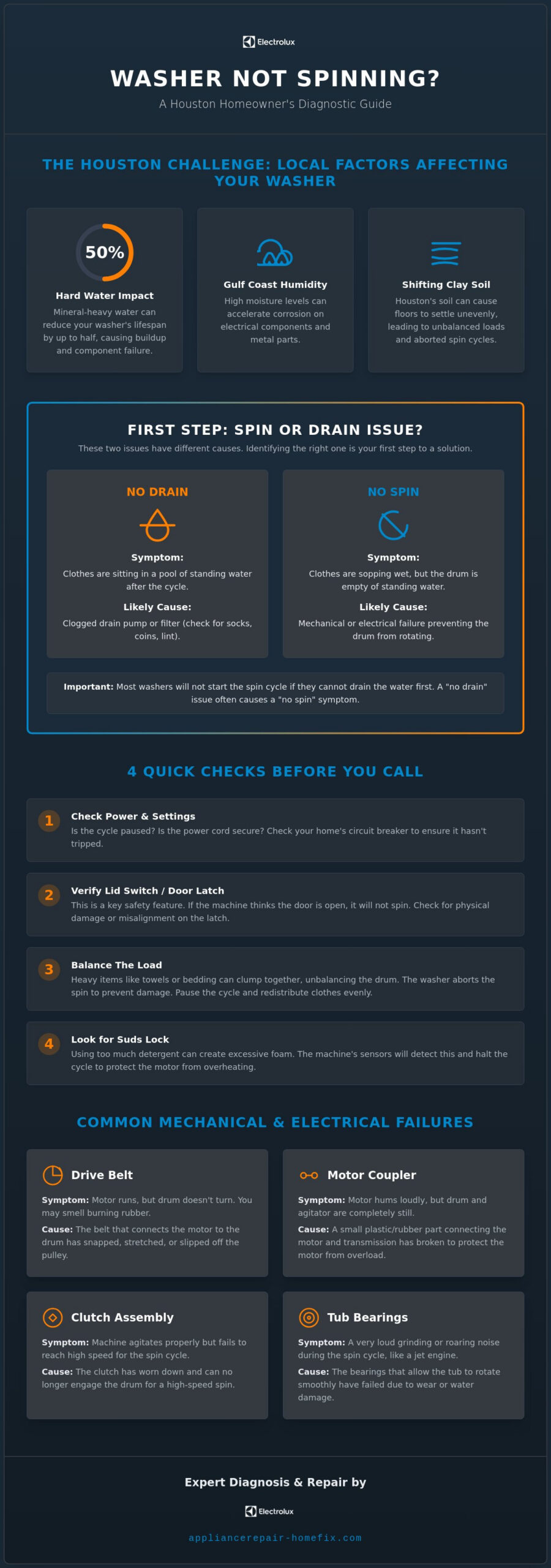
Start by watching the machine through its cycle. Is the drum completely still, or is it struggling to pick up speed? A slow spin often points to a worn belt or a heavy load. A stationary drum usually indicates a triggered safety feature or an electrical failure. Before searching for a solution for a washer not spinning Houston, check if the cycle is simply paused. Modern digital displays are sensitive. A light bump can halt the entire process. Verify that the power cord is secure in the outlet and that no circuit breakers have tripped. If you need professional help with these checks, a washer repair specialist can quickly identify the power source issue.
You must distinguish between a “no spin” and a “no drain” problem. These are different mechanical failures. If your clothes are sitting in a pool of water, the drain pump is likely clogged or broken. Most washers are designed to prevent the spin cycle from starting until the water level drops. Understanding how washing machines work helps you see that the spin and drain sequences are connected. Excess suds from using too much detergent can also trigger a “suds lock.” The machine detects the foam and stops to protect the motor from overheating. Check the pump filter for small items like coins or socks that might be blocking the flow.
The Lid Switch and Door Latch Security
The lid switch is a primary safety mechanism. It tells the control board that the door is closed and it’s safe to spin at high speeds. If this switch fails, the washer will fill with water but refuse to move. On front-load models, check the door strike for physical damage or cracks. A misaligned latch prevents the electrical circuit from completing. If you can pull the door open easily while the machine is supposed to be locked, the latch is likely broken and needs replacement.
Unbalanced Loads and Leveling Issues
Heavy items like wet towels or comforters often clump together during the cycle. This creates an off-center weight that causes the drum to vibrate violently or hit the cabinet. To prevent structural damage, the machine will automatically abort the spin. This is a frequent cause of a washer not spinning Houston homeowners face when cleaning bulky bedding. Use the following steps to resolve a balance issue:
- Press pause and wait for the door to unlock.
- Manually redistribute the wet clothes evenly around the drum.
- Check the leveling legs. Houston’s shifting clay soil can cause floors to settle unevenly over time.
- Ensure all four feet are firm against the floor.
- Restart the spin-only cycle to see if the balance is restored.
Mechanical Failures That Stop the Drum from Rotating
When you hear the motor humming but the drum remains still, you’re likely facing a mechanical breakdown. The drive belt is the most common part to fail in these scenarios. If the belt snaps or slips off the pulley, the motor spins freely without turning the tub. You might notice a distinct smell of burning rubber if the belt is slipping under heavy friction. Another frequent failure point is the motor coupler. This small plastic and rubber component connects the motor to the transmission. It’s designed to break if the load is too heavy, which protects the expensive drive motor from burning out entirely.
The clutch assembly is another critical part that manages the transition from agitation to the high-speed spin cycle. If the clutch wears down, the machine may agitate perfectly but fail to reach the RPMs needed to extract water from your clothes. In some cases, the drive motor itself is the problem. A motor that hums but doesn’t turn often has a failed start capacitor or damaged internal windings. These mechanical parts are essential for a working appliance. If you suspect one of these components has failed, you can schedule a professional diagnostic to confirm the exact part needed for your machine.
Drive Belt Inspection and Replacement
On top-load machines, the belt is usually reached through the back or bottom panel. Front-load models require removing the back cover to access the large drive pulley. Look for visible fraying, longitudinal cracks, or piles of black rubber dust at the base of the machine. Even if the belt looks intact, it may have stretched over time. Professional tensioning is vital for a lasting fix. A belt that’s too loose will slip, while one that’s too tight can put excessive strain on the motor bearings. This is a frequent fix for a washer not spinning Houston residents encounter during heavy laundry days.
Transmission and Bearing Issues
Listen closely to your machine during operation. A loud, roaring, or grinding noise during the spin cycle usually indicates failing tub bearings. These bearings allow the drum to rotate smoothly at high speeds. When they wear out, the friction becomes too great for the motor to overcome, causing the cycle to stall. You should also check for oil spots on the floor under the machine. This typically means the transmission seal has failed. Replacing a transmission is a major mechanical job. For older units, the cost of this repair might approach the price of a new machine. However, for high-end brands, a transmission swap is a smart way to extend the life of your appliance. Resolving a washer not spinning Houston often requires this level of mechanical expertise to ensure the repair is safe and permanent.
Electrical and Sensor Problems in Modern Washers
Modern washing machines rely on complex electronic circuits to manage every movement. The Electronic Control Board acts as the brain of the appliance. It sends signals to the motor to begin the spin sequence only after receiving confirmation from various sensors. If the control board has a short circuit or a software glitch, the machine might simply sit idle at the end of the wash cycle. This is a common technical hurdle for a washer not spinning Houston families encounter with newer high-efficiency models. These “smart” systems are highly sensitive to even minor electrical disruptions.
The pressure switch is another critical component. It monitors the water level inside the tub. If this switch fails or the air tube leading to it gets clogged, the washer thinks it’s still full of water. To prevent a flood, the system will refuse to engage the high-speed spin. In direct-drive models from brands like Samsung and LG, the stator and rotor replace traditional belts. These parts use magnets and copper coils to create motion. A cracked magnet or a burnt-out coil will result in a drum that jitters but never fully rotates. These components require specialized testing to verify their electrical integrity.
Houston’s power grid presents its own challenges. Frequent storms and grid fluctuations can cause power surges that fry sensitive electronics. Even a small voltage spike can damage a single chip on the control board, leading to intermittent failures. Using a high-quality surge protector is a simple way to protect your investment from these local environmental risks. If your machine has been exposed to a surge, the control board may need a full reset or a complete replacement to restore functionality.
Drain Pump Obstructions and Spin Interlocks
A washer won’t enter the spin cycle if the internal safety system can’t confirm that the water has been evacuated. The drain pump must clear the tub before the motor receives the signal for high-speed rotation. We often find coins, hairpins, and even small socks lodged inside the pump housing. These obstructions prevent the impeller from turning. If you see standing water in the drum, you should investigate the causes of a washer not draining Houston homes often face. Once the drainage path is clear, the spin interlock usually resets automatically.
Electronic Control Board Diagnostics
Failing control boards often produce “ghost” cycles or intermittent spinning. The machine might work perfectly one day and refuse to move the next. Testing these boards requires specialized equipment. DIY electrical testing is dangerous and can lead to further damage if the unit isn’t properly grounded. HomeFix technicians use advanced diagnostic software specifically designed for brands like GE and LG. This allows us to read error codes directly from the machine’s memory. We can pinpoint whether the issue is a faulty sensor or a total board failure without unnecessary part replacements. This data-driven approach ensures a fast, accurate fix for your washer not spinning Houston.
Houston-Specific Factors Affecting Your Washing Machine
Houston’s environment presents unique challenges for household appliances. Our city’s water has a hardness level of 8.0 grains per gallon, which is double the threshold where mineral damage begins. This heavy mineral content creates scale buildup on heating elements and inside the drain pump. Over time, these deposits can seize moving parts, resulting in a washer not spinning Houston residents might mistake for a total motor failure. These issues are often preventable with the right local maintenance approach.
High Gulf Coast humidity also plays a significant role in appliance longevity. Moisture settles on sensitive electrical connectors, leading to corrosion that disrupts signals between the sensors and the control board. If your laundry setup is in a garage or an unconditioned utility room, you also face higher risks of pest intrusion. Local rodents often seek the warmth of appliance motors and chew through wire insulation. This causes electrical shorts that stop the drum mid-cycle. High ambient heat in a Texas garage can also cause a washer not spinning Houston homeowners find frustrating, as motors trip their thermal protection sensors to prevent overheating.
Schedule a professional washer inspection today
Managing Hard Water Buildup
Hard water can reduce the lifespan of your washing machine by 30 to 50 percent. Minerals act like sandpaper on the tub bearings, causing them to grind and fail prematurely. We recommend using a monthly descaling product to break down these deposits before they seize the pump. If you notice a white, chalky residue on the drum or your clothes feel stiff after a wash, your machine is already battling scale buildup. Regular cleaning helps maintain the efficiency of the drainage system and protects the internal seals from cracking.
The “Repair vs. Replace” Decision in 2026
With the Texas “Right to Repair” law (HB 2963) taking effect in September 2026, accessing parts and documentation is becoming easier for independent services. For major brands like LG, Samsung, and GE, repairing a mechanical issue is usually the smarter financial move. Most professional repairs fall between $150 and $350, while a new high-quality unit can easily exceed $800. If your machine is less than eight years old, the return on investment for a professional fix is high. Repairing a well-built machine is also better for the environment, as it keeps heavy electronic waste out of Texas landfills.
Expert Washer Repair Services in Houston and Katy
HomeFix understands that a broken appliance isn’t just an inconvenience. It’s a disruption to your family’s daily life. We specialize in providing rapid, reliable solutions for a washer not spinning Houston homeowners can trust. Our team offers same-day or next-day service across the entire metro area, including Sugar Land and Cypress. We arrive ready to work with a fully stocked vehicle, aiming to resolve most issues in a single visit. Our goal is to minimize the time your laundry sits wet and unwashed.
Our technicians undergo rigorous training and certification for the industry’s leading brands. Whether you own a high-tech Samsung front-loader or a traditional Whirlpool top-load unit, we have the specific expertise required for the job. We also service GE and LG systems using advanced diagnostic tools that interface directly with the machine’s control board. We use only genuine OEM parts for every replacement. This ensures your machine operates at its original factory specifications. To give you peace of mind, we back our work with a 1-year parts warranty on most components.
We prioritize transparency in our business model. Many companies hide their fees until the end of the visit. We don’t. We offer a $69 diagnostic credit that applies directly to the final cost of your repair. If you choose to move forward with the fix, the initial assessment fee is effectively waived. This makes it easier for you to get a professional opinion without worrying about high upfront costs or hidden surcharges. We believe in providing honest work at a fair price.
Our Service Area: From Memorial to Fulshear
Our reach extends to the most active communities in the region. We provide dedicated service in Katy and surrounding neighborhoods like Memorial. We know that navigating Houston traffic is a challenge. To accommodate your busy schedule, we provide a 3-hour arrival window. We deploy our professionals based on your specific ZIP code. This ensures the technician is already in your neighborhood, reducing wait times and increasing efficiency. Whether you’re in Cinco Ranch or Bunker Hill, we have a pro nearby.
Booking Your Houston Washer Repair
You don’t have to wait for business hours to get help. Our online scheduling portal is available 24/7. Simply select your appliance type, describe the issue, and pick a time that works for you. When our technician arrives, they will conduct a comprehensive diagnostic to find out why you have a washer not spinning Houston. We provide a clear, written estimate before any work begins. Once you approve, we get straight to the repair to restore your appliance’s functionality.
Schedule your washer repair now
Restore Your Washer’s Performance Today
Don’t let a mountain of wet laundry stall your week. Whether the issue is a snapped belt or a sensor glitch caused by Gulf Coast humidity, most problems have a direct mechanical solution. You now know how to spot the difference between a simple drainage clog and a more complex motor failure. Taking action early prevents further damage to your machine’s internal bearings and sensitive electronics.
Professional help is just a click away. Our certified technicians handle all major brands and offer same-day service throughout Houston and Katy. We apply your diagnostic fee directly to the repair cost, ensuring you get transparent pricing from the start. We’re ready to fix your washer not spinning Houston and get your home running smoothly again.
Book Your Houston Washer Repair Online
Trust a local specialist to handle the technical work so you can focus on your family. We’ll have your drum spinning and your clothes dry in no time.
Frequently Asked Questions
Why is my washer making a loud banging noise but not spinning?
A loud banging noise usually indicates an unbalanced load or failing tub bearings. Heavy items like towels can clump together and hit the cabinet during high-speed rotation. If the noise persists even with an empty drum, your internal bearings have likely failed. This friction prevents the machine from spinning properly. You should stop the cycle immediately to avoid causing permanent damage to the outer tub or the drive motor.
Can I fix a washer that won’t spin by myself?
You can often fix simple issues like a tangled load or a dirty lid switch on your own. However, mechanical failures involving the drive belt or motor coupler require specific tools and technical knowledge. Attempting to repair a washer not spinning Houston without experience can lead to electrical shorts or water damage. Professional diagnostics ensure the correct part is replaced the first time to protect your appliance.
How much does it typically cost to fix a washer spin issue in Houston?
The total cost depends on whether the issue is a simple belt replacement or a complex control board failure. Generally, fixing an existing unit is much more affordable than purchasing a new high-efficiency model. We provide a clear, written estimate after our initial diagnostic is complete. To help manage your budget, we apply the diagnostic fee directly toward the total cost of your professional repair service.
Why does my washer spin slowly and leave clothes soaking wet?
A slow spin is often caused by a stretched drive belt or a worn clutch assembly. These parts lose their grip over time and cannot transfer enough power to rotate the drum at full speed. Excessive detergent can also create “suds lock,” which confuses the machine’s internal sensors. If the tub isn’t reaching the necessary RPMs, your clothes will remain heavy with water at the end of the cycle.
Will my washer not spinning cause a leak in my laundry room?
A failure to spin doesn’t usually cause a direct leak, but it often happens alongside drainage problems. If the water remains in the tub, the weight can put excessive pressure on the door seals of front-load models. This pressure may lead to minor seepage on your floor. Always check for standing water if your machine stops mid-cycle to prevent moisture damage to your laundry room flooring or baseboards.
How long does a typical washer repair take with HomeFix?
Most repairs are completed within a single visit lasting one to two hours. We offer same-day or next-day service to get your household routine back on track quickly. Our technicians arrive with a stocked vehicle containing common OEM parts for all major brands. This preparation allows us to diagnose and resolve a washer not spinning Houston without the need for multiple follow-up appointments or long delays.
What brands of washing machines does HomeFix repair in Katy and Houston?
We service all major appliance brands found in Texas homes today. Our certified technicians have specialized training for LG, Samsung, GE, and Whirlpool systems. We also handle high-end units and traditional top-load models regardless of their age. We use genuine parts to ensure your machine meets its original factory standards. We provide expert care for residents across the entire region, from Katy to the inner loop.
Is it worth fixing a 10-year-old washing machine?
Repairing a 10-year-old machine is often worth it if the unit is a high-end brand or has a minor mechanical failure. Many well-built washers can last 15 years or more with professional care. If the cost of the fix is significantly lower than buying a brand-new replacement, a repair is a smart way to extend the life of your appliance. We help you calculate the value during our visit.