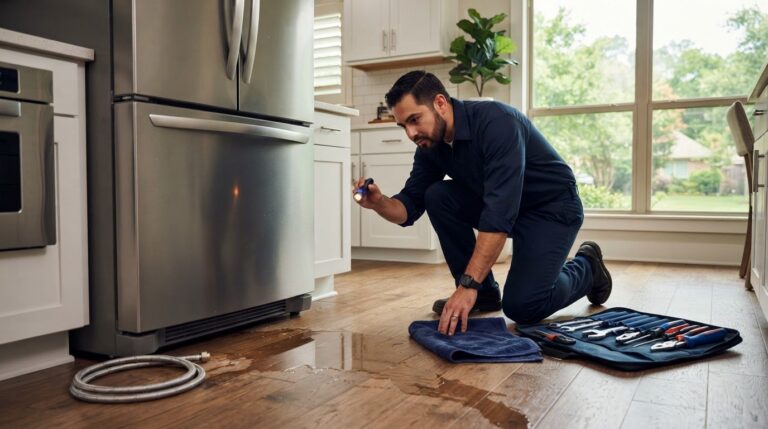
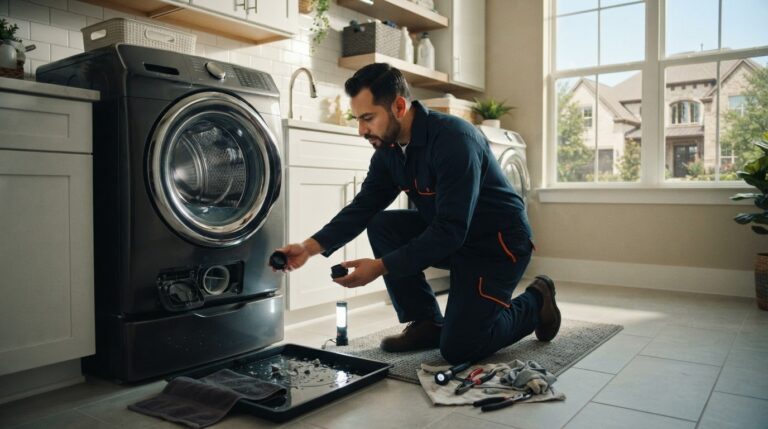
You open the lid expecting clean, damp clothes ready for the dryer, but you’re met with a heavy, soaking wet mess instead. Your laundry routine just hit a wall. Now you’re staring at a machine that won’t budge. It’s incredibly frustrating when a household staple stops working, especially when you start worrying about the cost of a new machine or a massive repair bill. Dealing with a washer not spinning in Houston doesn’t have to ruin your entire week.
Most of the time, the problem is a simple mechanical failure like a worn belt or a faulty sensor rather than a total motor death. You can identify the culprit quickly and get your machine back in action without the guesswork. This guide breaks down the five most common reasons for drum failure. We’ll also explain how the new 2026 Texas Right to Repair laws give you more control over your appliance maintenance. You’ll learn exactly what’s wrong and when it’s time to call a local specialist to get your household back on track today.
Key Takeaways
- Identify the difference between motor noise and drum movement to pinpoint drive belt or coupler failures.
- Check your lid switch or door latch first, as these safety sensors are the most common cause of a stalled cycle.
- Save time by troubleshooting simple power issues and unbalanced loads before dealing with a washer not spinning Houston.
- Leverage the 2026 Texas Right to Repair laws to access better diagnostics and parts for your household appliances.
- Recognize when complex electrical or control board issues require a professional repair specialist in Katy, Memorial, or Sugar Land.
The Frustration of a Washer That Won’t Spin
You hear the motor humming. You expect the familiar whir of the spin cycle to start any second. Instead, the drum remains perfectly still. This is the classic “no-spin” condition. It differs from a total power failure because the machine’s “brain” is active, but the physical connection to the drum has failed. Understanding how washing machines work helps you realize that this is usually a disconnect between the motor’s power and the drum’s movement. It is a high-priority issue that stops your household productivity in its tracks.
In our city, a broken appliance creates an immediate backlog. A washer not spinning Houston families depend on leads to piles of laundry that grow faster than you can manage. You must also distinguish between a drainage problem and a spin failure. If the tub is still full of water, the machine won’t spin because it’s stuck in the drain phase. However, if the water has cleared but the drum won’t rotate, you are likely dealing with a mechanical or sensor malfunction. Professional washer repair can quickly identify which system has stalled.
Signs Your Washer is Struggling Before it Stops
Rarely does a washer fail without warning. You might notice your clothes coming out soaking wet or dripping, even after a full cycle. This suggests the drum isn’t reaching the necessary speeds to extract water. Listen for loud thumping or violent vibrating during the final stages of the wash. These sounds often point to an unbalanced tub or worn internal supports. If you detect a sharp, burning smell coming from the back of the unit, stop the machine immediately. This often indicates a drive belt is slipping and overheating due to friction.
Why Houston Homeowners Face Unique Appliance Challenges
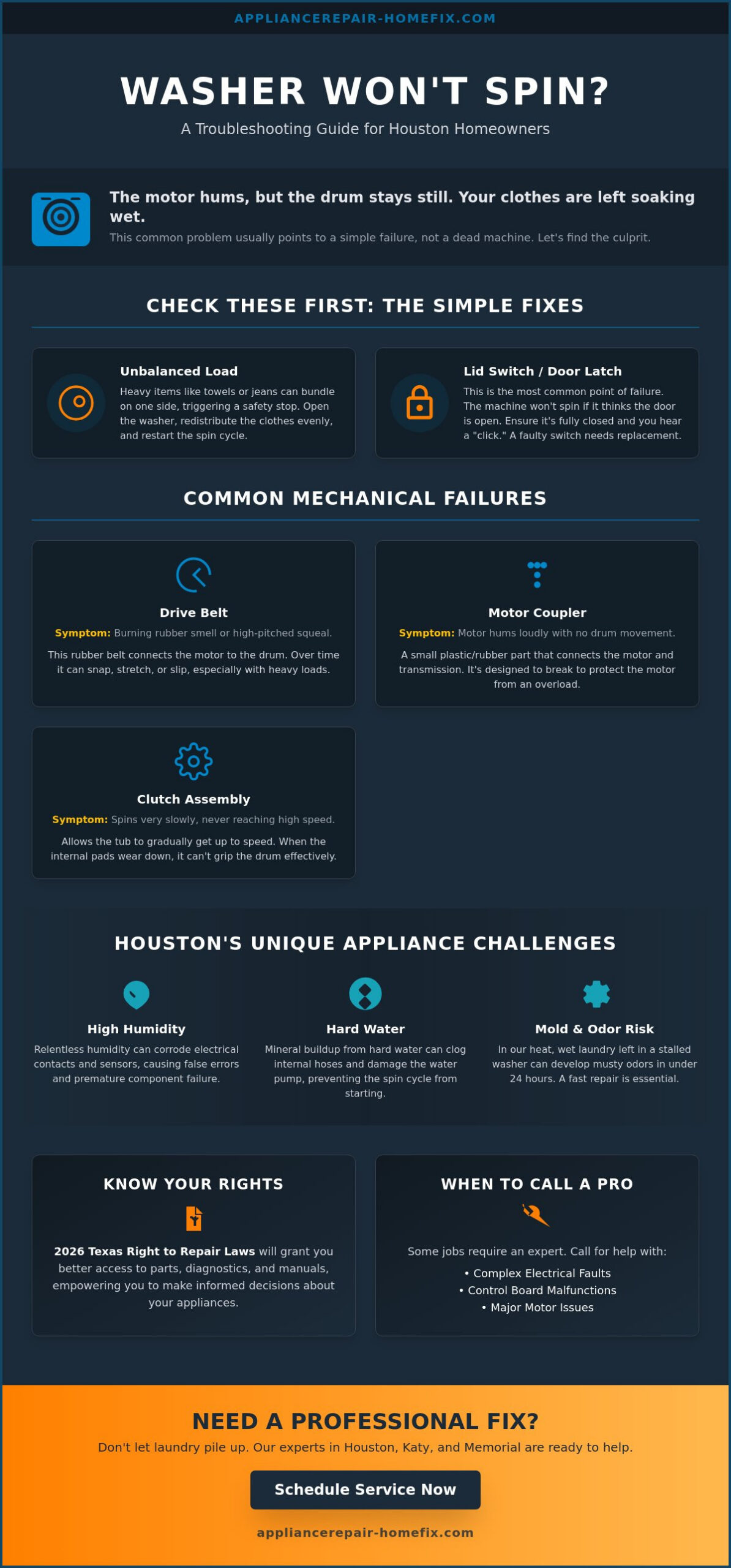
Living in East Texas presents specific environmental hurdles for your laundry room. Our relentless high humidity can cause electrical contacts and sensors to corrode faster than in drier climates. This often leads to “ghost” errors where a sensor falsely reports that the lid is open. Hard water is another common culprit. Mineral buildup can clog internal hoses or damage the pump, which indirectly prevents the spin cycle from initiating.
The biggest risk with a washer not spinning Houston residents face is mold. In our heat, wet laundry sitting in a closed drum can develop a musty odor in less than 24 hours. Rapid response is essential to save your clothes and protect your machine’s interior from fungal growth. Getting the drum moving again isn’t just about convenience; it’s about maintaining a healthy, functional home environment. Finding a fast, professional washer repair Houston specialist who understands local conditions is the most effective way to protect your home and appliances.
Mechanical Failures: Why Your Drum Stopped Moving
Mechanical failure is the most frequent reason for a washer not spinning Houston residents encounter. You might hear the motor working hard, but if the drum isn’t turning, the physical connection has likely failed. Components like belts, couplers, and pulleys act as the bridge between the motor’s power and the drum’s rotation. When these parts wear out or break, the system can’t transfer energy to the tub. This results in a machine that sounds like it’s working while your laundry remains completely still.
The Drive Belt: The Most Common Culprit
The drive belt is the primary link between the motor and the drum. Over time, this rubber component can snap, slip, or stretch out of shape. You can often tell a belt is failing if you smell burning rubber or hear a high-pitched squeal during the cycle. Heavy loads of damp towels or jeans put immense strain on this part. In our local climate, the high humidity can make rubber parts brittle or slick, leading to premature failure. If the belt is loose, it won’t have the grip necessary to spin a full load of laundry effectively.
Motor Couplers and Pulleys
Some machines use a motor coupler instead of a belt. This small plastic and rubber part connects the motor to the transmission. It’s designed to be a sacrificial part for safety. If the washer is overloaded, the coupler breaks to protect the expensive motor from burning out. If you hear a humming sound but see no movement, a cracked coupler is the likely suspect. Worn pulleys can also cause issues. A pulley that’s seized or stripped will create a loud screeching noise every time the machine tries to enter the spin cycle. Top-load machines often rely on a transmission to switch between agitating and spinning, while front-load models use high-tension belts and pulleys to manage the drum’s weight.
Neglecting these mechanical parts can lead to more than just wet laundry. It can create safety risks from unbalanced loads where the drum becomes loose and causes the machine to shake violently. If your machine spins slowly but never reaches high speed, the clutch assembly might be worn out. The clutch allows the drum to gradually increase its RPM. When the pads inside the clutch wear down, they can’t maintain the friction needed for a fast spin. If you suspect a mechanical part has reached its limit, scheduling a professional washer repair is the fastest way to get your machine back to peak performance without risking further damage.
Electrical and Sensor Issues: The Brain of Your Washer
While mechanical parts are the muscles of your appliance, the electrical system acts as the brain and nerves. If the physical components like belts and pulleys are intact but the motor refuses to engage, you are likely facing a sensor or circuit board failure. This type of washer not spinning Houston residents often experience can be harder to diagnose without professional tools. The machine might simply sit silent, or it may cycle through every stage except the final spin. Identifying the specific “nerve” that has failed is the only way to restore function.
The Lid Switch: A Safety Feature That Can Fail
The lid switch is the most common electrical failure in modern washers. It serves as a critical safety feature that prevents the tub from spinning while the door is open. If this small plastic component breaks or the internal contact wears out, the machine stays in a permanent “pause” mode. You can perform a simple manual click test on many top-load models. Press the switch down with a pen or your finger. If you don’t hear a distinct, sharp click, the switch is likely dead. This is a frequent issue we see during front load washer repair Houston calls, where the door latch assembly must also confirm a secure lock before the high-speed spin begins.
Pressure switches and speed sensors also play a vital role in the cycle. The pressure switch tells the washer when the water has fully drained. If the switch is clogged with lint or the sensor fails, the machine believes the tub is still full. To prevent a flood, the board will block the spin cycle entirely. Speed sensors monitor the actual RPMs of the drum. If the sensor cannot read the speed, the control board will shut down the cycle to prevent the machine from shaking itself apart. These sensors act as the eyes and ears of your appliance, and a single bad reading can stop everything.
Control Board and Wiring Failures
The main control board is the most complex and expensive part of the electrical system. It coordinates every action from the initial fill to the final spin. Houston’s frequent summer storms and power surges can easily fry these sensitive electronics. Look for erratic behavior as a primary symptom. If the machine skips cycles, the display flickers, or the buttons don’t respond consistently, the board is likely failing.
Wiring failures can also mimic board issues. Vibrations over years of use can shake a wire harness loose or cause a wire to rub against the frame until it shorts out. A washer not spinning Houston homeowners are dealing with might just have a loose connection. Diagnosing a board-level issue or a complex wiring short requires professional diagnostics. You don’t want to guess on an expensive control board only to find out a simple wire was the true culprit.
DIY Troubleshooting: What Houston Homeowners Can Check First
Not every spin failure requires a full toolbox or a major part replacement. Before you worry about the cost of a new machine, run through a few basic checks. A washer not spinning Houston families rely on can often be revived with a simple adjustment. These steps address the most common user errors and minor blockages that mimic serious mechanical failures. Start with the easiest solutions first to save time and stress.
Step 1: Balance Your Load
Modern washers are equipped with sensitive vibration sensors. If you’re washing a single heavy comforter or a load of thick towels, the laundry can clump on one side of the drum. This creates an “out of balance” condition. To protect the motor and frame, the machine will simply stop spinning. Open the lid and manually redistribute the wet clothes. If the tub is packed too tightly, remove a few items and try the spin cycle again.
You should also verify that the machine is physically level. Houston sits on expansive clay soil that shifts as it dries and wets. This movement can cause your home’s foundation to settle, which eventually leaves your washer sitting at a slight angle. Use a carpenter’s level on the top of the machine. Adjust the threaded feet at the base until the bubble is centered. A level machine is much less likely to trigger a safety stop during high-speed rotation.
Step 2: Check for Obstructions
Small items are the natural enemies of a functional wash cycle. Coins, hairpins, and stray baby socks frequently find their way into the drainage system. A clogged drain prevents the spin cycle from initiating because the “brain” of the washer won’t allow a spin while water is still in the tub. Inspect your drain hose for kinks or clogs. If the hose is clear, check the debris filter, which is usually located behind a small door at the bottom front of the machine.
- Verify the power: Ensure the plug hasn’t vibrated loose from the outlet.
- Check the breaker: A sudden power surge can trip the circuit breaker without you noticing.
- Perform a reset: Unplug the unit for ten minutes. This clears the temporary memory of the control board and can often resolve minor software glitches.
- Inspect the lid: Look for physical damage or debris around the latch that might prevent a solid connection.
If you have cleared the clogs and balanced the load but the drum still won’t move, the problem is likely internal. Don’t risk damaging the motor by repeatedly forcing a failed cycle. Schedule a professional diagnostic with a local specialist to identify the exact mechanical or electrical failure. Moving quickly prevents small issues from turning into expensive motor repairs.
Professional Washer Repair in Houston: When to Call HomeFix
If you’ve balanced the load and cleared the drain hose but still face a washer not spinning Houston families can rely on our team for a fast resolution. Some failures are too complex or dangerous for a DIY approach. When the issue involves high-voltage control boards or heavy transmission components, you need a specialist with the right diagnostic tools. We provide expert service throughout Katy, Memorial, and Sugar Land to get your laundry routine back on schedule.
We understand that a broken washer is an urgent problem. That’s why we offer same-day and next-day availability to address your needs quickly. You won’t have to wait around all day. We provide narrow 3-hour arrival windows so you can plan your afternoon. Our process is completely transparent. You’ll receive a clear diagnostic fee and a detailed quote for labor and parts before any repair begins. We believe in honest, straightforward service without hidden costs.
Expert Care for All Major Brands
Our technicians are factory-trained to handle the specific engineering of major manufacturers. We provide specialized support for Whirlpool, LG, and Samsung units. Dealing with a washer not spinning Houston heat can quickly turn a wet load of clothes into a moldy mess. Choosing a local specialist ensures faster parts acquisition. We stock common components locally to minimize your machine’s downtime. Professional washer repair Houston homeowners trust prevents the risks of improper DIY fixes that could void your warranty.
Schedule Your Diagnostic Today
Getting your machine fixed is simple and stress-free. You can book your appointment online in seconds or give us a call to speak with a neighborly representative. We are committed to technical excellence and dependable service for every household we visit. Don’t let a stalled drum disrupt your home any longer. Schedule your repair now and let our experts handle the heavy lifting.
Restore Your Laundry Routine Today
You don’t have to let a broken appliance derail your entire week. Most spin cycle failures come down to a few specific mechanical or electrical parts that wear out over time. Whether it’s a snapped drive belt or a faulty lid switch, identifying the cause is the first step toward a solution. Simple DIY checks can often save you time; however, complex motor or control board issues require the steady hand of an expert.
A washer not spinning Houston residents encounter is a high-priority repair that we handle daily. Our expert local technicians specialize in getting your machine back to peak performance with minimal disruption. We offer 3-hour arrival windows and serve families across Houston, Katy, and Sugar Land. Take the guesswork out of your appliance maintenance and get your laundry back on track.
Schedule Your Houston Washer Repair Now and let us handle the hard work for you. You’ll be back to your normal routine before you know it.
Frequently Asked Questions
Why is my washing machine not spinning but the motor is humming?
A humming motor with no drum movement usually points to a snapped drive belt or a broken motor coupler. The motor is getting power and trying to work, but the physical link to the tub is gone. You’ll hear the electrical hum while the laundry stays still. This is a common mechanical failure that requires a part replacement to restore the connection between the motor and the drum.
How much does it cost to fix a washer that won’t spin in Houston?
Repair costs in our area depend on the specific parts required and the complexity of the labor. Every brand has different pricing for components like control boards or motors. We provide a transparent quote after a professional diagnostic so you know exactly what to expect. This ensures you aren’t guessing about the total before the work begins, allowing you to make an informed decision for your home.
Is it worth repairing a 10-year-old washing machine?
Repairing an older machine is often worth it if the fix is a simple mechanical part like a belt or sensor. These machines were built for durability and can last another five years with basic maintenance. However, if the repair requires a major transmission or motor replacement, you should weigh that cost against the energy savings of a modern model. We can help you evaluate the machine’s overall condition during a service call.
Can a clogged drain hose stop a washer from spinning?
A clogged drain hose will stop the spin cycle every time. Washers are designed to wait for the water to empty before they start the high-speed rotation. If the pump can’t push the water out due to a clog or kink, the machine will sit idle. Always check the drain line and debris filter if you see standing water in the tub. Clearing a simple blockage often solves the problem immediately.
How do I know if my washer lid switch is broken?
You can identify a broken lid switch if the machine fills with water but won’t agitate or spin. Many models allow you to test the switch manually with a pen or finger. If you don’t hear a distinct click when the switch is depressed, the component has likely failed. This safety sensor must signal that the lid is closed before the motor engages. Without that signal, the machine stays in a permanent pause mode.
Does HomeFix offer same-day washer repair in Katy or Cypress?
We offer rapid response times and frequently have same-day or next-day appointments available for residents in Katy and Cypress. Our team prioritizes urgent laundry disruptions to help you get your household back on track. We use 3-hour arrival windows so you don’t have to spend your entire day waiting for a technician to arrive. You can check our real-time availability through our online booking system or by calling us directly.
What is the most common reason a front-load washer stops spinning?
The most common reason for a front-load washer not spinning Houston residents experience is a faulty door latch assembly. Front-load units require a confirmed lock for safety before spinning at high speeds. Our local humidity can cause the electrical contacts inside the latch to corrode over time. This prevents the sensor from sending the “locked” signal to the main control board, which effectively kills the cycle before the spin begins.
Why does my washer spin slowly and leave clothes soaking wet?
A worn clutch or a stretched drive belt is usually the culprit when a washer spins too slowly. These parts lose their grip and can’t maintain the high RPMs needed to pull moisture out of heavy fabrics. If your clothes come out soaking wet, the machine is struggling to overcome the weight of the load due to mechanical friction loss. Replacing these worn components restores the high-speed performance needed for dry laundry.