

Imagine walking into your kitchen to find the milk is warm and the freezer is dripping on the floor. Dealing with a refrigerator not cooling Houston families often face is a direct threat to your grocery budget and your daily routine. You’re likely feeling the pressure of potential food loss and the uncertainty of unexpected repair costs. It’s a frustrating disruption that demands a fast, practical solution to get your home back in order.
We understand you need a working fridge and a clear path forward without the stress. This guide will help you identify why your appliance is failing and when you should call a local professional to protect your investment. You’ll learn five straightforward steps to troubleshoot the problem, including how to check your condenser coils and door seals for common issues. We’ll provide the information you need to restore your cooling quickly and avoid the expense of a total replacement.
Key Takeaways
- Perform immediate power and thermostat checks to rule out simple fixes before assuming the worst.
- Identify mechanical failures like clicking start relays or faulty evaporator fans that prevent cold air circulation.
- Learn how local humidity clogs coils and why a refrigerator not cooling Houston heat often struggles in a garage.
- Recognize critical warning signs like oily residue or electrical faults that require professional diagnostic tools.
- Protect your groceries by understanding when DIY troubleshooting ends and expert repair becomes necessary.
Quick DIY Checks for a Refrigerator Not Cooling in Houston
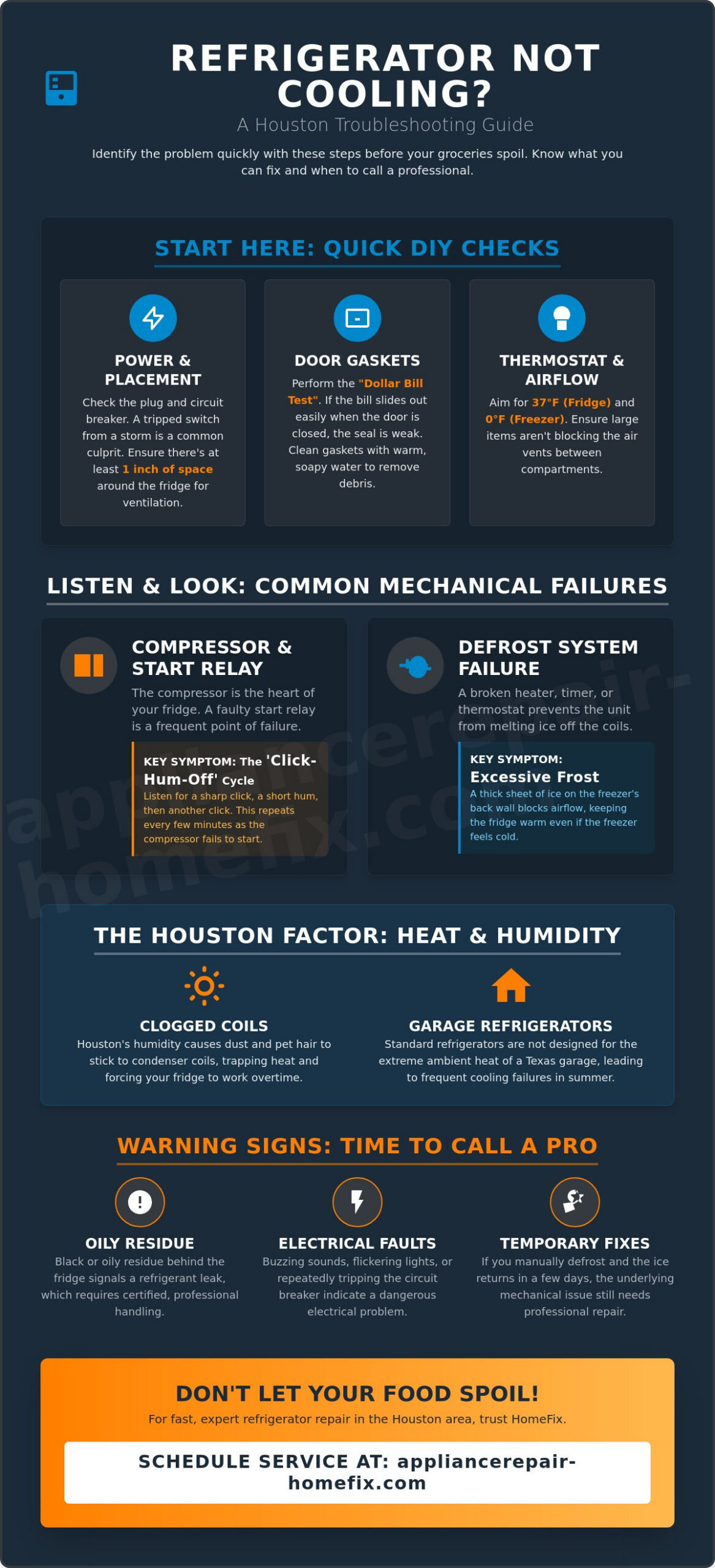
Before you worry about a total breakdown, start with the basics. A refrigerator not cooling Houston homes often has a simple power or placement issue. Check the plug first. It sounds obvious, but vibrations can loosen the cord over time. If the power is fine but the unit stays silent, you may need a professional refrigerator repair to diagnose the internal wiring. Next, head to your circuit breaker panel. A power surge from a Houston thunderstorm might have tripped the switch without you realizing it. Reset it and wait to see if the compressor kicks back on.
Your fridge needs room to breathe. If you’ve pushed it too close to the wall or crowded the top with boxes, heat can’t escape. This forces the system to work harder, eventually leading to a warm interior. Ensure there’s at least an inch of space on all sides for proper ventilation. This is especially important in the Texas heat where ambient kitchen temperatures can rise quickly.
Testing the Door Gaskets
The seal is the only thing keeping the Houston humidity out. Use the “dollar bill test” to check its integrity. Close the door on a dollar bill. If it pulls out easily, your seal is weak. Cold air is escaping, and warm, moist air is rushing in. Clean the rubber gaskets with warm, soapy water to remove sticky spills. These spills often prevent a tight seal. Inspect the rubber for any visible cracks or tears. If the gasket is damaged, it needs a replacement to maintain the internal temperature and protect your food.
Thermostat and Airflow Basics
Check your settings. Someone might have bumped the dial while reaching for a snack. Aim for 37°F in the fridge and 0°F in the freezer. Understanding how refrigerators work helps you spot these issues early; the cooling cycle relies on consistent airflow between compartments. Look inside and ensure large containers aren’t blocking the air vents. If the vents are clear but it’s still warm, listen for the evaporator fan. You should hear a light hum coming from the back of the freezer. If it’s silent, the cold air isn’t moving where it needs to go, which is a common reason for a refrigerator not cooling Houston residents deal with during peak summer months.
Common Mechanical Causes of Fridge Cooling Failure
Once you’ve ruled out power issues and blocked vents, it’s time to look at the mechanical components. These parts do the heavy lifting to keep your food at safe temperatures. When you’re dealing with a refrigerator not cooling Houston summers make the situation urgent. Mechanical failures are the most common reason for a refrigerator not cooling Houston residents report during the hottest months of the year. Identifying these sounds and signs early can prevent a total system meltdown.
Compressor and Relay Issues
The compressor is the heart of your appliance. It pumps refrigerant through the system to remove heat from the interior. Effective maintaining your refrigerator includes ensuring the compressor can run without obstruction. If the compressor fails, the cooling cycle stops entirely. However, the problem is often a smaller part called the start relay.
Listen closely to the back of your fridge. A bad start relay creates a distinct “click-hum-off” pattern. You’ll hear a sharp click, a short hum as the compressor tries to start, and then another click as the overload protector shuts it down. This cycle repeats every few minutes. If you own a newer model and hear this pattern, an LG refrigerator compressor replacement might be the necessary step to restore your kitchen to full functionality.
The Defrost System Failure
Your refrigerator uses a defrost system to keep ice from building up on the evaporator coils. This system includes a heater, a timer, and a thermostat. If any of these parts fail, ice will eventually clog the coils. This ice acts as an insulator, preventing the cold air from reaching the rest of the unit. You can often spot this by checking for a thick layer of frost on the back wall of your freezer.
A failed defrost timer or control board is usually the culprit when the freezer stays cold but the fridge stays warm. The timer tells the heater when to turn on. If it gets stuck, the ice never melts. While many homeowners try to fix this by manually defrosting the unit, this is only a temporary fix. The ice will return within a few days if the underlying electrical fault isn’t addressed. If you notice ice buildup that returns shortly after cleaning, it’s best to schedule a professional diagnostic to find the root cause before your groceries spoil.
- Start Relay: Listen for clicking sounds every few minutes.
- Evaporator Fan: Check if the freezer is freezing but the fridge is warm.
- Defrost Heater: Look for heavy frost on the back freezer panel.
- Condenser Fan: Ensure the fan near the compressor is spinning freely.
The Houston Factor: How Heat and Humidity Affect Cooling
Houston’s environment creates a unique set of challenges for household appliances. High humidity and extreme heat are more than just uncomfortable for you; they are brutal on your fridge’s cooling system. This local climate is a primary driver behind a refrigerator not cooling Houston homeowners deal with every summer. Moisture in the air makes household dust and pet hair “sticky.” Instead of blowing off, this debris clings to vital components, forcing the motor to run longer and hotter than intended.
Summer storms also play a role in appliance failure. Frequent power fluctuations in areas like Katy and Cypress can send surges through your home’s electrical system. These spikes often damage sensitive control boards, leading to intermittent cooling or a total system shutdown. Protecting your unit with a high quality surge protector is a simple way to avoid a costly refrigerator repair later in the season.
Condenser Coil Maintenance
Your condenser coils dissipate heat from the refrigerator. You will usually find them behind a bottom grille or on the back of the unit. In the Houston area, these coils act like a magnet for humid dust. When they are coated in grime, the fridge cannot release heat effectively. This is a leading cause of a refrigerator not cooling Houston residents report during peak humidity months.
Follow these steps to clean them safely:
- Unplug the unit: Always disconnect the power before performing maintenance.
- Access the coils: Remove the base grille or pull the unit away from the wall.
- Vacuum thoroughly: Use a brush attachment to gently remove dust and pet hair.
- Wipe the floor: Clear any remaining debris to prevent it from being sucked back in.
If you have pets, perform this task every 3 to 6 months. For homes without pets, twice a year is usually sufficient to maintain efficiency.
Garage Refrigerators in Texas
Secondary refrigerators kept in unconditioned garages face extreme stress. During a typical Texas summer, garage temperatures can easily exceed 100°F. Most standard refrigerators are designed to operate in ambient air temperatures below 95°F. When the surrounding air is too hot, the compressor cannot shed enough heat to cool the interior. This leads to constant running and eventual compressor burnout.
To help a garage unit survive, ensure it has at least three inches of clearance on all sides. Avoid tucking it into a tight corner where heat gets trapped. If the unit still struggles to stay cold, it may not be “garage ready.” These specialized models have internal heaters to trick the thermostat and more robust cooling systems built for extreme temperature swings. If your garage unit stops cooling entirely, it’s likely a victim of the Texas heat.
When to Call a Houston Refrigerator Repair Specialist
Sometimes DIY troubleshooting reaches its limit. If you have cleaned the coils and checked the power but still have a refrigerator not cooling Houston heat will quickly ruin your food. You need to know when a problem requires specialized equipment and professional training. Certain red flags indicate that the cooling failure is deep within the internal systems of the appliance. If you notice oily residue on the floor or near the compressor, you likely have a sealed system leak. This residue is actually refrigeration oil escaping the lines. You might also notice a faint, chemical odor near the back of the unit. These are serious issues that homeowners cannot fix safely or legally.
Listen for unusual sounds coming from the motor area. A light hum is normal, but loud grinding or screeching is a sign of mechanical distress. This usually indicates that the bearings in the condenser fan or the compressor itself are failing. Additionally, if you find yourself resetting the circuit breaker repeatedly, there is an internal electrical fault. These faults can lead to short circuits or damage to the main control board. If your cooling issues return just days after a DIY attempt, the root cause remains unaddressed. Continuing to run a struggling unit can lead to a more expensive total system failure. Before committing to a major fix, it’s worth reviewing a detailed repair vs replace refrigerator guide for Houston homeowners to ensure you’re making the smartest financial decision for your situation.
Professional Diagnostics vs. Guesswork
Many homeowners fall into the trap of “part-changing.” They buy a new start relay or thermostat hoping it solves the problem without actually testing the components. This approach often costs more in the long run and leaves your fridge warm for days longer than necessary. A professional refrigerator repair Houston service uses advanced tools like multimeters and leak detectors to find the exact failure point. At HomeFix, we prioritize a solution-first approach. During a diagnostic visit, our technicians inspect the entire cooling cycle. We provide a clear explanation of the failure and a firm quote before any work begins. This transparency ensures you aren’t paying for parts you don’t need.
Local Service Areas and Availability
We know that a broken fridge is a household emergency. Our team is strategically positioned to provide fast response times in Katy and Memorial. We offer 3-hour arrival windows to respect your busy schedule. This prevents you from waiting around all day for a technician to show up. If your groceries are at risk of spoiling, check our availability for same-day service. We carry common replacement parts on our trucks to complete most repairs in a single visit. To get your kitchen back to normal, book your diagnostic appointment online today.
HomeFix: Fast Refrigerator Repair Solutions in Houston
A refrigerator not cooling Houston homes is more than a minor inconvenience; it’s a race against time. Every hour the temperature rises, the risk of food spoilage increases. HomeFix specializes in rapid, professional refrigerator repair to get your kitchen back in order. We bring technical expertise and a neighborly approach to every service call. Our team is trained to handle the specific mechanical stresses caused by the Texas climate. We don’t just fix the symptom; we address the root cause to prevent future breakdowns.
We work on all major brands, including Whirlpool, LG, and GE. Modern appliances often feature complex computer boards and sensors that require precise diagnostics. Our local technicians arrive with the tools needed to identify the failure quickly. We don’t believe in guesswork. Instead, we provide a clear path to a working fridge. By choosing a local specialist, you ensure your technician understands the common environmental factors, like humidity and dust, that affect units in this area. We focus on efficiency and professional standing to deliver the best results for your home.
In addition to local assistance, you can discover PrimeTech Appliance Repair to learn more about professional repair and maintenance for refrigerators and other essential household appliances.
Why Choose HomeFix for Your Fridge
Reliability is our standard. We provide steady, authoritative service designed to lower your stress levels immediately. If you’re struggling with a high-tech model, we offer the Samsung refrigerator repair Houston residents depend on for long-term results. Our process is completely transparent. We charge a fair diagnostic fee and apply that amount directly toward the total cost of your repair. This ensures you receive professional expertise without hidden costs or surprises. We value your time and your budget, focusing on efficient solutions that extend the life of your appliance. Our technicians are earnest, hardworking, and deeply practical.
Book Your Service Today
Stop worrying about your grocery bill and take action. A refrigerator not cooling Houston summers doesn’t have to result in total food loss. We offer flexible scheduling with morning and afternoon windows to accommodate your routine. Our technicians are ready to respond to your cooling emergency with speed and professional confidence. Schedule Now to secure your appointment. Let us handle the technical labor so you can get back to your day. We’re your no-nonsense partner in home maintenance, committed to restoring your cooling today. Trust the local experts to save your groceries and your peace of mind.
Restore Your Fridge and Save Your Groceries Today
Dealing with a refrigerator not cooling Houston heat is a stressful experience that shouldn’t wait. You’ve learned how to check the basics like power supplies and thermostat settings to rule out simple fixes. You also know how vital it is to keep condenser coils clean in our humid climate to prevent system strain. When mechanical sounds or frost buildup indicate a deeper failure, professional intervention is the fastest way to protect your groceries and your budget.
Don’t let a warm fridge disrupt your home any longer. Our team of expert local technicians is ready to help with fast 3-hour arrival windows. We provide transparent service and apply your diagnostic fee directly to the cost of your repair. We’re here to provide the steady, reliable support you need to get your kitchen back to full speed. Click below to book your appointment and stop the cooling loss before it’s too late.
Schedule Your Refrigerator Repair in Houston Now
You can get your appliance running efficiently again with just a few clicks. We look forward to helping you restore comfort and convenience to your Houston home.
Frequently Asked Questions
Why is my refrigerator running but not cooling?
Your refrigerator is likely running but not cooling because of an airflow obstruction or a failed evaporator fan. If you hear the motor but the temperature is rising, check to see if containers are blocking the internal vents. A failure in the defrost system can also cause ice to clog the cooling coils, which prevents cold air from circulating through the compartments.
How much does it cost to fix a refrigerator that is not cooling in Houston?
The total cost for a repair depends on the specific part that failed and the labor required for the fix. Common repairs for fans, thermostats, or door seals generally fall into a moderate price range, while compressor issues are more significant. Most professional services in the area will apply your initial diagnostic fee directly toward the final cost of the repair.
Is it worth fixing a 10-year-old refrigerator?
Deciding to repair a 10-year-old unit usually depends on the “50% rule.” If the repair estimate is more than half the price of a new model, replacement is often the better financial choice. However, many high-end appliances are built to last longer, and a targeted repair can add several years of reliable service for a fraction of the cost of a new unit. For a deeper look at how to apply this framework to your specific situation, our repair vs replace refrigerator guide for 2026 walks Houston homeowners through every factor to consider.
Can a dirty condenser coil cause a fridge to stop cooling?
Yes, clogged coils are a primary reason for a refrigerator not cooling Houston homes during peak summer months. When dust and pet hair coat the coils, the system cannot release heat effectively. This puts extreme stress on the compressor, causing it to overheat and eventually stop the cooling cycle entirely. Regular cleaning every six months prevents this issue.
How long can food stay safe in a fridge that is not cooling?
Perishable food stays safe for about four hours in a closed refrigerator that has lost its cooling power. A full freezer can maintain its temperature for up to 48 hours if you keep the door shut. Always use a thermometer to check the internal temperature; discard any meat, dairy, or eggs if they have been above 40°F for more than two hours.
Does HomeFix offer same-day refrigerator repair in Katy or Cypress?
We prioritize cooling emergencies and frequently provide same-day service for residents in Katy, Cypress, and the surrounding Houston metro area. Our local technicians carry a wide range of common replacement parts on their trucks to finish most jobs in one visit. Check our real-time online schedule to book the earliest available arrival window for your home.
What are the signs that my refrigerator compressor is failing?
A failing compressor often produces a persistent clicking sound or a loud knocking noise during operation. You might also notice the “click-hum-off” cycle where the unit tries to start but shuts down almost immediately. If the back of the fridge feels excessively hot or the compressor runs constantly without cooling the interior, the system’s heart is likely failing.
Can humidity in Houston cause my fridge to frost up?
High local humidity often causes rapid frost buildup if your door gaskets are worn or damaged. When moist Houston air enters the cabinet, it condenses and freezes on the evaporator coils. This ice eventually blocks the vents and leads to a refrigerator not cooling Houston families often experience. Ensuring a tight door seal is the best defense against humidity-related frost. For more guidance on finding fast, reliable refrigerator repair Houston homeowners can count on, our dedicated service overview covers same-day diagnostics, transparent pricing, and what to expect from a professional repair visit.


