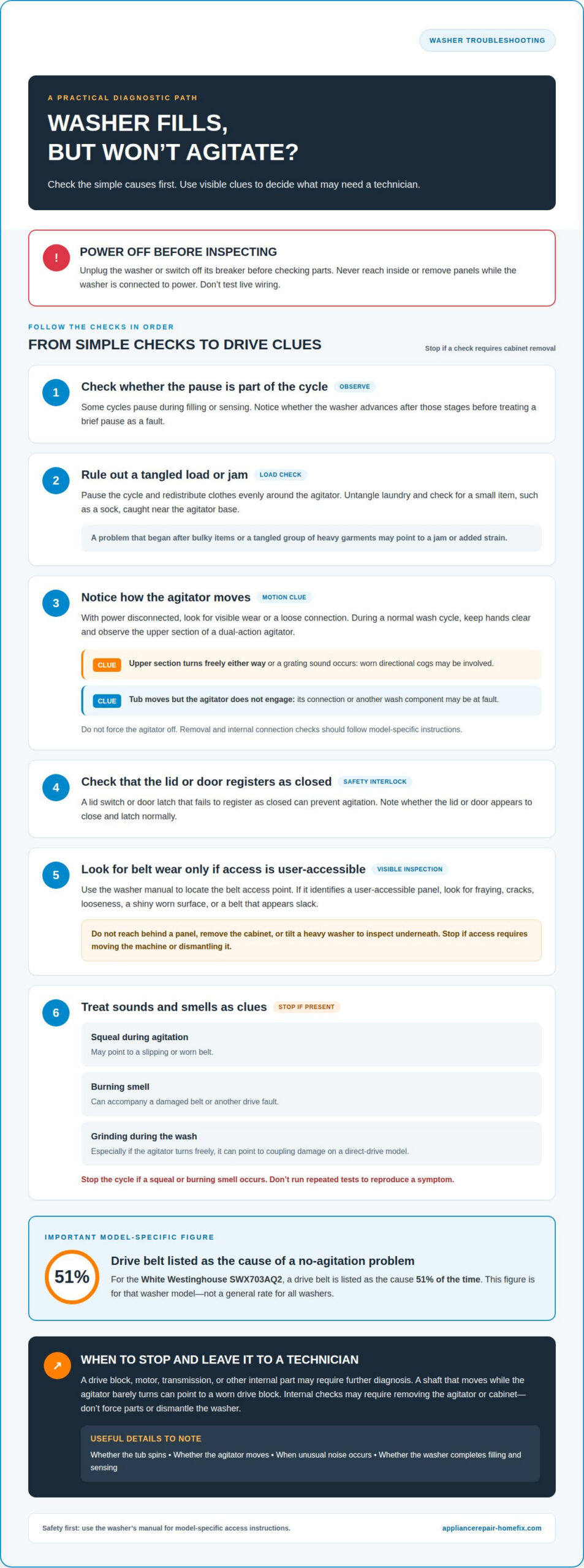
A washer can fill normally and still fail to agitate because of a jam, worn part, or lid-sensing problem. If your washer won’t agitate in Cypress, start by unplugging it, then check for tangled laundry, a loose or damaged belt you can see, worn agitator cogs, and a lid switch or door latch that may not register as closed. Don’t reach inside or remove panels while the washer is connected to power.
A washer that stops before agitation can disrupt the whole laundry routine, and the cause isn’t always obvious. Start with the load, cycle, and agitator, then check visible signs around the belt and lid or door lock. Some cycles pause during filling or sensing, so note whether the washer advances after those stages before treating a brief pause as a fault.
Key Takeaways
- Look for belt wear or damage, and note unusual sounds or smells that may point to a drive problem.
- Pay attention to how the agitator moves; its motion can help distinguish worn cogs from other faults.
- Check whether tangled laundry or a small item at the agitator base is blocking normal movement.
- A washer may not agitate if its lid or door latch fails to register as closed.
- Notice whether the washer completes filling and sensing, since some pauses are part of normal operation.
Drive belt inspection
- Disconnect power before inspecting the drive system. Unplug the washer or switch off its breaker before checking visible parts. Keep hands away from the cabinet’s underside and any moving components. Check the machine’s manual to locate the belt access point, since washer designs differ. For Cypress location information, see the Cypress service area.
- Look for visible belt damage without forcing access. If the manual identifies a user-accessible panel, inspect the drive belt for fraying, cracks, looseness, or a shiny worn surface. A belt that has slipped off its pulleys may look slack. Don’t reach behind a panel or tilt a heavy washer to inspect underneath. Stop if inspection requires removing the cabinet or moving the machine.
- Use sounds and smells as clues, not proof. A squeal during agitation can point to a slipping or worn belt. A burning smell can accompany a damaged belt or another drive fault. Stop the cycle if either symptom occurs, and don’t run repeated tests to reproduce it. Note when the noise happens, such as during agitation or draining, to help identify which operation is affected.
- Separate belt-driven faults from direct-drive faults. Some washers use a belt, while direct-drive models use a motor coupling instead. A broken coupling can prevent agitation even when the washer fills and drains normally. Grinding during the wash cycle, especially if the agitator turns freely, can point to coupling damage. Don’t assume a belt replacement will fix a direct-drive washer.
- Consider the drive block or bell if the agitator barely moves. These parts connect the agitator to the drive system. If the shaft moves but the agitator barely turns, a worn or damaged drive block may be preventing proper movement. Checking this connection usually requires removing the agitator, so don’t pry it loose without model-specific instructions.
- Leave internal motor and transmission checks to a technician. If the washer spins but won’t agitate, another component may be interrupting the wash action. A motor or drive-system fault can affect agitation and spin; transmission trouble is another possibility, but other components should be checked first. Don’t test live wiring or dismantle the cabinet. Record whether the tub spins, whether the agitator moves, and any unusual noises.
When a washer fills but does not agitate, a faulty lid switch or a loose or broken drive belt may be responsible. Check the belt for damage, wear, fraying, or burning when agitation stops. A broken or loose washer drive belt should be replaced. For the White Westinghouse SWX703AQ2 washer, a drive belt is listed as the cause of a no-agitation problem 51% of the time.
A worn or damaged washer drive block can let the transmission shaft move while the agitator moves only slightly or not at all. The agitator may also be stripped where it connects to the drive system; removing it can reveal visible wear or damage. Follow model-specific instructions, or have a technician assess the part rather than forcing it.
Agitator and directional cog wear
With power disconnected, check the agitator for visible wear and whether it moves freely. These observations can help distinguish a worn part from a load or drive problem.
-
Inspect the Agitator Assembly
Remove the agitator only if your washer’s instructions explain how to do so safely. Check its base, hub, and visible connection points for cracks, stripped splines, or loose parts. These components transfer movement from the drive system into the wash action. If the assembly feels damaged or won’t come off easily, stop rather than forcing it. A broken connection can prevent the agitator from working.
-
Check Agitator and Wash Mechanism Wear
Examine the agitator for broken fins, worn edges, or a loose connection. Look for rubbing marks or damage where it meets the wash mechanism. A top-loading washing machine relies on the transmission output shaft to drive the agitator. If the tub moves but the agitator doesn’t engage, the problem may be in that connection or another wash component.
-
Check Directional Cog Wear
Observe the upper section of a dual-action agitator during a normal wash cycle, keeping your hands clear. If it turns freely in either direction instead of gripping as intended, directional cogs may be worn. A grating sound during the wash is another clue. The cogs help the upper agitator section move the load through the water. Don’t keep running cycles to test noisy or visibly damaged parts.
- Consider wear from heavy or overloaded loads. Repeatedly washing many heavy items or filling the basket beyond its practical capacity can strain the agitator and connected parts. That strain may speed wear and weaken wash action. Note whether the problem began after washing bulky items or a tangled group of heavy garments. This history helps distinguish gradual wear from a sudden jam.
- Notice signs of clutch or bearing trouble. If the tub spins but clothes remain wet, worn clutch or bearing components may be involved. Those parts affect washer movement, though the symptom alone doesn’t identify which one has failed. Record whether the agitator moves, whether the tub spins, and when unusual movement occurs. Avoid dismantling the washer to reach internal parts.
- Stop before replacing an assembly. Agitator hubs, directional cogs, and related parts vary by washer design. Compare visible damage with the model’s repair instructions before selecting a replacement. A worn hub may stop an intact agitator from transferring movement, while damaged cogs can affect only its upper section. If the cause remains unclear, leave internal diagnosis to a repair technician.
Checking for laundry jammed in the agitator
Pause the cycle, then redistribute the clothes evenly around the agitator. Remove tangled items and check for small laundry, such as a sock, caught near the agitator base.
- Check the load before restarting. An overloaded or tangled load can interfere with wash action and stop agitation. Remove some clothes if the basket is tightly packed, then spread the remaining items evenly. Heavy garments bunched on one side can unbalance the load and interrupt normal operation. Keep laundry clear of the agitator instead of wrapping items around it, which can twist fabric and damage washer parts.
- Look for a small item caught at the base. With the washer unplugged, inspect the visible gap around the agitator base for a sock or other small item. Don’t force the agitator or reach into concealed spaces. A trapped item can prevent proper engagement. If it’s wedged underneath or removal requires taking the agitator apart, stop and arrange professional washer repair.
- Try a suitable cycle and balanced load. Some cycles use minimal agitation or pause during sensing, and a washer may wait until filling finishes. Select a normal wash cycle with a small, evenly distributed load and observe whether the machine advances into agitation. Compare the washer’s actions with the selected cycle. A brief pause during sensing doesn’t by itself mean the wash mechanism has failed.
- Check filling and the water-level signal. A top-load washer that fills but never agitates may have a faulty water-level switch. The air dome hose conveys pressure changes associated with the water level to the switch. With power disconnected, inspect only visible hose sections for a kink or disconnection. Don’t remove panels or test electrical parts. Poor filling can also keep the washer from entering its wash phase.
- Check draining clues without dismantling the pump. If clothes remain wet after a cycle, look for a visibly kinked drain hose and note whether water remains in the tub. A kink can interfere with draining, while a clogged or faulty pump can leave laundry wet after spinning. Record grinding or other unusual noises, but don’t reach into the pump or remove its housing.
- Confirm power before investigating further. If the display stays dark, make sure the plug is seated and check whether the outlet has power using a safe method. If the receptacle has no power, check the circuit breaker. Disconnect the washer before inspecting connections. If power is present but the washer still won’t advance, note the selected cycle and symptoms for diagnosis.
Lid switch and door latch problems
- Check that the lid or door closes fully. Remove laundry caught along the rim, then close the washer without slamming it. A lid switch or door latch must signal that the opening is closed before the machine can agitate. Look for a loose hinge, damaged latch, or obstruction that prevents the door from closing firmly. Don’t tape, hold, or bypass the safety switch to force operation.
- Listen for the lid switch click. With the washer unplugged, gently press the lid switch if it’s accessible without removing panels. No click can indicate a faulty switch, but the sound alone doesn’t prove the part has failed. Don’t probe wiring or dismantle the cabinet. If the lid closes normally but agitation doesn’t begin, record whether the washer fills, drains, or pauses.
- Check the door latch for visible damage. On a front-load washer, inspect the door hook and latch opening for cracks, looseness, or debris blocking engagement. Close the door and note whether it stays shut and the cycle begins. A latch can fail mechanically or electrically, so a door that looks closed may still fail to send the required signal. Don’t force a stuck door open.
- Leave continuity testing to someone equipped to do it safely. A door-lock switch can be tested for continuity with a multimeter, but the washer must be disconnected from power and the correct terminals identified. Testing the wrong contacts can produce misleading results or damage components. If reaching the connections requires removing the latch, stop and arrange qualified diagnosis instead of testing live wiring.
- Consider replacement only after identifying the faulty part. A lid switch that doesn’t click may need replacement, while a damaged door lock may fail mechanically or electrically. The correct replacement depends on the washer model and the fault found. Don’t order a part based only on a no-agitation symptom. If the switch or latch is inaccessible, leave internal checks to a repair technician.
- Include the selector switch in troubleshooting. If the lid or door closes properly, note the selected cycle and whether the washer responds to other settings. A defective selector switch can stop the motor from operating, even when the latch works. Don’t remove the control panel or test its wiring while powered. A burning smell, breaker trips, or damaged controls mean you should stop using the washer and arrange professional diagnosis.
A missing closed signal may explain why a washer won’t agitate, even when the lid or door appears shut. If pressing the lid switch produces no click, the switch may need replacement, but that symptom is a clue, not proof. A faulty lid switch can also prevent the machine from running, so a normal-looking closure doesn’t rule it out.
If the latch appears to engage but the cycle still doesn’t reach agitation, consider a control or sensor issue. A fault in these components can prevent the machine from advancing to the agitation phase. Use your notes about the cycle’s behavior to describe the problem when arranging diagnosis.
Symptoms of a washer that will not agitate
Track what the washer does before, during, and after the wash phase. The pattern can help narrow down what is stopping agitation.
-
Identify Agitation Symptoms
Follow the cycle from filling to draining and note where action stops. A washer can pause while sensing or filling, so wait for that stage to finish before judging the wash action. Record whether the tub spins, clothes stay wet, or the machine hums without moving the agitator. These details help distinguish a stalled wash phase from a complete loss of power.
-
Check Agitator Dogs, Belt, Switch, and Coupler
Compare visible symptoms with each part’s function, but don’t dismantle the washer. On a dual-action agitator, an upper section that turns freely or grates can point to worn agitator dogs. A squeal or burning smell can signal belt trouble. A lid that won’t register as closed points toward its switch, while grinding during washing can accompany a damaged motor coupler. These clues guide diagnosis but don’t confirm a broken part.
- Troubleshoot a washer that fills and drains but won’t agitate. First check whether the selected cycle has finished filling and sensing. Then note whether the tub spins during the spin phase and whether agitation is absent throughout the wash. If the washer fills and drains normally but has no wash movement, a direct-drive motor coupling is one possible fault. A washer that spins can still have a separate problem in its agitation system.
- Read error codes using the exact washer model. Codes differ by brand and model, and an agitation-related code doesn’t identify a failed part by itself. Record the displayed code and model information, then consult the matching owner’s manual. Don’t apply a code definition from another washer, even if the display looks similar. The code, cycle stage, and observed movement together provide useful diagnostic clues.
- Decide between repair and replacement by the washer’s condition. Repair may be practical when diagnosis points to an isolated fault and the rest of the machine works normally. Consider replacement if inspection finds several failing major components or recurring breakdowns. Weigh the washer’s overall condition and repair needs rather than treating no agitation alone as proof that it must be replaced.
- Stop using the washer if warning symptoms appear. A burning smell, grinding noise, or breaker trip can signal a fault beyond normal agitation wear. Disconnect power and don’t run another cycle. Keep the model number, displayed code, and notes about filling, spinning, and draining ready for diagnosis.
HomeFix: Washer Repair
HomeFix provides washer repair when a belt, agitator, lid switch, door latch, or drive component prevents normal washing. If your washer still won’t agitate after you’ve checked the load and cycle, or the cause requires opening the cabinet or testing electrical parts, a technician can diagnose the fault and determine the needed repair.
Share the washer’s model information and what happens during the cycle, such as whether it fills, drains, spins, or makes unusual noises. These details help narrow down where the wash action is failing. Stop using the washer if you notice a burning smell, grinding, or repeated breaker trips.
Contact HomeFix to arrange washer repair
Get Your Laundry Routine Moving Again
If your washer won’t agitate in Cypress, use the details you’ve observed to make the next step more useful. Note the washer’s model information and describe what happens during a cycle in clear terms. That gives the repair technician a starting point for diagnosing the fault, especially if the problem involves an internal drive part or electrical control. Avoid repeated test cycles if you’ve noticed burning, grinding, or a breaker trip. Protect the washer and your home by leaving the machine off until it can be assessed.
HomeFix offers washer repair for agitation problems, along with refrigerator and dryer repair. Choose repair when the fault needs diagnosis beyond a safe visual check or simple load adjustment. A clear description of the issue helps move the conversation toward the right next step without guessing at parts or attempting repairs that require opening the cabinet.
Take the next step with the information you have to get your laundry routine back on track.
Frequently Asked Questions
Why won’t my washer agitate, and what are the most common causes?
A washer commonly stops agitating when a part that transfers or enables wash motion fails. Possible causes include worn agitator cogs, a damaged belt or motor coupling, a faulty lid or door switch, or a control or water-level problem. If your washer won’t agitate in Cypress, note whether the problem began after a heavy load or a cycle change. Record the model and whether it fills, locks, or advances before agitation stops. These details help narrow the diagnosis.
How quickly can an appliance repair technician in Cypress, California, fix a washer that won’t agitate?
For the White Westinghouse SWX703AQ2, fixing a no-agitation problem takes 15-30 minutes on average; no general repair time is provided for other washers.