A dispenser that stops flowing doesn’t automatically mean the refrigerator needs a new part. If your refrigerator water dispenser isn’t working in Cypress, the cause may be a setting, a restricted or frozen water line, or a problem with the inlet valve or internal water path. A technician checks these possibilities in sequence to pinpoint where water flow stops.
It’s frustrating when the dispenser fails, especially if it sputters, runs slowly, or stops while the ice maker still works. These symptoms can help narrow down the cause, but they don’t identify the faulty part on their own.
This guide explains how a technician checks dispenser settings and the water filter, looks for a frozen line, and diagnoses possible valve or internal pathway problems. You’ll also learn which symptoms suggest low water flow or a dispenser-specific fault, and when professional refrigerator repair is the practical next step.
Key Takeaways
- A clogged, overdue, or poorly seated water filter can restrict dispenser flow, so filter condition and fit are early diagnostic checks.
- Control Lock and the selected dispenser setting can explain why the controls appear unresponsive.
- A frozen or kinked water line can interrupt flow; a technician checks the line and refrigerator conditions to locate the restriction.
- Humming, clicking, weak flow, and an ice maker that still works can help narrow down whether the issue involves the valve, switch, or dispenser water path.
- When basic setting and supply checks don’t resolve the problem, professional refrigerator repair can identify the fault without guesswork.
Why Is Your Refrigerator Water Dispenser Not Working?
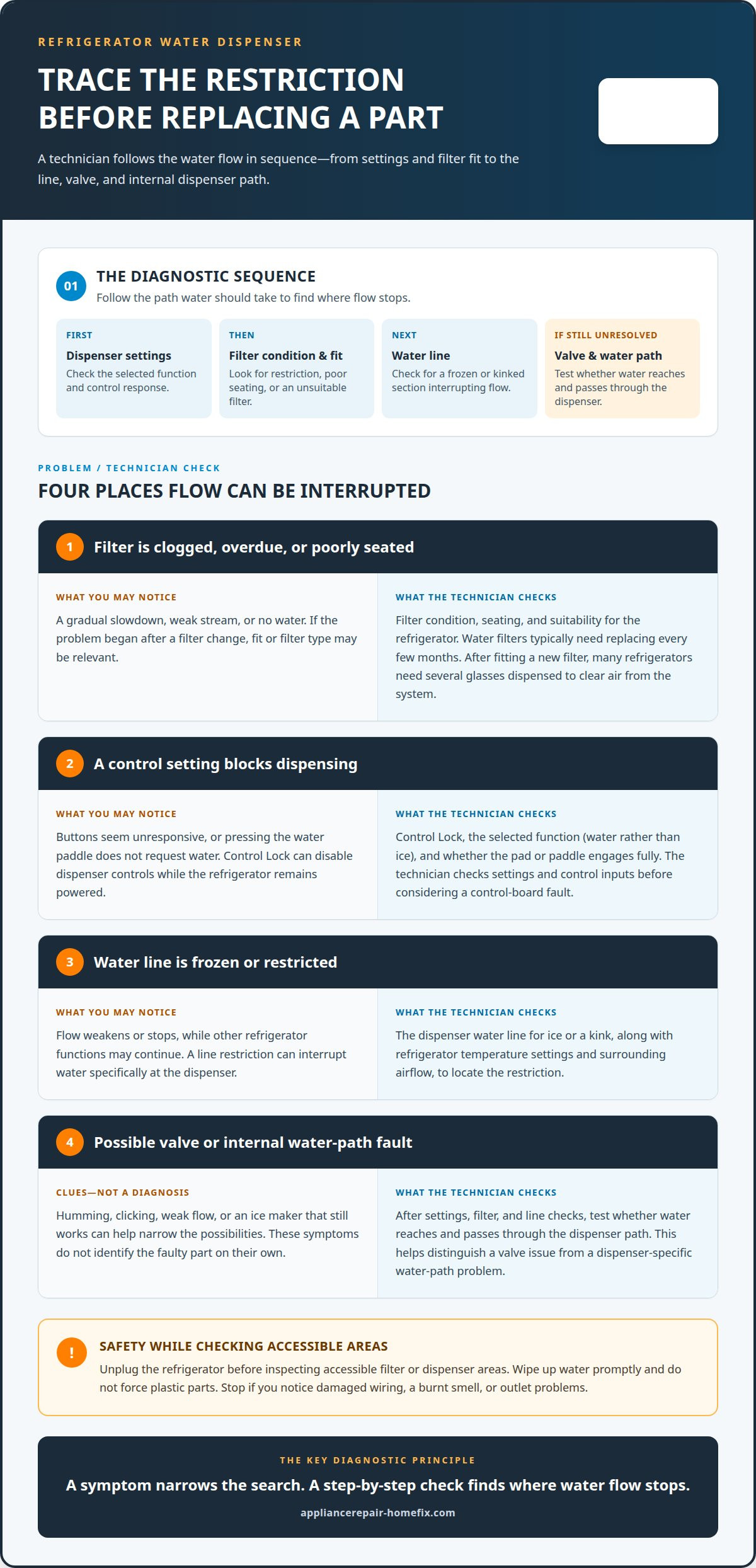
A clogged, overdue, or poorly fitted water filter can slow the dispenser or stop water flow. A technician checks the filter first, then follows the water path if replacing or reseating it doesn’t restore flow.
-
Have a Technician Assess Water Filter Condition
Tell the technician when the dispenser slowed or stopped and when the filter was last changed. Refrigerator water filters typically need replacing every few months, and an overdue or clogged filter can reduce flow or stop dispensing. The technician considers the filter’s condition alongside the symptoms rather than assuming a weak stream means the valve has failed. A gradual slowdown is useful context.
-
Have a Technician Check Filter Seating and Type
Share the filter packaging or model details if available, and describe any recent filter change. The technician checks whether the filter is seated correctly and is suitable for the refrigerator. If the problem began after replacement, possible causes include a poor fit, the wrong or defective filter, or air or restriction in the water path. Some filters may require preparation before installation.
-
Get Professional Filter Troubleshooting, Installation, or Replacement
Ask the technician to identify the filter issue before installing a replacement. After fitting a new filter, many refrigerators need several glasses of water dispensed to clear air from the system. Some models also require a specific installation process, so the technician follows the refrigerator’s instructions instead of forcing the cartridge. This helps distinguish a filter problem from a restriction elsewhere in the water path.
- A technician troubleshoots in sequence: checks dispenser settings, reviews filter condition and fit, then tests whether water reaches and passes through the dispenser path. Share whether the ice maker still works and whether the problem began after replacing the filter. Those details help narrow the next diagnostic step for a refrigerator water dispenser problem in the Cypress appliance service area.
- For safety, a technician watches for water spills, damaged wiring, a burnt smell, or outlet problems. Unplug the refrigerator before inspecting accessible filter or dispenser areas; wipe up water promptly, and don’t force plastic parts. Stop if you notice electrical damage or a burnt smell.
- Warranty coverage depends on the refrigerator’s manufacturer warranty and any home-warranty contract. Review the terms for the dispenser fault, filter parts, labor, and exclusions before authorizing covered work. Filter replacement and a mechanical failure may be treated differently.
Control Lock and dispenser selection
A control setting can stop a refrigerator dispenser even when the appliance remains powered. A technician checks the lock, selected function, and control response before diagnosing an internal fault.
-
Have a Technician Check Control Lock Settings
Tell the technician whether the display shows Control Lock or the dispenser buttons have stopped responding. On some refrigerators, Control Lock deactivates the dispenser controls and pad without shutting off power to the refrigerator, ice maker, or dispenser light. The technician checks the setting and model controls, then confirms whether unlocking restores the dispenser response.
-
Have a Technician Assess the Dispenser Control Board
Describe what happens when you press the dispenser control, including whether the display changes or remains unresponsive. The technician checks whether the selected setting and control inputs register before considering a control-board fault. A board diagnosis should follow checks of the lock and dispenser selection, since a blocked setting can mimic component failure.
- Ask the technician to confirm that the refrigerator is set to dispense water, not ice. On models with separate selections, choosing ice while pressing the water paddle won’t request water. The technician compares the selected function with the control response and checks whether the paddle or pad is fully engaged, since incomplete engagement can prevent dispensing.
- Report other control behavior, such as whether the dispenser light turns on while the controls don’t respond. That detail helps distinguish a disabled dispenser pad from a broader loss of control response. Control Lock can leave the dispenser light powered, so a working light alone doesn’t prove that the water function is enabled.
- Tell the technician if Sabbath Mode is active or was recently selected. A special operating mode may affect whether the refrigerator dispenses ice or water. The technician checks the active mode and restores the appropriate setting before treating the symptom as a failed switch or control board. Avoid repeatedly pressing controls when the display indicates a lock or special mode.
- After the settings are checked, describe whether the dispenser works consistently or fails on every attempt. The technician uses that pattern alongside the selected function and control response to decide whether further diagnosis is needed. If settings don’t resolve the fault, professional refrigerator repair can address the remaining dispenser problem.
Frozen water lines
A frozen or restricted line can stop water at the dispenser while other refrigerator functions continue. A technician checks the line, temperature settings, and surrounding airflow to locate the blockage safely.
-
Have a Technician Check for Frozen Water Lines
Tell the technician when water flow stopped and whether it weakened first. The technician checks the dispenser water line for ice and looks for a cold spot along its route. On some models, temperatures set too cold or airflow directed near the line can cause freezing. The refrigerator manual can help identify the line’s location and model-specific instructions.
-
Have a Technician Inspect Water Lines for Kinks or Disconnection
Describe any recent refrigerator movement, which may have shifted the supply line. A technician inspects accessible tubing behind the appliance and along the dispenser route for a kink, loose connection, or disconnection. A bent line can restrict water flow even when the household supply is available. Don’t pull or force the refrigerator, since careless movement can strain a connection.
- Ask the technician to compare the dispenser symptoms with ice maker performance. If the ice maker works but the dispenser does not, the restriction may be limited to the dispenser line. That pattern helps distinguish a frozen dispenser path from a broader interruption in the refrigerator’s water supply. It doesn’t identify the cause by itself, so the technician traces the relevant line.
- Have the technician review temperature settings and airflow around the suspected line. A setting that’s too cold or a concentrated cold-air path can freeze water inside some models. The technician uses the refrigerator manual for model-specific guidance, then checks whether the line is exposed to unusually cold airflow. Avoid changing multiple settings at once, since that can obscure the cause.
- Leave thawing and line access to the technician if ice is suspected. A frozen dispenser line can sometimes be thawed by pumping warm water into the tubing where it ends. The technician determines whether that method suits the model and checks the line afterward for restored flow. Don’t force tubing, remove trim, or apply heat without appropriate service procedures.
- Ask for a final flow check after the technician addresses a kink, disconnection, or frozen section. If water still doesn’t reach the dispenser, the technician continues tracing the internal water path rather than assuming the visible line was the only fault. Report whether flow returns steadily or remains weak. That result guides the next diagnostic check without repeating line adjustments.
Water inlet valve and internal water-path issues
If settings and accessible lines don’t explain the failure, a technician traces water from the household supply to the dispenser. The inlet valve, its screen, and internal tubing can each restrict flow.
-
Have a Technician Inspect the Water Inlet Valve and Supply-Line Screen
Tell the technician whether the dispenser stopped suddenly or weakened over time. Before inspecting the inlet valve, the technician shuts off the refrigerator’s water supply. Debris at the supply-line connection can obstruct its screen and limit flow. The technician checks for that restriction and assesses the screen without forcing the connection or spilling water near electrical parts.
-
Have a Technician Assess the Water Inlet Valve
Describe any hum or click when the dispenser is pressed. A hum without water can point to a blocked supply, frozen line, or faulty inlet valve. The technician assesses whether the valve receives the signal to open and whether water passes through it. Electrical testing and valve replacement require qualified repair work, not trial-and-error part changes.
- Ask the technician to confirm that the refrigerator connects to a cold water supply. The ice maker and water dispenser need cold water to operate. A connection to another supply can prevent proper function, even if the line appears attached. The technician traces the supply connection before deciding whether the valve or another internal component needs further testing.
- Have the technician inspect the water line from the household connection to the refrigerator. A kink can reduce flow and pressure, while a loose connection can interrupt delivery. The technician checks the route and connection points, then assesses whether straightening or securing the line restores adequate flow. Avoid pulling the appliance out or handling a pressurized connection yourself.
- Ask how the technician will distinguish a valve failure from an internal water-path blockage. A valve solenoid can be tested for continuity with a multimeter, but the refrigerator must be disconnected before electrical testing. A qualified technician considers the test result alongside water-flow symptoms. A failed reading can support valve replacement; a normal result directs attention elsewhere.
- Report whether the ice maker still produces ice while the dispenser remains dry. That difference can point toward a dispenser-specific switch, valve outlet, or internal path rather than a complete supply interruption. The technician uses this symptom to focus the diagnosis and checks the relevant outlet and tubing instead of replacing the inlet valve based on one symptom alone.
- Ask the technician to verify water flow after addressing a blockage or valve fault. A continuing hum, weak stream, or no flow means the internal path needs further inspection. The technician follows the route from the inlet valve toward the dispenser and checks each connection for restricted passage, keeping the diagnosis focused on where water stops.
Common symptoms of a refrigerator water dispenser failure
If your refrigerator water dispenser isn’t working in Cypress, record what it does, not just that it stopped. Flow, sound, and ice maker behavior help a technician narrow down the cause before testing parts.
- Describe whether water stops completely, runs slowly, or sputters. A weak stream can point to restricted flow or low water pressure. If the dispenser stopped after a filter was installed, tell the technician when the change happened and whether the filter was fitted correctly. The timing can help distinguish a filter-related issue from another fault.
- Note whether the ice maker still produces ice while the dispenser fails. Ice production with no dispenser water can suggest a dispenser-specific issue, such as its switch or water outlet path. If both functions are affected, the technician considers a wider supply problem. This comparison helps focus the diagnosis without treating one symptom as proof.
- Listen for a click or buzz when the dispenser is pressed. That sound can indicate the switch or inlet valve is trying to operate, but it doesn’t prove water can pass through the line. Tell the technician whether the sound occurs every time, only sometimes, or not at all. The pattern adds useful context to the flow symptoms.
- Check whether the paddle or pad engages fully during normal use. A dispenser may not release water if the control isn’t pressed far enough to activate it. Report if the paddle feels stuck, loose, or different from usual. Don’t force it; a technician can assess the actuator and its pivot without risking damage to plastic parts.
- Compare dispenser flow with the refrigerator model’s stated guidance. For Samsung refrigerators, the stated minimum flow rate is 6 ounces (3/4 cup) in less than 10 seconds. A slower result can help identify weak flow, but it doesn’t locate the cause by itself. A technician considers water pressure, the filter, and the water path together.
- Record any related signs, such as small or hollow ice cubes or slow ice production. Low water pressure can affect both ice quality and production, even if some water still reaches the dispenser. Share whether these symptoms began together or separately. That timeline helps the technician decide whether to focus on the shared supply or the dispenser’s own components.
- Arrange professional diagnosis if your refrigerator water dispenser isn’t working in Cypress after basic settings and visible supply issues are addressed. A technician uses the symptom pattern to choose the next test rather than replacing a part based only on a click, hum, or slow stream. For a persistent dispenser fault, book refrigerator repair with HomeFix.
HomeFix: Refrigerator Repair
HomeFix repairs refrigerator dispenser problems that persist after settings and visible water-line issues have been checked. A technician assesses the dispenser controls, water inlet valve, and internal water path to identify where flow stops and what repair is needed.
Arrange service when the dispenser stays dry, sputters, or runs weakly despite basic checks, especially if the ice maker behaves differently. Share when the problem began and any changes you noticed, such as a new sound or reduced flow. These details help focus the diagnosis.
Contact HomeFix to arrange refrigerator repair.
Choose a Clear Next Step
If your refrigerator water dispenser isn’t working in Cypress, note the refrigerator’s model information and how the problem affects daily use. Does the dispenser fail every time, or only intermittently? Did the change begin after a filter replacement or another adjustment? These details give a technician useful context for assessing the fault and deciding where to begin.
For persistent problems, professional diagnosis can help distinguish a control issue from a mechanical or water-path fault. The right repair depends on the technician’s findings, so avoid replacing parts based on one symptom alone. If you’re unsure whether the dispenser is safe to use, stop using it until it’s assessed.
With clear details and a focused assessment, you can move toward a practical repair and get your household routine back on track.
Frequently Asked Questions
Still Having Trouble Getting Water From Your Refrigerator?
If water still won’t flow after basic checks, arrange a technician’s assessment. Note whether the dispenser is silent, clicks, hums, sputters, or has weak flow. Also record whether the ice maker still works and when the symptom began. These details help the technician choose what to inspect next and avoid treating one symptom as proof of a failed part.
Was the water line installed correctly?
A technician can assess whether the line is connected to the refrigerator’s cold water supply and routed without a kink. For example, a line pinched behind a refrigerator may restrict water even when its connection appears secure. The technician can also consult the appliance manual for model-specific connection details. Avoid pulling the refrigerator forward yourself if doing so could strain its water line.
When Should You Call a Refrigerator Repair Technician?
Call a technician if the dispenser remains dry or weak after basic setting checks, or if you notice damaged wiring, a burnt smell, or an outlet problem. Stop using the dispenser if you see water near electrical components. A technician can diagnose the appliance without guessing based only on a hum, click, or change in ice production.
Why is my refrigerator water dispenser not working?
Common causes include a disabled control, a restricted filter, a frozen or kinked line, and a faulty valve or internal water path. Symptoms can help narrow the possibilities: a working ice maker with no dispenser flow may point toward a dispenser-specific issue. A technician considers the full pattern, including sounds and whether the problem began after a filter change.
How does a technician check whether the refrigerator water filter is clogged or needs replacement?
The technician considers the filter’s age, condition, fit, and the timing of the flow problem. An overdue or clogged filter can reduce water delivery, while an incorrectly seated or wrong-type filter can cause trouble after replacement. The technician can determine whether the cartridge is the likely restriction and follow the refrigerator’s installation instructions if it needs replacing.
How does a technician check the water supply line and shutoff valve to the refrigerator?
The technician checks that the refrigerator’s household supply valve is fully open and that the cold-water connection can feed the appliance. Before inspecting the inlet valve, the technician turns off the refrigerator’s water supply. They can also inspect the supply-line connection for a kink or debris at its screen, which may restrict flow.
How does a technician safely thaw a frozen refrigerator water line?
The technician first identifies the affected line and follows the refrigerator manual’s model-specific guidance. A frozen dispenser line can sometimes be thawed by pumping warm water into the tubing where it ends. The technician checks whether that method suits the appliance and verifies water flow afterward. Don’t force tubing or use uncontrolled heat, which can damage parts.
Which appliance repair services in Cypress, Texas, fix refrigerator water dispensers?
HomeFix provides Refrigerator Repair in Cypress, Texas, within the Houston metropolitan area. If you live in Cypress and your refrigerator dispenser needs diagnosis, a technician can assess the appliance and its water-delivery system. The service addresses refrigerator faults, including dispenser problems that persist after basic checks. Share the refrigerator’s model information and the symptoms you’ve noticed when arranging service.