

Soft ice cream and food that won’t freeze firm are warning signs, but they don’t automatically mean your freezer needs replacing. If you’re dealing with a freezer not freezing solid Sugar Land homeowners can start with a few safe checks before deciding what to do next.
It’s stressful when food may be thawing, especially when the cause could be as simple as a setting or blocked airflow, or a component that needs repair. Keep the door closed as much as possible, check the temperature setting, and make sure vents aren’t blocked. Skip removing panels or handling electrical parts.
This guide explains how to protect your food, which checks are useful, and what common freezer problems may be behind persistent softness. If basic checks don’t restore freezing, a professional diagnosis can help pinpoint the problem without guesswork. HomeFix Appliance Repair serves Sugar Land with on-site freezer diagnosis and written estimates before work begins, so you know the proposed repair before moving ahead.
Key Takeaways
- A freezer display shows the setting, not the actual interior temperature, so use a thermometer to check whether food is staying cold enough.
- For a freezer not freezing solid Sugar Land homeowners can start with safe checks for settings, blocked vents, and a poor door seal.
- Frost buildup or unusual running sounds can point to airflow or component problems, but they don’t identify the cause on their own.
- Keep the freezer door closed and use USDA food-safety guidance to decide what to keep, refreeze, or discard.
- If simple checks don’t restore freezing, HomeFix can diagnose the freezer on-site and provide a written estimate before work begins.
Freezer Not Freezing Solid in Sugar Land? Start With These Signs
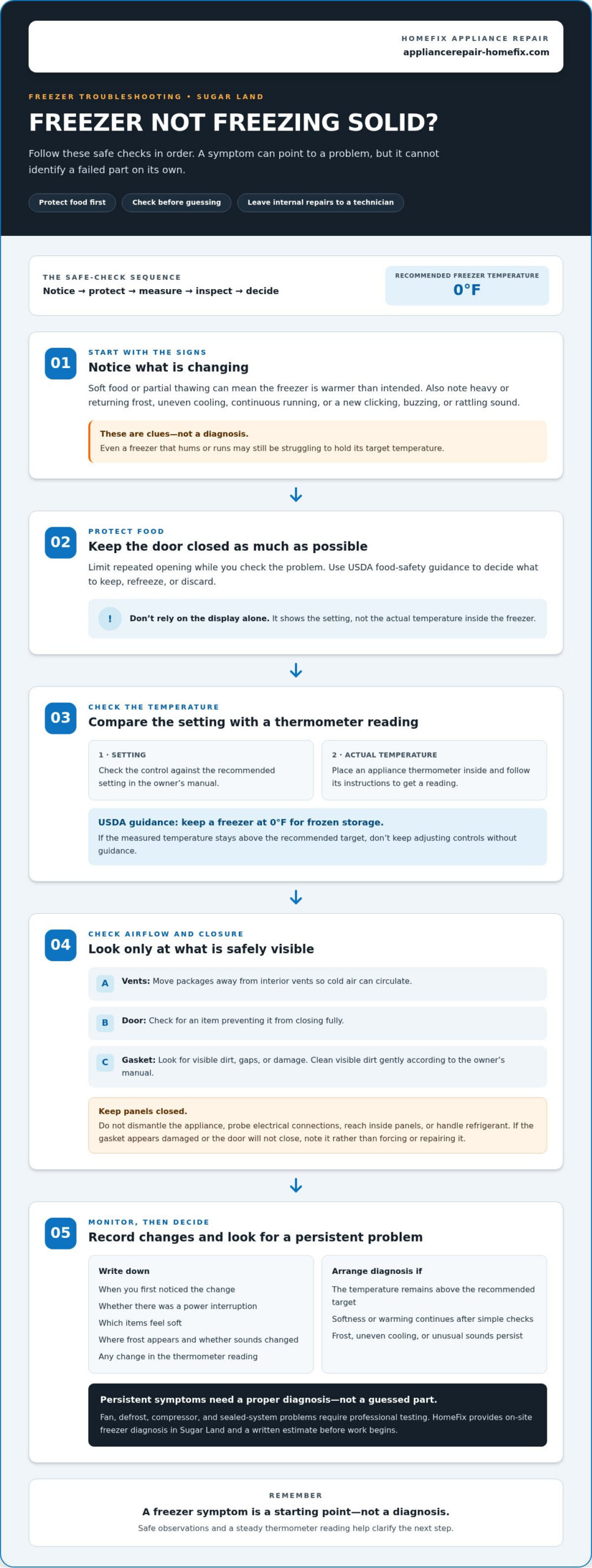
“Not freezing solid” means food stays soft or the freezer isn’t holding its intended temperature. A control set to a cold number doesn’t confirm the air inside has reached that temperature. Start with an appliance thermometer, then compare its reading with the setting and guidance in your owner’s manual. USDA guidance recommends keeping a freezer at 0°F to maintain frozen storage.
Freezers remove heat from stored food and keep it cold through a refrigeration cycle. The basic idea is shared across different freezer operation and types, but controls and recommended checks vary by model. Use your manual for appliance-specific instructions rather than assuming every freezer works the same way.
Which freezer symptoms suggest an urgent problem?
Look at the pattern, not just one item. Soft food can signal that the freezer is warmer than intended; partial thawing suggests the temperature may have risen further. Heavy frost can interfere with airflow, while a unit that runs continuously may be struggling to reach its target. These signs don’t identify a failed part by themselves. Persistent warming needs attention even if the freezer still hums or runs.
Write down when you first noticed the change and whether there was a power interruption. Note which items feel soft, whether frost is concentrated in one area, and if the running sound has changed. This record gives a technician useful context and helps distinguish a brief disruption from a problem that continues.
What should Sugar Land homeowners check first?
Keep the checks simple and avoid opening the freezer repeatedly. Confirm that the temperature control wasn’t changed accidentally, then consult the manual for the recommended setting. Check that the door closes fully and inspect the gasket, the flexible seal around the door, for visible dirt or anything blocking contact with the cabinet. If the seal looks damaged or the door won’t close, note that rather than trying to force it.
Use this quick sequence:
- Check the control setting against the owner’s manual.
- Place an appliance thermometer inside and follow its instructions to get a reading.
- Look for an object preventing the door from closing and a visibly dirty or obstructed gasket.
- Keep the door shut while monitoring the problem, and record any change in the reading or symptoms.
If the measured temperature remains above the recommended target, don’t rely on the display alone or keep adjusting controls without guidance. The phrase freezer not freezing solid Sugar Land describes a symptom, not a specific diagnosis. A stable reading and clear notes can help narrow down the next step. If the problem persists, HomeFix provides appliance repair in Sugar Land, with on-site diagnosis for residential freezers and a written estimate before work begins.
Common Reasons a Freezer Stops Freezing Solid
A freezer can stay powered on and still struggle to cool food evenly. A control set too warm, blocked air vents, or a door that doesn’t seal can disrupt cooling without an obvious breakdown. Other causes involve parts that circulate air, remove frost, or move refrigerant through the system. A freezer’s sounds and frost patterns can help narrow the possibilities, but they can’t confirm a failed component.
Could the door seal or blocked airflow be the cause?
Yes. Packages pushed against interior vents can restrict the movement of cold air, leaving some areas warmer than others. A bulky item can also stop the door from closing completely. Check for visible obstructions and look over the gasket for dirt, gaps, or damage. Move items away from vents and the door, but don’t remove panels or dismantle the appliance to inspect hidden parts.
A poor seal can let warmer, moist room air enter. That extra moisture may contribute to frost, while incoming warm air makes it harder for the freezer to hold a steady temperature. A visibly dirty gasket can be gently cleaned according to the owner’s manual. If it appears torn, loose, or misshapen, note what you see rather than trying to repair or replace it without model-specific instructions.
When might a fan, defrost system, or compressor need diagnosis?
Persistent frost, uneven cooling, or a new clicking, buzzing, or rattling sound can point to an airflow or component issue. Frost that returns after basic obstructions are cleared may involve the defrost system; uneven temperatures may make a fan problem one possibility. A freezer that runs for long stretches could be struggling, but sound and run time alone don’t identify the cause. These are clues, not diagnoses.
Fan, defrost, compressor, and sealed-system problems require professional testing. The compressor and sealed system are part of the equipment that moves refrigerant and supports cooling. Internal panels can cover wiring and moving parts, so leave them closed. Don’t reach inside, probe electrical connections, or attempt to handle refrigerant. Safe observations, such as noting when a sound happens or where frost appears, are more useful than taking the freezer apart.
For a freezer not freezing solid Sugar Land residents should treat repeating symptoms as a reason to arrange a proper diagnosis, not guess at a part based on one clue. HomeFix technicians diagnose residential freezers and refrigerators on-site. They can test the appliance, explain the findings, and provide a written estimate before work begins. If airflow and seal checks don’t resolve the issue, local appliance repair in Sugar Land can help determine what is actually preventing the freezer from holding temperature.
Safe Freezer Checks Versus Repairs to Leave to a Technician
Keep troubleshooting to steps that don’t require opening the appliance. A few careful checks can rule out simple causes, but taking panels off or handling electrical parts can create new risks. Use the owner’s manual for model-specific instructions, and stop if a check requires tools, force, or access to internal components.
Which checks can homeowners try without opening the appliance?
Follow this sequence and make one change at a time. First, confirm the control is set as recommended in the manual. Next, move packages away from vents, leaving the airflow clearance the manual specifies. Check that nothing blocks the door and look for visible dirt or damage on the gasket. Avoid repeatedly opening the freezer while you assess it.
- Place an appliance thermometer inside and follow its instructions. After a control adjustment, allow the time stated in the manual for the temperature to stabilize before judging the result.
- Rearrange food that is packed tightly against vents or the interior walls. Keep enough space for air to move as directed by the manufacturer.
- Check that the door closes fully and the gasket isn’t visibly obstructed. Don’t pull the seal off or dismantle the door.
- Record the temperature and note whether the symptoms improve, stay the same, or get worse.
Coils may collect dust, but cleaning access and instructions differ by model. Consult the owner’s manual first. Only clean them if it explicitly permits homeowner access, and unplug the freezer before accessing them if the manual directs or permits that procedure. If access requires removing a panel or you’re unsure how to proceed, leave the job to a technician.
Which freezer repairs should not be DIY projects?
Leave internal panels, wiring, motors, fan assemblies, compressor work, and refrigerant-system repairs to a qualified technician. These areas can involve electrical connections, moving parts, or sealed components that aren’t intended for homeowner servicing. Don’t probe wires, force a stuck part, or attempt to open a refrigerant line. Visible symptoms can guide a diagnosis, but they don’t establish which part has failed.
A reset may restart an appliance, but it can’t repair a failed component or show why the freezer stopped holding temperature. Repeated resets can also make it harder to track when the trouble began. If the freezer warms again after a reset or a safe check, note the change and stop troubleshooting.
Stop rule: If the temperature doesn’t improve after the safe checks, or if food is warming, unusual sounds intensify, or frost continues to build, arrange a professional diagnosis. For a freezer not freezing solid Sugar Land homeowners can have HomeFix assess the appliance on-site and provide a written estimate before work begins. Sugar Land appliance repair can help identify the cause without guesswork. Don’t keep adjusting controls or open the appliance to investigate.
Protect Frozen Food and Know When to Book Freezer Repair
Protect the food first. Keep the freezer door closed to hold cold air in, and don’t move food unless you have a safe alternative, such as another working freezer. If you do transfer items, limit the time they spend unrefrigerated. An appliance thermometer helps you record the actual temperature; also note when you first noticed the problem and how long the food may have been warming.
How can you reduce food risk while the freezer warms?
During a power outage, USDA guidance says a full freezer can keep food safe for about 48 hours and a half-full freezer for about 24 hours, provided the door stays closed. These time estimates are for outages, not a guarantee for every malfunction. For a specific food-safety decision, consult current USDA guidance and use the measured temperature and time, not guesswork.
USDA guidance says perishable food that has been above 40°F for more than two hours should be discarded. Don’t taste food to test it, and don’t rely on smell or appearance to establish safety. Food that still has ice crystals or has stayed at 40°F or below can generally be refrozen, though quality may decline. When you’re unsure how long food has been warm, follow current USDA guidance for that food rather than taking a chance.
Which signs mean it is time to stop troubleshooting?
Arrange a diagnosis if safe checks haven’t helped, the measured temperature keeps rising, or unusual noises continue. Repeated softening, heavy frost, or a freezer that runs constantly also deserve prompt attention. Note when each symptom started and share your temperature readings. These signs can help a technician investigate, but they don’t prove the freezer needs replacement.
For homeowners dealing with a freezer not freezing solid Sugar Land, a professional visit can help identify the cause before you make decisions about the appliance. HomeFix diagnoses residential freezers on-site and provides a written estimate before work begins. Local appliance repair in Sugar Land can be the next step when food keeps softening or the temperature won’t recover.
Keep your notes ready when scheduling. Share the freezer’s make and model if available, when the symptoms began, any power interruption, temperature readings, and changes in noise or frost. This gives the technician useful context for the visit. Don’t delay arranging service while waiting for food to become fully thawed if the temperature is still rising or the unit’s symptoms are worsening. Continue limiting door openings, and use a safe alternate freezer only if one is available.
Schedule a freezer diagnosis
How HomeFix Handles Freezer Repair in Sugar Land
If safe checks haven’t restored freezing, an on-site diagnosis is the next step. Book a visit and share the freezer’s brand and model, what you’re noticing, and when the problem started. HomeFix technicians diagnose residential freezers and refrigerators on-site, then explain what they find. Same-day or next-day service with three-hour arrival windows is offered, but appointment timing depends on availability.
What details help prepare for a freezer diagnosis?
Useful details help the technician understand the pattern before testing begins. Have the brand and model number ready, along with the measured interior temperature and a brief timeline of the symptoms. Note whether the food softened gradually or all at once, and whether the freezer recently lost power. These observations can help focus the visit without replacing hands-on diagnosis.
- Record unusual sounds and when they occur.
- Describe where frost appears and whether cooling seems uneven.
- Note any visible concern with the door seal or closure.
- Keep the model information and temperature readings handy.
Leave a built-in or heavy freezer in place. Don’t pull it out or shift it to make room; moving it can create a safety risk or damage nearby flooring and connections. The technician can assess the appliance at its installed location.
What should you expect before repair work begins?
The technician performs on-site diagnostics to identify the source of the cooling problem, which may involve mechanical or electrical components. A symptom such as continuous running doesn’t confirm which part has failed. After assessing the appliance, HomeFix provides a written estimate before work begins, with no hidden fees. You can review the proposed work before deciding how to proceed.
If a repair is appropriate, HomeFix uses high-quality or OEM parts. Replacement parts are covered by a one-year warranty in most cases, and labor is covered by a three-month warranty. The specific recommendation depends on the diagnosis, so avoid assuming a freezer needs replacement just because it has stopped freezing properly. A clear assessment helps you understand the issue and the repair plan.
HomeFix also handles related refrigerator issues. If you’re comparing symptoms in a refrigerator-freezer combination, the refrigerator repair service details explain the related repair option. For a freezer not freezing solid in Sugar Land, sharing your notes and appliance details when booking can help make the visit more focused.
Take the Next Step Toward Reliable Freezing
A freezer problem doesn’t have to leave you guessing about the appliance’s future. A clear diagnosis gives you a practical basis for deciding what to do next, rather than replacing the unit based on symptoms alone. If you’re facing a freezer not freezing solid Sugar Land situation, focus on getting the cause assessed before making a bigger household decision.
HomeFix’s certified technicians use high-quality or OEM parts when repairs call for replacements. You’ll receive a written estimate before work begins, with no hidden fees, and clear warranty terms for covered labor and most replacement parts. That gives you useful information to weigh the repair plan and move forward with confidence.
Take the next step when you’re ready. A focused freezer assessment can turn an ongoing problem into a clear plan for your home.
With the right diagnosis, you can make a confident choice and get back to dependable food storage.
Frequently Asked Questions
Why is my freezer not freezing solid even though it feels cold?
A freezer can feel cold while still being too warm to freeze food firmly or cool every area evenly. Cold air may reach some shelves better than others, or a component may be struggling to maintain temperature. A brief touch test can’t show the exact interior temperature. Check the condition of different foods and use an appliance thermometer to see whether the freezer is holding its target.
What temperature should a freezer be to keep food frozen?
USDA guidance recommends setting a freezer at 0°F. That target helps keep food safely frozen and maintain its quality, but the control setting alone doesn’t prove the inside has reached it. If the setting reads 0°F yet food is softening, compare it with an appliance thermometer reading. Check your owner’s manual for the correct way to place and read a thermometer in your specific model.
Can a blocked vent make a freezer stop freezing properly?
Yes. A package pushed against an air vent can disrupt circulation and leave parts of the freezer warmer than others, even if other items remain hard. Move packages away from vents and avoid packing food so tightly that air can’t move between items. Use the spacing guidance in your manual. If temperatures remain uneven after rearranging the contents, airflow may not be the only issue.
How long can food stay frozen if the freezer stops working?
During a power outage, USDA guidance estimates about 48 hours for a full freezer and 24 hours for a half-full one, provided the door stays closed. These are outage estimates, not a guarantee for a freezer that has been malfunctioning for an unknown length of time. Food that has been above 40°F for more than two hours should be discarded. Don’t taste food to judge safety.
Is it safe to clean freezer coils myself?
Only clean coils if your model’s owner’s manual describes homeowner access and gives instructions. Some designs may require removing a panel, which is a reason to stop rather than improvise. If the manual permits access, unplug the freezer before cleaning. Don’t reach near exposed wiring or moving parts. If you can’t access the coils as described without dismantling the appliance, leave the work to a technician.
When should I call for freezer repair in Sugar Land?
Arrange service if the temperature keeps rising, food repeatedly softens, or safe checks don’t improve cooling. Persistent unusual noises or heavy frost are also reasons to stop troubleshooting, especially if symptoms are worsening. For a freezer not freezing solid Sugar Land homeowners can request an on-site diagnosis from HomeFix. The company serves local households across Greater Houston, including Sugar Land, Katy, Cypress, Pearland, and Fulshear.
Can a freezer that is not freezing solid be repaired?
Often, a freezer can be repaired, but the right solution depends on what testing finds. Soft food alone doesn’t show whether the cause is a repairable part or another issue. HomeFix technicians diagnose residential freezers on-site and explain the findings before work begins. That assessment helps you make an informed decision about repair instead of assuming the appliance must be replaced.


