Your dryer is tumbling, but the clothes are still damp and cold. In our 2026 climate, a dryer not heating Houston homes often isn’t a broken machine; it’s an airflow crisis. You’re likely staring at a mountain of wet laundry and worrying about a massive repair bill or a potential gas leak. It’s frustrating to wait hours for a cycle that never finishes while the local humidity makes everything feel even heavier.
We understand you want dry clothes today without overspending on unnecessary parts. You can identify the cause of that cold air right now and potentially skip a service call with a few simple checks. This guide covers the five most common reasons dryers stop producing heat in Southeast Texas. We’ll walk through everything from tripped breakers to the strict Texas vent codes that affect your machine’s performance. By the end, you’ll know exactly why your laundry is cold and whether your dryer is worth fixing or if it’s time for a new unit.
Key Takeaways
- Learn a quick 5-point checklist to troubleshoot a dryer not heating Houston homes before you spend money on a service call.
- Understand how Houston’s high humidity and clogged vents trap moisture, making your dryer work harder without producing heat.
- Identify the specific components that fail in gas versus electric models and learn when it is safe to DIY.
- Discover routine maintenance tasks that prevent heating element burnout and significantly reduce your home’s fire risk.
- Know exactly when to stop troubleshooting and call for professional diagnostics to avoid damaging your appliance or risking safety.
The 5-Point ‘No Heat’ Checklist for Houston Homeowners
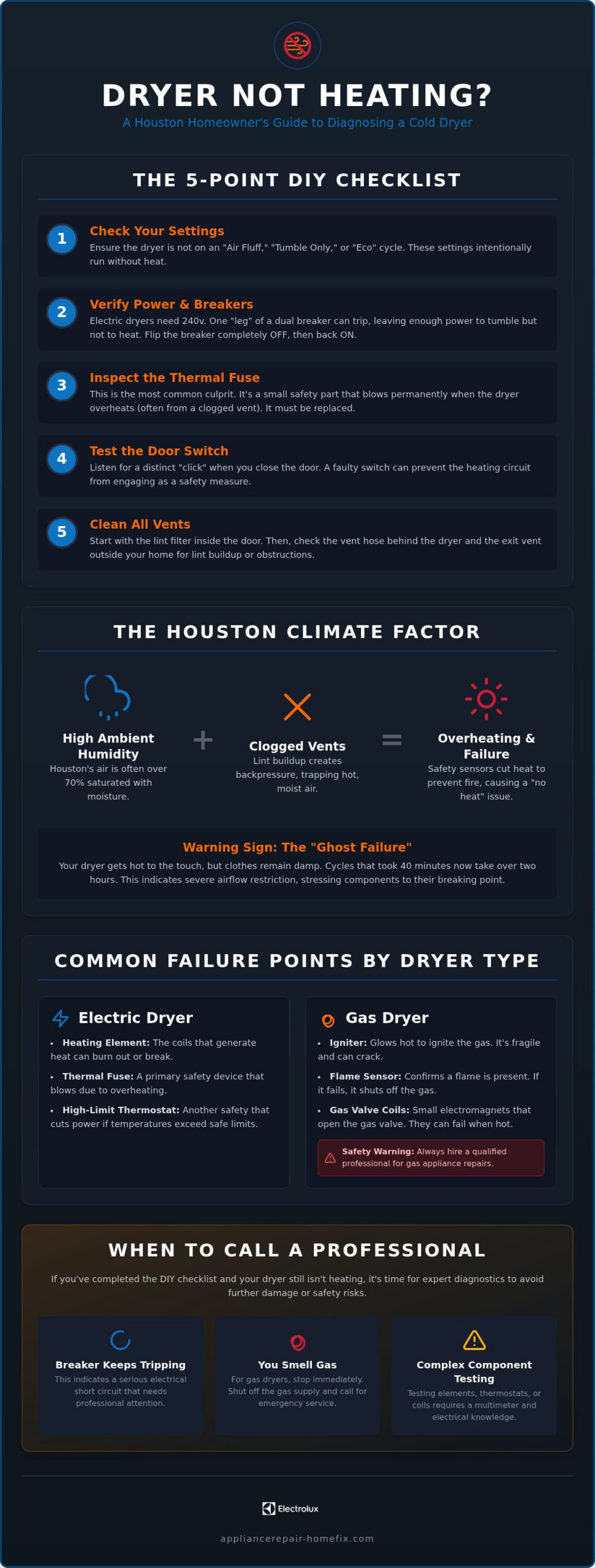
If you have a dryer not heating Houston laundry loads, don’t panic yet. A machine that tumbles but stays cold is a common headache, but the solution is often simpler than a full replacement. Before you assume the motor is dead or the heating element has burned out, run through these five immediate DIY checks. Understanding how a clothes dryer works helps you see that heat requires a perfect balance of power, airflow, and safety sensor signals.
Start by verifying your settings. It sounds basic, but ensure you aren’t on an “Air Fluff” or “Eco” cycle that disables the heater. Next, check for physical obstructions. A heavy load can sometimes block the internal sensors or prevent the door from sealing perfectly. If the settings are correct and the drum is spinning, move on to the technical side of the power supply and safety components.
Checking Power and Circuit Breakers
Electric dryers are heavy-duty appliances that require a 240v “dual leg” power supply. This is delivered through a double-pole circuit breaker in your main electrical panel. A common point of confusion occurs when one “leg” of that breaker trips while the other stays active. In this scenario, your dryer will have enough electricity to tumble the drum and light up the console, but it won’t have the 240v required to energize the heating element. Always flip the dryer breaker completely to the “Off” position and then back to “On” to ensure both legs are engaged. If you live in a home with an outdoor disconnect box near the laundry room, check those fuses as well.
Testing the Thermal Fuse and Door Switch
The thermal fuse is the most frequent culprit behind a “no heat” complaint. This small safety device is designed to fail and cut off the heating circuit if the dryer gets too hot. In our local climate, high humidity combined with lint buildup often causes internal temperatures to spike, blowing this fuse instantly. Once it blows, it must be replaced; it cannot be reset. You’ll typically find it on the blower housing or near the heating element.
You should also inspect the door switch. A broken plastic peg on the door or a failed internal switch prevents the heating circuit from engaging. If you don’t hear a distinct “click” when the door closes, or if the dryer starts tumbling but stops the moment you let go of the start button, the switch is likely faulty. If these steps don’t solve the issue, you likely need professional dryer repair near me to test the internal thermostats and heating coils with a multimeter.
Why Houston Humidity and Clogged Vents Kill Dryer Heat
In cities like Katy and Cypress, the “Evaporation Paradox” is a real issue. Dryers work by pulling in ambient air, heating it, and exhausting it once it’s full of moisture. When local humidity levels consistently hover above 70%, the air your machine pulls in is already saturated with water. This makes it much harder for the dryer to absorb moisture from your clothes. If you have a dryer not heating Houston loads effectively, it’s often because that moisture-laden air is getting trapped inside the system.
Clogged vents create backpressure. This forces your heating element to work much harder and stay on longer than the manufacturer intended. This extra strain eventually leads to a “ghost failure.” This is where the machine seems to work, but the heat is actually being cut off by safety sensors because the internal temperature is too high. If your machine is hot to the touch but the clothes are soaking wet, your vent is likely the culprit.
The Science of Airflow in a Humid Climate
Restricted airflow is the leading cause of dryer failures in Southeast Texas. When air can’t escape through the exhaust line, heat builds up rapidly inside the cabinet. This triggers the high-limit thermostat to kill the power to the heating circuit. It’s a vital safety measure to prevent fires, but it leaves you with cold laundry. One clear warning sign is a “long drying time” where cycles that used to take 40 minutes now take two hours before the heat fails entirely. Adhering to CPSC dryer safety guidelines for annual vent cleaning is the best way to prevent these sensor trips.
Identifying Vent Blockages Outside the Home
Go outside and inspect your external wall cap or roof vent while the machine is running. In Houston suburbs, bird nests and crushed foil ducts are common discoveries. Foil ducts often sag under the weight of wet lint, creating a trap that kills airflow. You can perform a “tissue test” to check your exhaust strength. Hold a single square of toilet paper near the exterior vent opening. If the air doesn’t blow the paper firmly away, you have a blockage somewhere in the line.
If you’ve cleared your vents and the machine still won’t get warm, a internal component has likely failed from the heat stress. Homeowners in Cypress can reach out for a professional inspection to see if the heating element or thermal fuse needs replacement.
Troubleshooting Electric vs. Gas Dryer Heating Failures
The solution for a dryer not heating Houston laundry depends entirely on your machine’s fuel source. Electric and gas dryers use completely different methods to generate warmth. If you have an electric model, you are looking for a failed heating element. If you have a gas model, the issue usually lies with the ignition system or the gas supply itself. Identifying which system you have is the first step toward a successful repair.
Listen closely to your machine during the first two minutes of a cycle. An electric dryer should produce a faint hum when the element engages. A gas dryer should make a distinct “click” followed by a low “whoosh” as the burner ignites. If you hear the click but no heat follows, the gas isn’t reaching the flame. If you hear nothing at all, the heating circuit is likely broken.
Electric Heating Element Burnouts
Electric dryers rely on a heavy-duty heating element that looks like a giant toaster coil. These coils expand and contract every time they heat up. Over time, the metal becomes brittle and snaps. If you have a dryer not heating Houston clothes, a burnt-out element is a prime suspect. You can often see the break visually; look for a snapped wire or a dark, charred spot on the coil housing.
Advanced DIYers can test for continuity using a multimeter. If the meter shows an “open” circuit, the element is dead and requires replacement. These components often fail prematurely in Houston because poor ventilation forces them to run longer cycles. This extra “on time” wears out the metal faster than in drier climates. Brands like Samsung and LG are particularly known for element failures when airflow is restricted.
Gas Igniter and Solenoid Issues
Gas dryers are more complex. Before you disassemble the cabinet, perform “Step 0”: check the gas supply valve. It is common for the manual shut-off valve behind the machine to get bumped into the “off” position during cleaning. If the valve is open and you still have no heat, look at the igniter. This component should glow bright orange before the gas valve opens. If it glows but no flame appears, your gas valve solenoids have likely failed.
Solenoids are small electromagnetic coils that pull the gas valves open. They often fail “softly,” meaning they work for the first ten minutes of a cycle but stop once they get hot. This results in clothes that are slightly warm but never fully dry. Safety is paramount here. Handling gas components requires specialized knowledge to prevent leaks. If you suspect a gas valve issue, it is safer to book a professional dryer repair near me. Experts can use OEM software to verify gas pressure and sensor timing without risking a leak in your home.
DIY Maintenance to Prevent Future Heating Failures
Prevention is always more affordable than a service call. If you want to avoid a dryer not heating Houston laundry again, you must adopt a proactive maintenance schedule. Our local humidity makes lint stickier and harder to remove than in drier climates. This buildup forces your heating element to stay energized for longer periods, which leads to metal fatigue and eventual failure. You can extend the life of your machine by performing a few simple tasks every few months.
Keep a basic toolkit ready for dryer care. You’ll need a vacuum with a long crevice attachment, a Phillips head screwdriver, and a small soft-bristled brush. These tools allow you to reach the areas where fire risks actually begin. Regular cleaning ensures your safety sensors don’t have to work overtime to keep the machine from overheating.
Cleaning the Internal Lint Trap and Housing
Cleaning the mesh screen after every load is not enough. Lint often bypasses the screen and settles in the chute below. Use your vacuum attachment to reach deep into the lint trap housing once a month. This prevents the “evaporation paradox” mentioned earlier by keeping the internal airflow path clear.
You should also pay attention to your moisture sensors. If you use dryer sheets or fabric softener, a thin, waxy film eventually coats the interior of the drum and the sensor bars. This film tricks the machine into thinking the clothes are dry when they are still damp, causing it to cut the heat prematurely. Scrub these sensors with a cotton swab dipped in rubbing alcohol to keep them accurate. A deep-clean of the trap area involves removing the front panel or the lint duct cover to reach the blower wheel, where heavy clogs often hide.
Professional Vent Cleaning vs. DIY Methods
DIY vent brush kits are popular, but they carry risks for Houston homeowners. If you have a long vent run typical of Memorial or River Oaks homes, these flexible brushes can snap or get stuck inside the duct. Even worse, a DIY brush can accidentally push a soft clog into a tight 90-degree turn, creating a total blockage that immediately trips your thermal fuse.
We recommend a professional vent inspection at least once a year. Professionals use high-powered compressed air or specialized vacuums that pull lint out rather than pushing it further in. This is especially critical if your vent terminates on the roof, where humidity can cause lint to “paste” onto the exit screen. Keeping this path clear is the single best way to ensure your heating element lasts for its full intended lifespan.
Book a professional dryer maintenance check today
When to Call HomeFix for Professional Dryer Repair in Houston
There is a point where DIY troubleshooting reaches its limit. If you have tested the breakers and cleared the vents but still have a dryer not heating Houston loads, the problem is likely internal. Attempting to disassemble a modern dryer without technical training can lead to broken clips, pinched wires, or even gas leaks. Safety is our priority. If you smell gas, see scorched wiring, or feel uncomfortable testing live electrical circuits, it is time to call a specialist.
Professional diagnostics take the guesswork out of the equation. We don’t just “parts-swap” until the machine works. Our technicians use advanced tools like SmartHQ and OEM-specific software to communicate directly with your dryer’s control board. This allows us to see real-time sensor data and historical error codes. We identify the exact failure point, whether it’s a faulty thermistor or a failing control relay, ensuring you only pay for the parts you actually need.
Our Expert Diagnostic and $69 Credit Offer
We believe in transparent, upfront pricing. Our standard diagnostic fee is $89. However, we offer a significant incentive for homeowners who move forward with a repair. If you choose to have us fix your machine, that diagnostic fee drops to $69 and is applied directly to your repair total. This ensures you aren’t paying twice just to get your laundry room back in order.
Efficiency is part of our service model. We provide 3-hour arrival windows so you aren’t stuck waiting all day. Every repair we complete is backed by a 1-year parts warranty and a 3-month labor warranty. This level of protection is why we are a top choice for dryer repair near me. We aim for a “one and done” visit, carrying common replacement parts on our trucks to get your heat back on the same day whenever possible.
Serving Katy, Memorial, and the Greater Houston Area
Local expertise matters in the Texas climate. We deploy technicians based on proximity to ensure the fastest possible response times across the region. Whether you are dealing with a stacked unit in a high-rise in Memorial or a gas dryer in a large family home in Cinco Ranch, we know the specific challenges of your neighborhood. Our service area covers a wide footprint, including the following locations:
- Katy and Cinco Ranch
- Sugar Land and First Colony
- Memorial and Bunker Hill Village
- Cypress and The Woodlands
Don’t let damp laundry sit in the Houston humidity. You can schedule your dryer repair online right now to book a technician. We are ready to help you decide if your machine is worth the investment or if it’s time for a replacement.
Get Your Laundry Room Back in Order
You shouldn’t have to live with a mountain of damp laundry. Most dryer problems have a straightforward solution, whether the issue is a tripped breaker, a clogged vent line, or a burnt-out heating element. Remember that Houston’s high humidity levels make regular maintenance essential for preventing airflow restrictions that kill your machine’s efficiency. If your DIY checks didn’t solve the problem, a specialist can identify the exact failure point using professional diagnostic tools.
Dealing with a dryer not heating Houston homes is stressful, but the fix is often more affordable than you think. We provide same-day or next-day service to minimize your household disruption. Our standard diagnostic fee becomes a $69 credit applied directly to your repair. Plus, you get peace of mind with our 1-year parts warranty and 3-month labor warranty.
Schedule Your Fast Houston Dryer Repair Now
You don’t have to tackle complex gas lines or electrical circuits alone. Let us handle the technical work so you can get back to your routine with dry, fresh clothes today.
Frequently Asked Questions
Why is my dryer running but there is no heat?
If your dryer tumbles but stays cold, the heating circuit has likely failed. For electric models, this often means a broken heating element or a tripped circuit breaker where only one leg of the 240v power is active. For gas models, a failed igniter or gas valve solenoid is usually the culprit. A dryer not heating Houston laundry might also be suffering from a blown thermal fuse triggered by high humidity and lint buildup.
Is it worth repairing a 10-year-old dryer that isn’t heating?
Most dryers have a lifespan of 10 to 13 years. If your unit is 10 years old, a repair is often worth it if the cost is less than half the price of a new machine. Many heating issues involve simple part replacements like fuses or sensors. Our technicians provide a written estimate during the diagnostic visit. This helps you determine if a repair makes sense or if you should invest in a new model.
How much does it cost to replace a dryer heating element in Houston?
The cost of replacing a heating element varies based on your specific brand and model. We provide transparent, written estimates before any work begins so you know exactly what to expect. Our standard diagnostic fee is $89, but we reduce this to $69 and apply it directly toward your repair total if you choose to move forward. This credit makes a professional repair more affordable for homeowners dealing with a dryer not heating Houston loads.
Can a clogged lint vent cause a dryer to stop heating?
Absolutely, a clogged vent is the leading cause of heating failures in Southeast Texas. When lint blocks the exhaust, heat cannot escape the drum. This causes the internal temperature to spike, which triggers the high-limit thermostat or thermal fuse to cut power to the heating circuit. In Houston’s humid climate, lint becomes damp and heavy, making it more likely to stick to the sides of your vent and create a dangerous blockage.
How do I reset my dryer’s thermal fuse?
You cannot reset a thermal fuse because it is a single-use safety device designed to break the electrical circuit permanently when it overheats. Once the fuse blows, it must be replaced with a new part. Attempting to bypass the fuse is a serious fire hazard and should never be done. If your fuse has failed, it is a sign that your dryer or vent system reached a dangerously high temperature that needs to be addressed.
My gas dryer isn’t heating; could it be the igniter?
A failed igniter is a common reason gas dryers stop heating. The igniter must glow bright orange to create enough heat to open the gas valve. If the igniter is cracked or worn out, the gas will never release or ignite. Other possibilities include faulty gas valve solenoids or a tripped flame sensor. Since gas repairs require specialized safety knowledge, our certified technicians use OEM software to test these components without risking a leak in your home.
How long does a typical dryer repair take with HomeFix?
Most dryer repairs are completed within one to two hours once our technician arrives. We stock our service vehicles with common replacement parts like thermal fuses and heating elements to ensure a fast turnaround. Our goal is to resolve your laundry disruption in a single visit. We offer three-hour arrival windows and complete most service calls within 24 hours of your booking to keep your household running smoothly.
Do you offer same-day dryer repair in Katy, TX?
Yes, we provide same-day or next-day dryer repair services throughout Katy and the surrounding West Houston suburbs. We deploy technicians based on their proximity to your ZIP code to ensure a quick response. Whether you are in Cinco Ranch or near Katy Mills, you can book a three-hour appointment window that fits your schedule. Our team is certified for both gas and electric models, providing the local expertise needed for humid-climate appliance care.