The hidden costs of appliance repair in Fulshear can matter as much as the repair itself. A diagnostic visit, hard-to-find parts, or a problem that worsens while you wait can all affect the final bill. The price depends on the appliance, failed part, and labor involved, and is given after a quote request.
It’s reasonable to want a clear cost before deciding whether to repair or replace an appliance. Washer repairs can involve anything from a belt or hose to a control board, so the diagnosed fault matters. Acting promptly can also limit damage when a washer leaks.
This article explains typical local price ranges, with focused guidance on washer and microwave repairs. You’ll also learn what can add to a repair bill and how to weigh the appliance’s condition and repair needs against replacement. Use these details to understand what drives the cost and make a practical decision for your home.
Key Takeaways
- Learn what can shape an appliance repair quote, including the diagnosis, parts, labor, and how quickly the fault is addressed.
- Compare typical local repair ranges for common household appliances, including microwaves and washers.
- See why a washer’s specific fault matters: a simple hose or belt repair differs from a control board replacement.
- Weigh repair against replacement by considering the appliance’s age, condition, and the cost of the needed work.
- Understand how diagnostic fees may be handled and what details can help clarify the likely repair scope.
How Much Does Appliance Repair Cost in Fulshear, TX?
Repair costs depend on the fault, the parts required, labor, and the service-call terms. For a household appliance, the diagnosis and written estimate explain what the proposed work includes.
Diagnostic and Service Call Fees
A diagnostic fee pays for a technician’s visit and assessment, while a service-call fee covers dispatch or travel. Most appliance repair companies charge a diagnostic or service-call fee. The diagnostic fee is typically applied toward repair costs when the customer proceeds. Ask how the estimate treats that fee before approving work, so you can compare the diagnosis with the proposed repair.
Additional Repair Charges
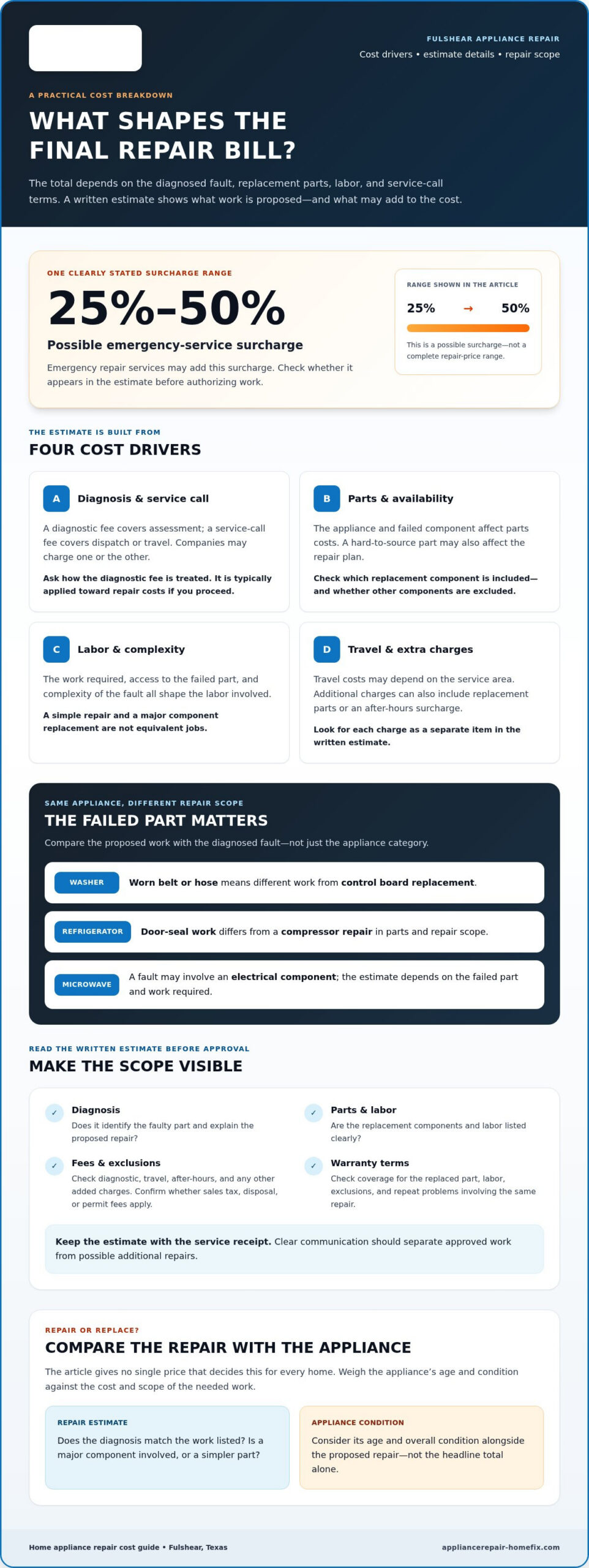
Additional charges can include travel, replacement parts, or an after-hours surcharge. Trip costs may depend on the service area, while parts costs reflect the appliance and failed component. Emergency repair services may add a surcharge of 25% to 50%. These charges can change the total beyond labor, so look for each item in the written estimate before authorizing a repair.
That is the practical meaning of the hidden costs of appliance repair in Fulshear: the diagnosis, parts, labor, and repair scope all affect the decision. A refrigerator compressor repair, for example, involves different parts and work from replacing a worn washer hose.
Warranty Coverage
A repair warranty sets out whether labor, replacement parts, or both receive coverage after service. Fulshear repair companies don’t all provide identical terms; the coverage and exclusions depend on the company and repair. Read the written warranty before approving the work. Check how it treats the replaced part, the labor, and a repeat problem involving the same repair.
To verify licensing, insurance, reviews, and fees in Texas, check relevant licensing records, request proof of insurance, and compare recent customer feedback. Read the estimate for the diagnostic fee, parts, labor, and any additional charges. Keep the estimate and warranty terms with the service receipt.
Customer experience also depends on clear diagnosis and communication. Technicians should explain what they found, identify the parts involved, and separate approved work from possible additional repairs. For brand-specific repair information, see LG appliance repair.
This cost discussion applies to residential appliances such as refrigerators, washers, dryers, dishwashers, ovens, and microwaves. Commercial equipment has different operating demands and repair requirements, so household estimates aren’t directly comparable.
Response time can affect the experience, especially when a refrigerator stops cooling or a washer leaks. In Houston, technicians may be harder to book during periods of high demand. Share the appliance type, model and serial number, any error code, and a short description of the fault. Those details help technicians prepare to diagnose the issue and explain the repair services needed.
Typical Fulshear appliance repair price ranges
Repair costs vary by appliance, fault, replacement components, and repair complexity. A quote request is the starting point for a case-specific price, with the diagnosis and work required shaping the estimate.
Repair Costs by Appliance
Appliance repair costs can range from a simple fix to a repair involving costly parts or more labor. The appliance type alone doesn’t determine the total: the failed component and the access needed for the repair matter, too.
A washer with a worn belt or hose needs different work from one requiring a control board. Refrigerator problems can involve a seal or compressor, while a microwave fault may involve an electrical component. For a dishwasher, oven, range, or dryer, the estimate depends on the failed part and work required. Compare the proposed repair with the diagnosed fault, not just the appliance type.
Fulshear and Texas Cost Ranges
Local and statewide ranges offer context, but they can’t predict a specific repair bill. In Fulshear and across Texas, the appliance type, replacement components, labor, and fault complexity shape the estimate. A simple repair and a major component replacement aren’t equivalent, even when both involve the same home appliance.
The price depends on the case and is given after a quote request; the fault, parts, labor, and repair complexity shape it. Use the estimate to understand which work is included and whether a replacement component accounts for much of the proposed total. A refrigerator compressor issue, for example, differs from a door-seal problem in both parts and repair scope.
Texas estimates don’t automatically tell you whether sales tax, disposal, or permit fees are included. Review the estimate for each item and whether it applies to the specific repair before approving the work.
Home warranty coverage depends on the contract’s terms, covered appliances, exclusions, and service conditions. Homeowners insurance is governed by the policy and the circumstances of the damage, so distinguish a mechanical breakdown from damage covered by a policy provision.
Compare the repair itself, not just the headline total. Check whether the diagnosis identifies the faulty part, whether the listed work addresses it, and whether other components are excluded. For example, a washer estimate that identifies a control board should explain whether board replacement is the proposed work. A refrigerator estimate should distinguish compressor work from a seal repair.
Electrical faults and older appliances can bring different repair considerations. A difficult-to-source part may affect the repair plan, while a complex diagnosis can require more labor. Ask for the repair scope in plain language and keep the estimate with the receipt. This helps you compare the planned work with the appliance’s condition and decide what to do next.
The hidden costs of appliance repair in Fulshear are easier to understand when the estimate explains the diagnosis, labor, parts, and work involved. Compare like with like, and make sure the listed repair addresses the diagnosed problem.
Choosing between repair and replacement
Compare the repair with the appliance’s age, condition, and expected usefulness. Repair may be practical when one component has failed, while recurring problems or a costly major part can change the calculation. Weigh the diagnosed repair against replacing the appliance rather than deciding from the first symptom alone.
Age offers useful context, but it doesn’t settle the decision by itself. Repairing an appliance may be more affordable than buying a new one, especially when it’s less than 10 years old. Consider its recent performance, any recurring faults, and whether the current problem affects one part or several. A newer refrigerator with one identified fault differs from an older unit with repeated cooling failures.
Part costs can shift the balance before labor is added. These examples show why the estimate should identify the component, labor, and any additional work separately.
A compressor problem also deserves careful consideration. Professional estimates for this type of major fix outline the repair cost itself, not a replacement appliance. Consider the refrigerator’s age, condition, and whether the diagnosis points to the compressor alone or other failures as well. A faulty compressor on an otherwise dependable refrigerator presents a different choice from the same fault alongside recurring problems.
Use the diagnosis to ask practical questions:
- What failed? Identify the specific component and how it caused the symptom.
- What work is included? Separate parts, labor, and any additional repair needs.
- Have similar failures returned? A history of repeated faults affects the appliance’s value after repair.
- What condition is the rest of the appliance in? Check whether the repair addresses the main issue or leaves other known problems.
Compare the estimate with the appliance’s overall condition and likely remaining usefulness. Consider the cost of the diagnosed work alongside the appliance’s age, repair history, and current performance. A clear estimate lets you weigh repair against replacement without relying on a fixed percentage rule. The right choice depends on whether the proposed work is likely to restore reliable use or leave important faults unresolved.
For a washer, a simple mechanical failure and an electronic control failure require different parts. For a range or refrigerator, a major component can affect the decision more than a small, isolated fault. Ask the technician from HomeFix to explain the diagnosis in plain language, including what the proposed repair fixes and which problems remain. That comparison helps you decide based on your appliance, not assumptions.
Washing machine repair costs
A washer’s repair cost depends on the failed part, labor, and whether the fault has caused additional damage. The price depends on the case and is given after a quote request; the fault, parts, labor, and repair complexity shape it.
Start with the symptom, then connect it to the likely repair. A washer that won’t drain may have a problem in its drain system, while one that won’t spin could have a belt or another mechanical fault. Address a leak promptly because ongoing water can damage floors or nearby areas.
Control boards can change the repair calculation. A hose or belt repair generally involves a different scope from an electronic fault. Ask the technician to explain which component failed and what the proposed work will address.
Bring useful details to the diagnosis. Note when the washer stops, whether it fills or drains, and any error code on its display. The model and serial number can help identify the appliance. Mention steps you’ve already tried, such as restarting the cycle, so the technician has a clearer picture of the problem.
- Leaking: Note where water appears and whether it happens during filling, washing, or draining.
- No spinning: Record whether the drum turns by hand and whether the cycle stops at the same point.
- No draining: Describe any standing water and whether the pump makes an unusual sound.
- Error code: Write down the exact code before switching the washer off.
Don’t treat every appliance repair as the same job. A refrigerator’s cooling system, a washer’s drain problem, and an oven’s heating element involve different components and diagnostic steps. Repeated washer failures matter, too: a repair may address the immediate fault while another problem remains. A clear estimate should explain which issue the proposed work fixes.
Check the written warranty terms for the washer repair. Read whether coverage applies to labor, replacement parts, or both, and note any exclusions or conditions. Keep the estimate, receipt, and warranty together. Those records help you understand what was repaired if the same symptom returns.
For a washer that leaks, stops mid-cycle, or won’t drain, share the symptoms and model details to support an accurate diagnosis. Comparing the identified fault, repair scope, and appliance condition gives you a clearer basis for deciding whether to proceed. That’s a practical way to assess the hidden costs of appliance repair in Fulshear without treating every washer problem as the same job.
Are diagnostic fees credited toward appliance repair costs in Fulshear?
Usually, yes. A diagnostic fee is typically applied toward the repair cost if you proceed with the recommended repair. The technician’s visit identifies the fault, such as a washer that won’t drain or a refrigerator that isn’t cooling. The estimate should show how the diagnostic charge affects the total before you approve the work.
A diagnostic fee and a service-call fee describe related but distinct charges. The service call covers sending a technician to your home, while diagnosis involves testing the appliance and identifying the problem. Some companies use one charge for both. The estimate or booking terms should make clear whether the fee is credited, and what happens if you decline the repair.
For example, a technician may find a damaged washer hose and quote for the repair. If the diagnostic charge is credited when you accept that work, it counts toward the quoted total rather than being added again. If you decline, the visit and diagnosis may still carry a charge. That difference matters when comparing repair estimates for the same appliance.
Before the visit, describe the symptom clearly. Say whether a dishwasher leaves standing water, a dryer stops heating, or a refrigerator runs continuously. Share the model and serial number, any display error code, and what you’ve already tried. These details help the technician prepare for the appointment and focus the diagnosis on the reported problem.
After diagnosis, review the written estimate for these items:
- Visit charge: Identify any service-call or diagnostic fee.
- Credit terms: Confirm whether that fee reduces the repair total when you proceed.
- Repair scope: Check the named part and labor included in the proposed work.
- Additional work: Note any separate charges that aren’t part of the first repair.
Separate charges can make two estimates look different even when both address the same fault. For instance, one estimate may list diagnosis apart from labor, while another may show a combined service charge. Compare the total and the included work, not just the first line. Keep the estimate and receipt together so the diagnostic charge and completed repair remain easy to track.
If the diagnosis points to a refrigerator compressor, a washer control board, or another major component, compare the repair scope with the appliance’s condition. The diagnostic credit affects the bill, but it doesn’t determine whether repair is the best choice. The identified fault, replacement part, and labor still shape that decision.
For a clear next step, schedule an appliance repair assessment.
HomeFix: Refrigerator Repair
HomeFix repairs refrigerators with household cooling problems, from inconsistent temperatures to a unit that stops cooling. Consider service when symptoms disrupt food storage or return after a reset. A clear description of the issue helps the technician assess the repair.
HomeFix also repairs washers, dryers, and dishwashers. Service can help when a washer leaks or won’t drain, a dryer stops heating, or a dishwasher leaves water behind. Compare the diagnosed problem and repair scope with the appliance’s condition before deciding how to proceed.
For a refrigerator or another household appliance, contact HomeFix Appliance Repair to discuss the repair.
Make Your Next Repair Decision With Confidence
Before authorizing work, consider what matters most for your household: restoring a dependable appliance, limiting disruption, or avoiding further investment in a unit with recurring trouble. Keep that priority in view as you assess the repair plan. Understanding the hidden costs of appliance repair in Fulshear can help you choose work that fits your needs and the appliance’s condition.
HomeFix repairs refrigerators, washers, and dryers. If one is disrupting your routine, describe the problem and discuss the repair plan. A focused conversation can help you move from uncertainty to a practical next step.
Take the decision one step at a time. A clear repair plan can help get your household back to its usual rhythm.
Frequently Asked Questions
Is it worth repairing an appliance instead of replacing it?
Repair can make sense when an appliance has one clear fault and the rest works reliably. For example, replacing a single washer component may be preferable to replacing a washer without recurring problems. Consider its age, repair history, condition, and diagnosed fault. If problems keep returning or several major components have failed, compare the repair plan with replacement before deciding.
Is there a diagnostic fee?
Appliance repair companies commonly charge for diagnosing a fault, though the way they apply the charge varies. HomeFix applies its diagnostic fee toward the repair when work proceeds and waives the fee when a repair is performed. Ask how the assessment charge appears in the estimate and what it covers. A written breakdown helps distinguish diagnosis from parts and repair labor.
Is there a fee just to have a technician come look at my appliance?
Yes, a service-call or diagnostic charge may apply to a visit, even if you don’t approve the repair. The charge covers the technician’s visit and assessment, rather than replacement parts. Before booking, clarify how the visit charge is handled if you decline the work. For example, a refrigerator diagnosis and a washer diagnosis both involve assessment, but their proposed repairs may differ.
Want an exact price for your repair?
Request a written estimate after the appliance has been assessed. The exact total depends on the diagnosed fault, parts needed, labor, and repair scope. HomeFix provides written estimates before work begins, so you can review the proposed work before authorizing it. For a more useful assessment, describe the symptom, share the model information, and note any error code or recent change in performance.
Will I know the exact cost before the repair starts?
HomeFix provides an estimate before repair work begins. The diagnosis identifies the fault, and the estimate explains the proposed labor and parts. If the technician finds a different problem during the repair, review the revised estimate before authorizing additional work. This keeps your decision tied to the actual repair scope.
What is the average appliance repair service call fee in Fulshear, TX?
A service-call fee can vary because companies define the visit and diagnosis differently. Compare what the initial charge covers and how it applies if you proceed, rather than relying on its label. Assessing a noisy dryer may involve different diagnostic steps from checking a refrigerator that isn’t cooling.
What are typical appliance repair labor rates in Fulshear and nearby Houston suburbs?
Labor costs vary with the technician’s expertise, appliance, and repair complexity. A straightforward washer repair differs from diagnosing an intermittent electrical fault or replacing a difficult-to-access component. Review the estimate for the labor and parts involved and the work included. Comparing the same repair scope in Fulshear and nearby Houston communities gives you a clearer basis than comparing hourly rates alone.
How much do common refrigerator, washer, dryer, oven, and dishwasher repairs cost in Fulshear?
The repair total depends on the specific fault and components involved, so appliance type alone can’t set an exact price. A refrigerator cooling issue may involve a seal, fan, or compressor; a washer problem may involve drainage or controls. Dryer, oven, and dishwasher estimates also depend on the failed part and labor. Review the diagnosis and written scope to understand the proposed cost.