Replacing isn’t automatically the smarter choice: for the repair vs. replace oven decision in Sugar Land, a useful rule of thumb is to consider replacement when the repair costs more than half the cost of installing a comparable new oven. A professional diagnosis can help show whether the problem is limited or whether the oven’s overall condition changes the value of repairing it.
It makes sense to weigh repair costs against the price of a replacement, especially when your oven has stopped working and you need a practical answer. The right choice depends on more than the immediate fault: age, recurring breakdowns, cooking performance, and the repair estimate all matter.
This guide explains how to compare a repair with a comparable new range, what your oven’s condition can tell you, and when professional help is useful. Use the decision framework to weigh the estimate against the appliance’s remaining usefulness and choose your next step with confidence.
Key Takeaways
- Use the oven’s age, condition, and history of repeat breakdowns to judge whether another repair makes sense.
- Compare the repair estimate with the cost of a comparable new oven; a repair above half that replacement cost may favor replacing it.
- For an oven in the middle of its lifespan, weigh the repair cost alongside parts availability and cooking performance.
- A professional diagnosis can identify the faulty part and help clarify whether the problem is limited or part of a pattern.
- Use the final decision guide to weigh the estimate and appliance condition before choosing to repair or replace.
Factors affecting repair-versus-replacement decisions
Compare your oven’s age, the diagnosed fault, fuel type, and overall condition. For an oven in Sugar Land, each factor can affect whether repairing the existing appliance or replacing it makes more sense.
Gas and Electric Oven Considerations
Gas ovens tend to last longer than electric ovens because they have fewer parts and can be easier to maintain. That difference can affect how much useful life remains, but age alone doesn’t decide the repair. For a gas or electric oven, weigh its condition and the specific fault alongside its repair estimate.
Induction is electric, but replacing an induction range adds an electrical-fit consideration. Most induction ranges use a dedicated 240V circuit; breaker size, outlet type, outlet location, and model requirements also matter. Include those requirements in the replacement comparison rather than comparing appliance prices alone.
Repairable Oven Problems
A failed bake element can be a straightforward electric oven repair when the part is available and the appliance is otherwise in good condition. A limited fault on an oven that still cooks reliably may support repair. By contrast, repeated failures or a major repair on an oven over 15 years old can make replacement worth considering.
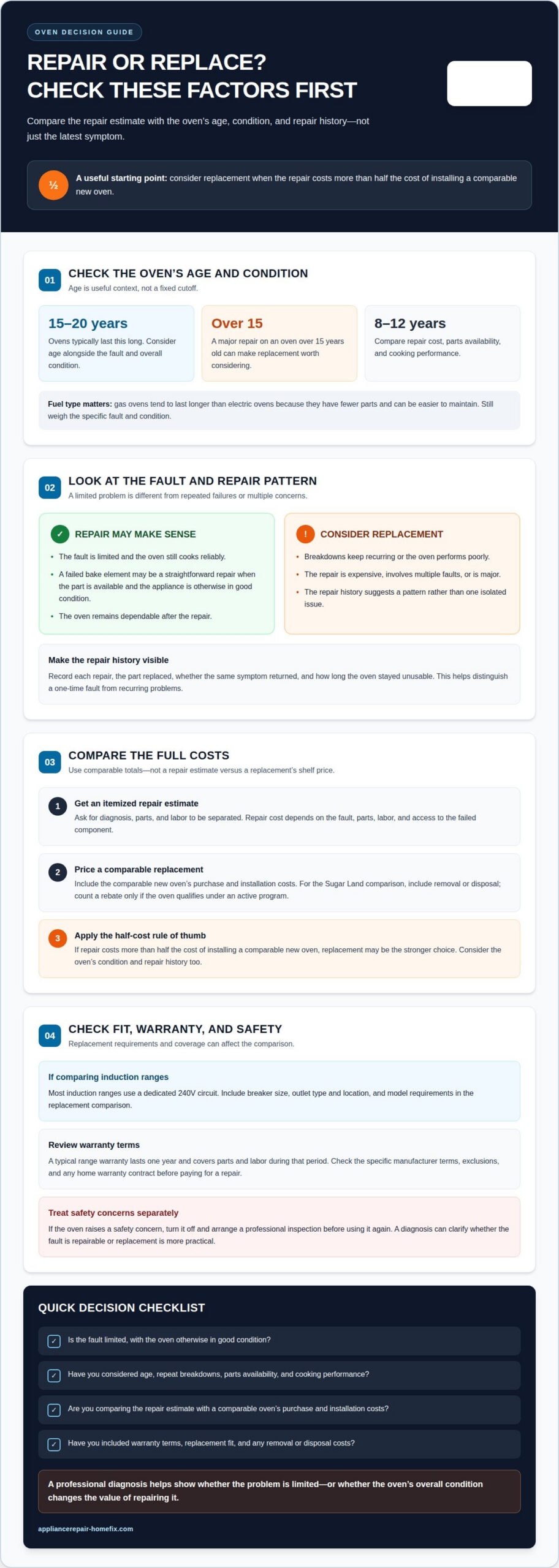
Ovens typically last 15 to 20 years, so use age as context, not as a fixed cutoff. If your oven is 8 to 12 years old, compare repair cost, parts availability, and cooking performance. Those factors help distinguish a fixable problem from an appliance nearing the end of its useful life.
Safety Risks and Professional Inspection
If your oven raises a safety concern, turn it off and arrange a professional inspection before using it again. An inspection can clarify whether the fault is repairable or replacement is more practical. Don’t treat a single symptom as proof that the whole appliance must go.
Use this comparison to organize the main factors before deciding:
| Option | Age and condition | Repair outlook | Replacement considerations |
|---|---|---|---|
| Repair | Relatively newer; otherwise works well | Limited fault, such as a failed bake element | Keep the existing fuel type and setup |
| Replace | Older, recurring failures, or poor performance | Expensive repair or multiple concerns | Compare fuel type, fit, and electrical requirements |
Choose repair when the fault is limited and the oven remains dependable. Consider replacement when its age, recurring problems, and repair scope point the other way.
For a Sugar Land replacement, count a rebate only if the oven qualifies under an active program, and include removal or disposal in the new-oven total. These costs can change the comparison, so weigh them alongside the appliance and installation costs.
For local appliance-repair context, see appliance repair in Sugar Land.
Is it worth it to hire an appliance repair technician?
A technician can diagnose an oven fault, identify the parts involved, and help clarify whether repeated repairs still make sense. For Sugar Land homeowners deciding whether to repair or replace an oven, the fault, repair history, warranty terms, and kitchen downtime all matter.
Frequent Breakdowns and Repair Costs
Recurring breakdowns change the calculation. One repair may resolve a single fault, while several separate failures can mean continuing to pay to restore an oven with other problems. Record each repair, the part replaced, and whether the same symptom returned. That timeline helps distinguish an isolated issue from a pattern.
Oven repair costs depend on the diagnosis, parts, labor, and access to the failed component. Replacing a simple part differs from work involving a control board or multiple faults. Ask for an itemized estimate separating diagnosis, parts, and labor. Compare the total with a comparable new oven’s purchase and installation costs, not its shelf price alone.
Range repair costs also depend on whether the problem affects the oven, cooktop, or shared controls. A broken burner and an oven that won’t heat may involve different parts and labor. A technician’s diagnosis clarifies the repair scope before you decide whether to fix the range or install a replacement.
When choosing an oven technician in Sugar Land, look for licensing and insurance information and verify it with the issuing organization and insurer. Online reviews or a service-area claim alone don’t establish credentials.
Warranty Coverage for Parts and Labor
A typical range warranty lasts one year and covers parts and labor during that period. Manufacturer coverage depends on the warranty terms for your specific appliance, including its coverage period and exclusions. Review those terms before paying for a repair; coverage may affect whether you arrange service through the warranty or pay directly.
Home warranty coverage follows its contract, not the manufacturer’s warranty. Check whether the agreement covers your oven, which faults it includes, and how it handles parts and labor. Compare the written contract with the repair estimate before authorizing work.
For the repair-or-replace decision in Sugar Land, consider the full repair history, not just the latest estimate. Note whether the same issue returned, how long the oven stayed unusable, and whether the proposed work addresses the diagnosed fault. A clear explanation of the repair scope helps you judge whether another repair makes sense or replacement better fits your needs.
Repair cost compared with the cost of a comparable new range
Compare the full repair estimate with the purchase and installation cost of a similar replacement. For Sugar Land homeowners, the 50% rule offers a starting point, but the oven’s condition and the replacement setup also affect the decision.
Repair Costs and New Oven Prices
A repair estimate reflects the diagnosed fault, required parts, and labor. A burner issue, for example, may involve a different scope of work than a failed control panel. Compare the complete estimate with a new oven offering similar capacity and features, rather than using a higher-priced model as your baseline.
That range gives you a practical comparison point, but the right figure depends on the model you’re considering. A technician’s diagnosis can clarify the repair work before you weigh either option.
Replacement Costs and Installation
For a Sugar Land replacement, account for the oven purchase and installation separately. The combined expense depends on your chosen model and installation needs.
Compare like with like. Match a basic replacement with an oven offering similar features; a more advanced model may cost more. Include installation in your total, and consider whether a gas or electric model fits your existing kitchen setup.
The 50% Repair-or-Replace Rule
The 50% rule says to consider replacement when the repair cost exceeds half the cost of installing a new oven. Use the full installation cost in that comparison, not only the replacement model’s price. For example, compare the written repair estimate with half the installed cost of a comparable oven.
This rule is a decision aid, not an automatic verdict. A repair below the threshold may still be poor value if the oven has recurring faults. A higher estimate may deserve consideration when replacement involves a more expensive model. Use the technician’s diagnosis alongside the comparable installed price.
Build the comparison in three steps: select a genuinely comparable new oven, add its installation cost, then compare the repair estimate with that total. These figures are for planning, not a quote for a particular kitchen or model.
Focus the comparison on the cost of restoring the same cooking function. If a repair addresses one fault but another issue remains, account for that separately rather than treating the first estimate as the full repair cost. If replacement requires a different fuel type, include the changed setup instead of comparing appliance prices alone.
DIY repairs versus hiring a professional
DIY checks can help with basic observations, while a technician can diagnose faults requiring appliance-specific testing. The distinction isn’t simply effort versus expense. Consider whether you can identify the cause, complete the repair correctly, and preserve any applicable warranty terms.
Start by gathering information, not disassembling the oven. Note when it fails, which setting you used, and whether the display shows an error. For example, an oven that heats on one setting but not another gives a technician a more useful symptom than “it’s broken.” Record recent changes, such as a power interruption or cleaning cycle.
Basic checks can include confirming the selected cooking mode, setting, and timer. Compare the controls with your oven’s manual. If the display is blank, the oven won’t heat, or the problem returns after you correct the settings, stop guessing at parts. A symptom can have several possible causes, so replacing a component without diagnosis may not solve it.
A technician is useful when diagnosis requires testing internal components or tracing a fault across controls. They can explain which part failed, what repair is proposed, and whether the oven’s condition supports further work. Ask for the diagnosis and estimate before authorizing a repair. That gives you a specific scope to compare with replacement options.
- Gather: the oven’s make and model, the symptom, and when it occurs.
- Review: the manual and warranty terms before attempting work beyond basic controls.
- Compare: the diagnosed repair scope with the oven’s condition and replacement cost.
Warranty terms matter. A manufacturer’s warranty may set conditions for covered repairs, while a home warranty follows its own contract. Read the terms before opening the oven or installing a part yourself. If a washer or another kitchen appliance has a separate fault, treat it as its own diagnosis rather than assuming its symptoms share the oven’s cause.
DIY can make sense when the issue is clearly a setting or a straightforward user-control mistake. Internal faults are different. A technician’s diagnosis can prevent trial and error, such as buying a control part when the actual problem lies elsewhere. Professional help gives you clarity about what failed, what work is needed, and how that work compares with replacing the range.
Make the decision in sequence: document the symptom, review the warranty, and get a diagnosis if the cause remains unclear. Then use the repair scope and oven’s overall condition to choose. This helps prevent a simple control issue from becoming an unnecessary parts purchase and gives complex faults a clearer path forward.
Deciding whether to repair or replace an oven range
Make the decision in order: consider age, identify the failure, then compare the repair estimate with a comparable replacement. For Sugar Land households, these steps help distinguish a manageable fix from an oven that may keep disrupting meals.
Age provides context, not an automatic deadline. An oven typically lasts 15 to 20 years, while an electric or induction range under about 8 years old is often a repair candidate. Between 8 and 12 years, weigh repair costs, parts availability, and cooking performance together. An oven over 15 years old needing more than a small, inexpensive repair may be a stronger replacement candidate.
Next, assess how well the range performs beyond the current failure. If heating is consistent, the controls respond, and the fault is limited, repairing one component may restore dependable cooking. If temperature problems, control issues, and recurring breakdowns appear together, consider the total repair scope. One fault is different from a pattern affecting several functions.
Use the diagnosis to establish what failed and what work would address it. Then compare the estimate with a comparable replacement, including installation. Check whether the required part is available and whether the repair addresses the actual symptom. Fixing a fault in an otherwise sound oven differs from paying for another repair while performance continues to decline.
- Repair is more reasonable: The oven is under about 8 years old, performs fairly well, and has a limited fault.
- Compare carefully: The range is 8 to 12 years old, so weigh parts availability, cooking performance, and the estimate.
- Consider replacement: The oven is over 15 years old and needs more than a small, inexpensive repair.
- Reassess: The same failure returns, or several functions need attention.
For an electric range, a failed bake element may be a straightforward repair when the part is available and the appliance remains in good condition. This example shows why diagnosis matters: one repairable fault doesn’t automatically mean the whole range needs replacing. Gas and induction models have different parts and replacement requirements, so compare like with like.
Before deciding, write down the oven’s age, diagnosed failure, repair scope, and comparable installed replacement cost. Review them together. If one small repair restores reliable heating, repair may make sense. If age, repeated failures, and a major repair all point the same way, replacement may be more practical.
Use this final decision guide: repair when the oven is relatively young, the fault is limited, and performance remains sound. Compare both options closely for a middle-aged range. Consider replacement when an older oven has recurring problems or needs substantial work. A range repair service can diagnose the fault and clarify the repair scope.
HomeFix: Oven Repair
HomeFix repairs ovens for Sugar Land residents dealing with heating problems, failed controls, and other range faults. Turn to a technician when the cause isn’t clear or you need a professional assessment before deciding whether to repair or replace your appliance.
A diagnosis identifies the issue and the work needed. Use that information alongside your oven’s age, condition, and comparable replacement cost to decide. If repair makes sense, HomeFix can address the oven problem. If replacement is more practical, use the estimate to plan your next step.
Contact HomeFix to discuss your oven repair needs.
Choose the Next Step With Confidence
When deciding whether to repair or replace an oven in Sugar Land, focus on what will keep your kitchen dependable over the long term. A clear diagnosis can turn uncertainty into a practical next step, whether you arrange a repair or plan for a replacement. Choose based on the appliance’s condition and how you use it, not pressure to decide before you understand the issue.
HomeFix also repairs refrigerators, washers, and dryers, helping with other essential household appliances when they need attention. If your oven isn’t working properly, professional repair can clarify the problem and the work involved. You can then decide how to proceed with a better understanding of the range’s condition.
Take the next step when you’re ready. Start by understanding what your oven needs.
Frequently Asked Questions
How Long Do Ovens Last?
Ovens typically last 15 to 20 years. Actual lifespan depends on the appliance’s condition and how consistently it performs over time. For example, an oven that heats evenly and holds temperature may remain useful longer than one with recurring problems. Track changes in cooking results, such as meals browning unevenly, to spot declining performance before deciding whether to repair or replace it.
Is it worth fixing a 10-year-old oven?
It can be worth fixing a 10-year-old oven if the fault is limited and the appliance still cooks reliably. At that age, weigh the repair estimate against parts availability and performance. For example, a single component failure differs from a range that also struggles to maintain temperature. Consider whether the repair addresses the specific problem and restores the oven’s everyday function.
What is the average oven repair cost in Sugar Land, TX?
There isn’t one useful average for every oven repair in Sugar Land because the total depends on the fault, parts, and labor involved. A failed heating element and a control problem require different work. The estimate should identify the diagnosis and proposed repair, so you can compare the actual work with your appliance’s condition and the cost of replacing it.
How old is too old to repair an oven, and what is its typical lifespan?
Ovens typically last 15 to 20 years, but age alone doesn’t set a firm repair cutoff. Consider replacement for an oven over 15 years old when it needs more than a small, inexpensive repair. An appliance over 20 years old is also a strong reason to assess replacement. A useful decision depends on both age and the size of the repair.
Do oven repair companies in Sugar Land charge diagnostic or service-call fees?
HomeFix charges a diagnostic fee, which is waived when a repair is performed. The diagnostic visit helps identify the oven’s fault; labor and parts are separate repair considerations. Before approving work, understand what the diagnosis found and which repair it supports. That distinction helps you compare the proposed work with replacement without treating diagnosis and repair as the same service.
How do repair costs compare for gas, electric, and wall ovens?
Repair costs depend on the failed part and the work required, not fuel type alone. Gas and electric models have different components, while a wall oven’s installation and access can affect the work involved. For a fair comparison, use the diagnosis and estimate for your specific model. Compare that repair scope with a replacement of similar type and cooking capacity.