You spent the evening prepping a family meal only to pull a dish out of the oven that is burnt on the outside and raw in the middle. It is a frustrating experience that many neighbors face, but an oven temperature not accurate Houston homeowners often deal with is usually a sign of a specific, fixable mechanical failure. Whether it is a gas igniter losing its strength or an electric element wearing thin, you should not have to guess if your appliance is actually doing its job.
We understand the stress of dealing with undercooked food, high energy bills, and the underlying anxiety of potential electrical shorts. You need a kitchen that operates with steady reliability every time you turn the dial. This guide will help you discover exactly why your oven is failing to hit the right temperature and how to restore perfect results with professional repair insights. We will walk through the most common culprits, from faulty sensors to control board glitches, so you can stop worrying and get back to cooking with total confidence.
Key Takeaways
- Identify common symptoms like uneven browning and long preheat cycles that signal your appliance needs professional attention.
- Pinpoint the mechanical failures causing an oven temperature not accurate Houston homeowners face, from failing sensors to broken heating elements.
- Learn how to use your oven’s built-in calibration settings to adjust temperature offsets by up to 35 degrees for more precise results.
- Determine when to skip the DIY approach and call a certified specialist for complex gas repairs or electronic control board diagnostics.
- Discover how same-day expert service can restore your kitchen’s performance and lower energy costs immediately.
Why Your Oven Temperature is Inaccurate (And How to Test It)
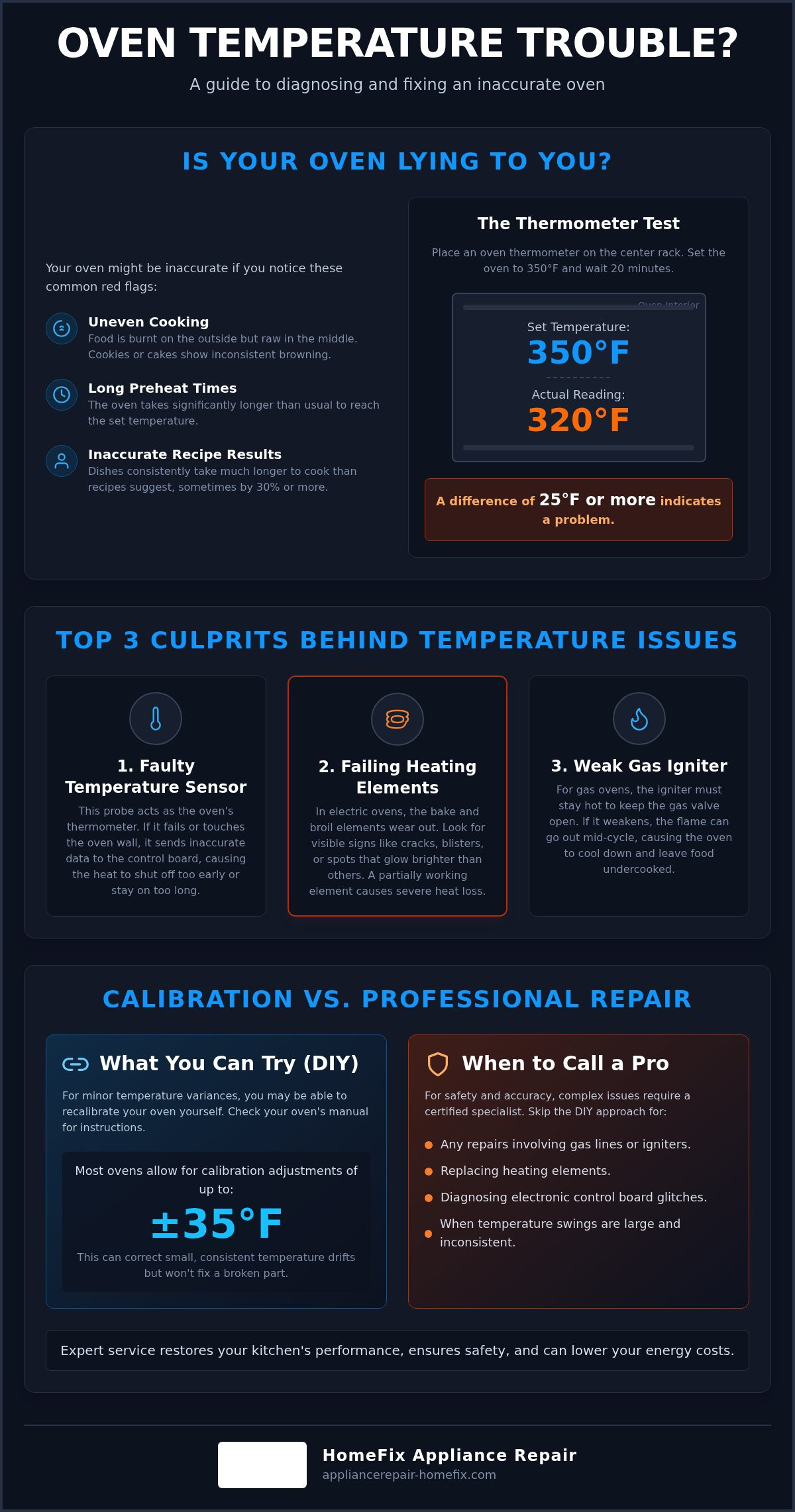
When your oven fails to reach the set temperature, it disrupts your entire kitchen routine. Inaccuracy simply means the internal heat does not align with what you see on the digital display or analog dial. While modern units use digital controls, many homes in the area still use older models where high Houston humidity can occasionally affect the mechanical components of analog thermostats over time. Moisture can lead to slight corrosion or sluggish movement in older sensors, causing the reading to drift. If you find your oven temperature not accurate Houston homeowners should start with a basic diagnostic to find the root cause. Recognizing the symptoms early prevents ruined meals and wasted energy. Common red flags include uneven browning on cookies or a preheating cycle that seems to take forever.
The Oven Thermometer Test
To confirm if your unit is failing, perform a manual check. Buy a standalone oven thermometer and place it in the center of the middle rack. Set your oven to 350°F, which is one of the most common standard oven temperatures for baking. Wait at least 20 minutes for the heat to stabilize. This allows the heating elements to cycle several times for a more accurate average. Look through the oven glass to read the thermometer rather than opening the door. Opening the door releases a massive amount of heat and ruins the test. We define a significant temperature variance as any gap of 25°F or more between the dial and the thermometer reading.
Signs Your Oven is Lying to You
Sometimes the signs are more subtle than a thermometer reading. If your cakes are repeatedly falling in the center, the oven likely isn’t maintaining consistent heat throughout the cycle. You might also notice that large roasts are taking 30% longer than the recipe suggests. These delays often point to a failing igniter or a weak heating element. To check for hot spots, try the “Sugar Test.” Place small piles of sugar on a baking sheet and heat the oven to 375°F. Since sugar melts at a specific point, you can see which piles melt first. This shows you exactly where the heat is uneven. If you find significant issues, you may need a professional range repair to calibrate the system or replace a failing component. Addressing an oven temperature not accurate Houston technicians can diagnose quickly ensures your meals come out perfectly every time.
The Top 3 Culprits Behind Oven Temperature Issues
Most heating failures boil down to a few specific parts. If you find your oven temperature not accurate Houston technicians usually look at the sensor or the heating elements first. While modern appliances have complex circuits, the physical process of creating heat hasn’t changed much. Whether you use gas or electricity, the failure is typically mechanical rather than a mysterious software glitch.
Faulty Temperature Sensors
The sensor probe acts as your oven’s thermometer. It is a thin metal tube usually located in the back corner. As the oven heats up, the electrical resistance within the probe changes. The control board reads this resistance to determine the internal temperature. If the probe fails, it sends the wrong data, causing the oven to shut off too early or stay on too long. A sensor touching the oven wall provides false readings because it picks up the temperature of the metal rather than the air. Keeping the probe clean and clear of the wall is a vital first step in troubleshooting.
Failing Bake and Broil Elements
For electric ranges, the bake and broil elements are the workhorses. Over time, the internal wiring in these elements breaks down. You can often spot a problem just by looking. Check for visible cracks, blisters, or spots that glow brighter than the rest of the element. If an element only heats partially, it leads to significant temperature drops. Professionals use a multimeter to check for continuity, confirming if the electrical path is broken. If your electric unit is struggling, a quick oven repair can swap these out in minutes to restore consistent heat.
Weak Gas Igniters
Gas ovens rely on an igniter to start the flame and keep it going. The igniter must stay hot enough to keep the gas valve open throughout the entire cycle. A weak igniter might have enough power to light the initial flame but lose its strength shortly after. This causes the oven to lose heat mid-cycle, leaving your food undercooked. Before assuming the whole unit is broken, it is helpful to learn how to calibrate an oven to see if a simple software tweak can fix a minor variance. However, a failing igniter is a physical part that requires replacement to ensure safety and performance.
Sometimes the issue lies in the control board itself. This is the brain of the appliance. If the board glitches, it may ignore sensor data entirely. While less common than element failure, board issues require advanced diagnostics to ensure you aren’t replacing parts unnecessarily. If your oven is acting up, reaching out to a local specialist can save you from the headache of ruined dinners.
Calibration vs. Repair: What Can You Fix Yourself?
Not every heat issue requires a technician. If you notice your oven temperature not accurate Houston homeowners can often resolve minor discrepancies through calibration. Modern digital control boards allow you to adjust the factory settings to match your specific cooking environment. This process is designed for units that are consistently off by the same amount every time you use them. If your thermometer shows a different variance every time you bake, calibration won’t help. Fluctuating temperatures usually signal a failing part that needs replacement rather than a simple software tweak.
How to Calibrate Your Oven Control
Most modern ovens feature a hidden menu for temperature offsets. You can typically find this by holding down the ‘Settings’ or ‘Options’ button for several seconds until the display changes. Check your owner’s manual for the specific key combination for your brand. Most manufacturers allow for a 35-degree offset adjustment in either direction. If your earlier thermometer test showed a consistent 15-degree deficit, enter ‘+15’ into the calibration screen. Save your settings and run a second test at 350°F to verify the change. It is helpful to remember that calibration is often a temporary fix for aging sensors. If the variance continues to grow over the next few months, the sensor is likely nearing the end of its life and will eventually fail completely.
Simple DIY Maintenance Tips
Before assuming you need a major range repair, check the basic physical health of the unit. Inspect the door gasket for tears, cracks, or brittle spots. You can perform the ‘dollar bill test’ by closing the door on a bill. If it pulls out easily, your seal is weak. A loose seal allows heat to escape, forcing the oven to work harder and creating cold spots. Clean the sensor probe gently with a damp cloth and mild soap. Heavy grease buildup on the probe can insulate it, leading to incorrect resistance readings. For those with convection models, ensure the fan is spinning freely and is not obstructed by a loose rack or baked-on debris. A blocked fan prevents even heat distribution, making it feel like the temperature is wrong when the air is simply stagnant. If these steps don’t fix the problem, the issue is likely internal and requires professional diagnostic tools.
Oven Repair in Houston: When to Call a Pro
If your calibration attempts failed, the problem is likely a component failure. Gas oven repairs are particularly sensitive. You should never handle gas valves or igniter assemblies without professional certification. Electrical work on hardwired units in Texas also requires specific expertise to ensure safety and insurance compliance. If you are dealing with an oven temperature not accurate Houston specialists can perform advanced diagnostics that go beyond basic troubleshooting. We focus on getting it right the first time so you don’t face repeated service calls. Our technicians are certified for both gas and electric units, ensuring your home remains safe throughout the process.
The Repair vs. Replace Dilemma
Homeowners often struggle with whether to invest in an old appliance. Use the “50% Rule” as your guide. If the quote for a repair is more than half the cost of a brand-new unit, it is time to go shopping. Most standard ovens in Texas homes have a functional lifespan of 10 to 15 years. This range varies based on how often you use the self-cleaning cycle, which can be hard on internal sensors. Premium brands like Wolf, Viking, or Thermador are exceptions to this rule. These professional-grade machines are engineered for decades of service and are almost always worth repairing. You can find more specific advice on making this choice in our article on Oven Repair Houston.
Why Local Expertise Matters in Katy and West Houston
Our technicians are stationed throughout the metro area for rapid deployment. Whether you are in Katy, Memorial, or Sugar Land, we prioritize proximity to reduce wait times. Local expertise is about more than just driving distance. Houston’s climate and aging power grid create unique challenges for kitchen appliances. Frequent power surges in West Houston can easily damage sensitive digital control boards. We understand these local patterns and carry specialized diagnostic tools to test these boards. Because we keep high-demand OEM parts on our trucks, we can resolve an oven temperature not accurate Houston issue during the first visit. This preparation allows us to offer same-day or next-day service for most calls.
Schedule Your Oven Repair Today
Fast Temperature Restoration with HomeFix Appliance Repair
When you discover your oven temperature not accurate Houston families need a partner who values their time. HomeFix provides rapid response times with same-day and next-day service across Katy, Memorial, and Sugar Land. We don’t believe in leaving you with a cold oven for days. Our technicians are fully certified for both gas and electric ranges, ensuring every repair meets strict safety standards. We arrive prepared to handle everything from simple sensor swaps to complex igniter replacements during the first visit.
Consistency is the hallmark of a professional repair. We exclusively use high-quality OEM parts to ensure lasting accuracy for your appliance. Generic components often lack the precision needed for modern digital controls, which can lead to recurring heat fluctuations. By using original equipment, we restore your oven to its factory specifications. Every job we perform includes a 3-month labor warranty and a 1-year parts warranty. This gives you peace of mind that your investment is protected long after we leave your home.
Our Diagnostic and Pricing Model
We eliminate the guesswork from appliance service with a clear, transparent pricing structure. Our standard diagnostic fee is $89 to pinpoint the mechanical or electrical failure. If you move forward with the repair, we reduce this fee to $69 and apply it directly to your labor costs. You’ll always receive a detailed written estimate before we start any work. This document outlines the parts needed and the labor involved, ensuring there are no hidden fees or surprises. Our goal is to provide a no-nonsense service that respects both your budget and your schedule.
Expert Care for All Major Brands
Our team undergoes regular training to stay current on the latest kitchen technology. We offer expert care for all major brands, including Samsung, LG, GE, and Whirlpool. For homeowners with premium appliances, we provide specialized KitchenAid Repair Houston services, as well as support for JennAir, Bosch, and Thermador. We understand the unique heating patterns and control board logic of these high-end machines. Schedule your 3-hour arrival window online today to get your kitchen back to peak performance. We arrive on time and ready to work.
Restore Your Kitchen’s Performance Today
Stop guessing if your dinner is cooked properly. Testing your unit with a standalone thermometer confirms the variance, while checking for physical damage to elements or sensors reveals the mechanical root of the problem. Calibration offers a quick fix for minor drifts. However, persistent heat fluctuations usually require a professional diagnostic to ensure long-term safety and energy efficiency in your home.
Dealing with an oven temperature not accurate Houston homeowners face shouldn’t be a source of daily stress. We provide same-day service across Katy and West Houston with technicians certified for both gas and electric ranges. Our $89 diagnostic fee is applied directly to your repair cost if you choose to fix it with us, ensuring you get transparent value from the start.
Schedule Your Oven Diagnostic in Houston Now
You deserve a kitchen that operates with steady reliability every time you turn the dial. Let us handle the technical details so you can get back to enjoying perfectly cooked meals with your family today.
Frequently Asked Questions
In the meantime, if you’d rather skip the cooking hassle entirely, you can enjoy a fresh meal at The Catch, a local favorite for Cajun seafood in Houston.
How do I know if my oven sensor is bad?
A bad sensor often triggers an error code on your digital display. You can also test it with a multimeter to check for proper electrical resistance at room temperature. If the probe is covered in heavy grease or touching the back wall, it will provide a false reading. Replacing a faulty sensor is a common fix for an oven temperature not accurate Houston technicians handle during a standard service call.
Is it worth repairing an 8-year-old oven in Houston?
An 8-year-old oven is usually worth repairing. Most residential units last between 10 and 15 years in Texas homes. If the repair quote is less than half the price of a new appliance, fixing it is the practical choice. Premium brands like Wolf or Viking are engineered for much longer lifespans. These professional-grade models are almost always worth the investment of a component replacement rather than a full unit replacement.
Why does my oven take so long to preheat?
Slow preheating usually points to a failing bake or broil element in electric models. If one element burns out, the other must work twice as hard to reach the target heat. In gas units, a weak igniter takes longer to open the gas valve. You should also check the door gasket for tears. A leaky seal allows heat to escape into your kitchen, significantly extending the time needed to reach 350 degrees.
Can a bad igniter cause inaccurate oven temperatures?
A weak igniter is a frequent cause of heat loss in gas appliances. The igniter must stay hot enough to keep the gas valve open throughout the baking cycle. If it loses strength, the burner may light once but fail to reignite when the temperature drops. This results in an oven that starts hot but finishes cold, leading to undercooked meals and inconsistent baking results for your family.
How much does it cost to fix an oven that isn’t heating correctly in Houston?
The total cost depends on which part failed, such as a sensor or a control board. We charge an $89 diagnostic fee to find the exact problem. If you choose to complete the repair with us, we reduce that fee to $69 and apply it to your labor costs. This transparent pricing ensures you know the final amount before we begin working on your gas or electric unit.
Does HomeFix provide same-day oven repair in Katy?
We provide same-day or next-day appointments in Katy and surrounding neighborhoods. Our technicians are stationed throughout the metro area to ensure a fast response when your kitchen routine is disrupted. We offer convenient 3-hour arrival windows so you aren’t waiting all day. Our team arrives with common OEM parts to resolve most heating issues during the very first visit to your home.
Can I still use my oven if the temperature is slightly off?
Using an oven with a slight variance is possible but risky for food safety. An oven temperature not accurate Houston residents experience can prevent meats from reaching the necessary internal temperatures to kill bacteria. It also leads to uneven browning and collapsed baked goods. It is safer to use a standalone thermometer to track the variance or call a professional to recalibrate the system for more reliable cooking results.
What brands of ovens does HomeFix repair?
We repair all major residential brands, including Samsung, LG, Whirlpool, and GE. Our technicians also have specialized training for premium professional lines like Viking, Wolf, Sub-Zero, and Thermador. Whether you have a standard freestanding range or a high-end double wall oven, we use genuine OEM parts to ensure a perfect fit. We are fully certified to handle both gas and electric models from every major manufacturer.