

What if your dryer isn’t actually broken, but just suffocating in the Houston humidity? It’s a common issue for local homeowners. You’re likely staring at a growing pile of wet laundry and wondering why your machine is spinning but staying cold. Dealing with a dryer not heating Houston situation is stressful. You want dry clothes in one cycle, not a wasted afternoon and a high utility bill.
You’ve probably worried about the cost of a new machine or the safety of your gas line. We understand that your time is valuable. This guide helps you identify the root cause of the heat loss and explains when you can fix it yourself. You’ll learn how to restore your laundry routine and find a local Katy or Houston technician who offers transparent diagnostics and same-day availability.
We’ll walk through five simple DIY checks that often solve the problem. We also provide a look at common mechanical failures like thermal fuses or heating elements. By the end, you’ll know if you need a quick vent cleaning or a professional repair to get your home back on track.
Key Takeaways
- Learn how to troubleshoot a dryer not heating Houston by checking for airflow restrictions caused by local humidity and lint buildup.
- Discover five simple DIY steps, such as inspecting the exterior vent flap, that could save you from an unnecessary service call.
- Understand why a blown thermal fuse is often a symptom of a deeper ventilation problem rather than just a part failure.
- Identify the specific signs of gas valve or igniter failure to determine if your gas dryer requires professional intervention.
- Find out how to access same-day dryer repair in Katy or Houston with a transparent diagnostic fee that applies toward your final bill.
Why Your Dryer Is Not Heating: Common Houston Causes
A dryer “not heating” means the drum is spinning and the timer is ticking, but your clothes remain damp and cold. It’s a frustrating situation that stalls your household routine. In our experience, a dryer not heating Houston service call often traces back to environmental factors as much as mechanical ones. While a broken part is possible, the local climate plays a major role in how these machines fail. Understanding the root cause helps you decide whether to grab a screwdriver or call for professional help.
The Impact of Houston Humidity on Dryer Vents
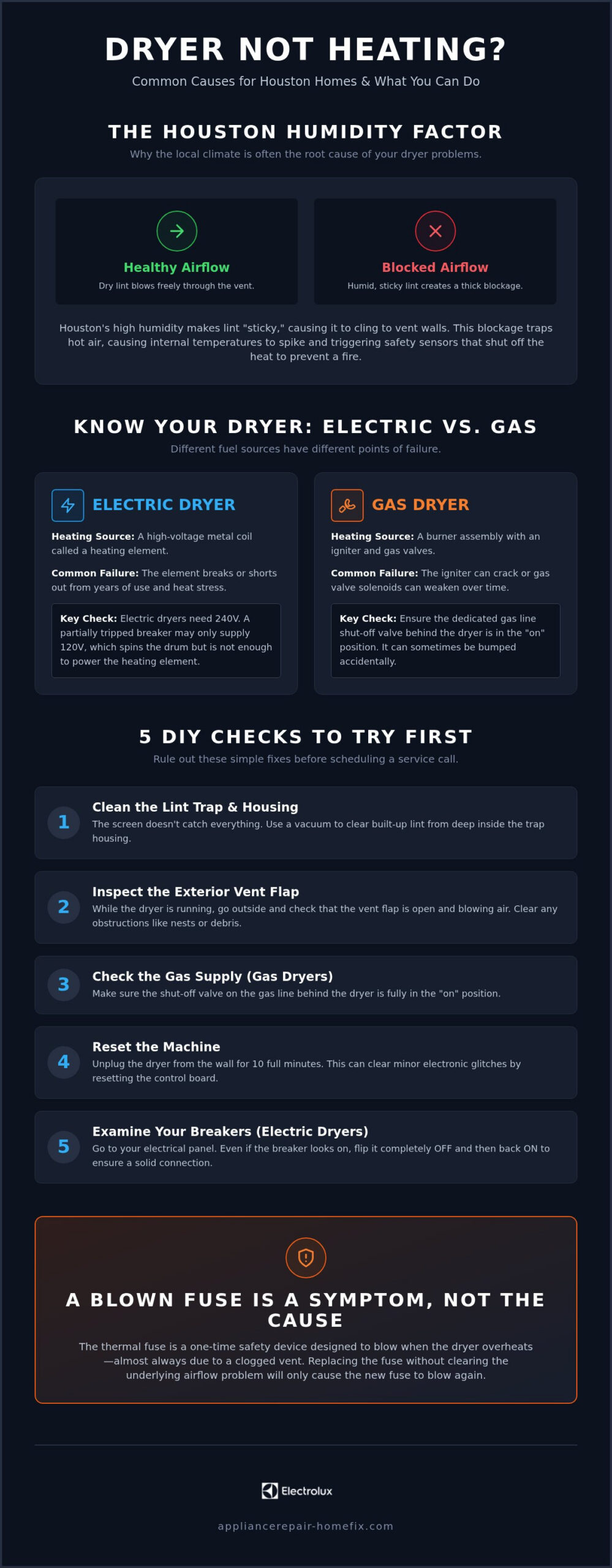
Houston’s high humidity creates a unique challenge for laundry systems. Moist air makes lint “sticky.” Instead of blowing freely through the vent to the outside, damp lint clings to the walls of the ductwork. Over time, this creates a thick, felt-like barrier. This restricted airflow is the primary cause of heating failure in Southeast Texas. When air cannot escape, the internal temperature spikes. This forces the dryer to work harder, eventually triggering safety sensors that shut down the heat to prevent a fire. If your dryer takes two or three cycles to dry a single load, your vent likely needs a professional cleaning rather than a mechanical overhaul.
Electric vs. Gas Dryer Heat Mechanics
Understanding how a clothes dryer works is the first step in troubleshooting. You must first identify your fuel source. Electric dryers use a high-voltage heating element. This is essentially a large metal coil that glows red hot when electricity passes through it. Gas dryers rely on a burner assembly. This includes an igniter that glows to light the gas and valve coils that control the flow of fuel. Both systems are highly efficient but have different failure points.
Regardless of the fuel source, both types rely on a thermal fuse. This is a one-time safety device designed to “trip” or blow if the unit gets too hot. Once it blows, the dryer will no longer heat until the fuse is replaced and the underlying airflow issue is resolved. If you are unsure which type you have, look at the power cord. Electric units use a thick, three or four-prong plug. Gas units have a standard thin cord and a dedicated gas line. If you need assistance identifying the fault, a professional dryer repair near me can quickly diagnose the specific component failure.
Component wear is the final piece of the puzzle. Heating elements in electric units eventually break or short out from years of expansion and contraction. In gas units, igniters can crack or gas valve solenoids can weaken. In Houston, this wear and tear is often accelerated by the extra strain of clogged vents. Identifying these issues early can prevent more costly repairs down the road.
5 DIY Checks for a Dryer That Won’t Get Hot
Before you assume the worst about your appliance, try these five simple checks. Many dryer not heating Houston issues are actually external to the machine itself. You can often save time and money by performing a quick inspection of your home’s utilities and venting. Start with these basic steps to rule out simple fixes.
- Clean the lint screen and housing: Use a vacuum attachment to reach deep into the lint trap area. A screen alone cannot catch every fiber.
- Inspect the exterior vent flap: Walk outside while the dryer is running. The flap should be open and blowing air. If it’s stuck or blocked by a bird’s nest, the heat will back up.
- Check the gas supply: For gas units, ensure the shut-off valve behind the dryer is in the “on” position. Sometimes these valves get bumped during cleaning.
- Reset the machine: Unplug the dryer for 10 full minutes. This clears the control board and can reset minor electronic glitches.
- Examine your breakers: This is a frequent culprit for electric units that seem to work but stay cold.
Testing Your Power Supply and Breakers
Electric dryers are unique because they require 240 volts of electricity to operate properly. A standard dryer circuit uses a double-pole breaker, which consists of two switches tied together. If only one side of that breaker trips, your dryer will still receive 120 volts. This is enough power to spin the drum and light up the control panel, but it isn’t enough to power the heating element. You might think the dryer is working because it’s tumbling, but the heat will never kick in.
To fix this, find your electrical panel and locate the dryer breaker. Even if it looks like it’s in the “on” position, flip it completely to “off” and then back to “on.” Look for warning signs like scorched plastic around the outlet or a power cord that feels hot to the touch. If you see physical damage, stop immediately and contact a professional for dryer repair in Houston.
Clearing Airflow Obstructions Safely
Restricted airflow is a silent killer for dryer components. Start by pulling the machine away from the wall and disconnecting the flexible vent hose. Look inside the hose and the wall duct for lint slugs. A lint slug is a dense mass of wet lint blocking airflow. These often form in the bends of the ductwork where moisture collects, especially in our humid climate. Use a brush or a vacuum to pull these blockages out. If the vent hose is crushed or kinked, replace it with a rigid metal duct to ensure the air can move freely.
If your basic checks didn’t solve the problem, the issue is likely internal. The most frequent internal failure for a dryer not heating Houston is a blown thermal fuse. This small, plastic-housed component acts as a vital safety guard. It is designed to permanently break the electrical circuit if the dryer’s internal temperature exceeds a safe limit. This prevents the lint inside the machine from igniting and causing a house fire.
Replacing the fuse is straightforward, but doing so without fixing the root cause is a waste of time. Fuses rarely fail on their own. They blow because the airflow is restricted. If you install a new fuse but leave a clogged vent in place, the new part will likely fail during the very first load. Always clear your ductwork before you consider the repair complete. This is a common mistake we see in Katy and Houston homes where high humidity makes lint particularly stubborn.
Signs of a Blown Thermal Fuse
A blown fuse has very specific symptoms. The dryer will usually tumble and spin exactly as it should, but the air remains at room temperature. You might remember the exterior of the dryer feeling unusually hot during the previous cycle. Because of our local climate, lint buildup happens faster here than in drier regions. This makes thermal fuse failure the #1 mechanical repair for Houston homeowners who find their laundry staying wet.
Testing the Heating Element (Electric Units)
If you have an electric unit, the heating element is the next suspect. This component is a large metal coil that generates heat through electrical resistance. Over years of constant use, these coils expand and contract until they eventually snap. Safety is your first priority. Always unplug the dryer and turn off the breaker before you open the back panel or cabinet.
Perform a visual inspection once the element is accessible. Look for any visible breaks in the wire or dark, scorched spots on the metal housing. Sometimes the coil sags and touches the metal frame, which causes a “grounded” element that may heat partially or stay on constantly. If you are uncomfortable opening the cabinet or don’t have the right tools, contact a professional for dryer repair near me. A technician will use a multimeter to test for continuity. This tool confirms whether electricity can still flow through the part. If there is no continuity, the component is dead and must be replaced.
Gas Dryer Heating Issues: Safety and Solutions
Gas dryers are more complex than electric models. They rely on a precise ignition sequence to create heat. If any step in this chain fails, your machine will tumble but stay cold. While electric units often have a “total failure” where the coil snaps, gas units can fail intermittently. This makes a dryer not heating Houston diagnostic slightly more technical for gas-powered homes.
Safety is the most important factor. If you smell a “rotten egg” scent, shut off the gas valve immediately and open your windows. Gas leaks and carbon monoxide buildup are serious risks. Never attempt to bypass safety sensors or tamper with gas lines without proper certification. Our team is trained to handle these components safely while restoring your appliance to full function.
Troubleshooting Gas Valve Coils
A common symptom of gas valve failure is a dryer that starts hot but turns cold halfway through the cycle. This usually happens because the gas valve solenoids are worn out. These small electromagnetic coils pull the gas valve open. When they weaken, they might work for the first few minutes of a load. As the coils get hot during operation, they lose their ability to hold the valve open. The flame goes out, and the rest of the cycle runs on room-temperature air. This specific repair requires professional gas dryer repair Houston expertise to ensure the new components are seated and sealed correctly.
Igniter and Flame Sensor Failures
You can often diagnose a gas dryer by looking through the small inspection port at the bottom of the front panel. When you start a cycle, you should see a bright orange glow. This is the igniter. If you see no glow at all, the igniter is likely cracked or burned out.
But a glowing igniter doesn’t always mean the burner will light. If the igniter glows but then clicks off without a flame appearing, the flame sensor or the gas valve is likely at fault. The sensor tells the machine it’s safe to release gas. If it’s dirty or faulty, the system stays shut down for safety. If you’ve checked your gas supply and the igniter is glowing but you still have no heat, it’s time to stop DIY efforts. Certified technicians have the tools to test these electrical signals safely.
Book Professional Gas Dryer Repair Now
Professional Dryer Repair in Houston and Katy
When DIY checks don’t solve the problem, you need a professional partner who understands local conditions. HomeFix offers fast, reliable solutions for any dryer not heating Houston emergency. We understand that a broken dryer stops your entire household routine. That’s why we prioritize same-day and next-day service availability for residents across the region. Our certified technicians are equipped to handle the most complex gas and electric failures on the first visit. We arrive in fully stocked vans to ensure we can complete your repair without unnecessary delays.
Why Choose HomeFix for Your Dryer Repair?
We value your time and your budget. We provide 3-hour arrival windows so you can plan your day with confidence. You won’t be stuck at home waiting for a technician who never shows up. Once on-site, we perform a complete diagnostic to find the root cause of the heat loss. We charge an $89 diagnostic fee, but we apply that full amount toward your repair cost if you choose to move forward. This ensures you receive a professional evaluation without paying extra for the visit itself. We provide a clear, written estimate before any tools touch your machine. This transparency removes the fear of hidden costs or surprise bills.
Our Houston Service Area and Brand Expertise
Our reach extends throughout the Greater Houston area. We provide dedicated service to homeowners in Katy, Memorial, and Cypress. We also have technicians ready to assist in Sugar Land, Pearland, and Cinco Ranch. Our team maintains specialized training for the industry’s top brands. We offer expert Whirlpool and LG appliance support, along with Samsung, Maytag, and Kenmore. Whether it’s a high-tech smart unit or a traditional heavy-duty model, we have the parts and knowledge to fix it. We stand behind our labor and offer a 1-year warranty on most parts. This commitment to quality ensures your dryer not heating Houston issue is solved for the long term, giving you peace of mind and a restored laundry routine.
Restore Your Laundry Routine Today
A cold dryer doesn’t have to ruin your week. You now know that Houston’s humidity and sticky lint often cause airflow blockages that trigger safety fuses. Whether you’ve cleared a lint slug or checked your breakers, you’ve taken the right first steps. If your DIY efforts didn’t solve your dryer not heating Houston problem, don’t let the laundry pile up. Identifying the difference between a simple vent clog and a failed heating element is the key to a lasting fix.
Our team is ready to help you get back to normal. We offer same-day service and 3-hour arrival windows to fit your schedule. Our $89 diagnostic fee is applied directly toward your repair cost, so you only pay for the solution. We also provide a 1-year warranty on most parts to ensure your appliance stays reliable for the long haul.
Schedule Your Houston Dryer Repair Now
Don’t settle for multiple drying cycles or damp clothes. Professional help is just a click away. We’ll have your dryer running hot again before the next load is ready.
Frequently Asked Questions
Why is my dryer running but not getting hot?
Your dryer likely has a failed heating component or a tripped safety sensor. For electric units, the heating element coil often snaps after years of use. For gas units, the igniter or gas valve coils are the most common culprits. A blown thermal fuse will also stop all heat production while still allowing the drum to spin.
How much does it cost to fix a dryer that’s not heating in Houston?
Total repair costs depend on the specific part that failed and the brand of your appliance. A thermal fuse is generally the most affordable fix, while replacing a gas valve assembly or an electric heating element involves higher part costs. We provide a transparent diagnostic for a dryer not heating Houston and apply our $89 service fee toward the final repair bill.
Is it safe to use a dryer that isn’t heating?
It’s not safe to continue running a dryer that has lost its heat. The lack of heat is often a symptom of a major airflow restriction or an electrical short. Continuing to use the machine can lead to motor burnout. In some cases, it can even lead to a house fire if the venting is clogged with lint.
Can a clogged vent cause my dryer to stop heating?
Yes, a clogged vent is the leading reason dryers stop heating in our humid climate. When lint blocks the exhaust, the dryer cannot breathe. This causes the internal temperature to spike. The machine then intentionally trips the thermal fuse to prevent the unit from overheating and catching fire. This is a common dryer not heating Houston issue.
How do I know if my dryer thermal fuse is blown?
The most telling sign is a dryer that tumbles normally but stays completely cold. You won’t feel any warmth on the door glass or the clothes after a few minutes of operation. To be certain, a technician uses a multimeter to check the fuse for continuity. If there’s no electrical path through the fuse, the part is dead.
Is it worth repairing a 10-year-old dryer?
We recommend using the 50% rule for older appliances. If the repair cost is more than half the price of a new, comparable dryer, replacement is usually the better financial choice. However, many high-quality dryers can last 15 years or more with proper maintenance. A simple part replacement can often add several years to its life.
Do you offer same-day dryer repair in Katy or Sugar Land?
Yes, we offer same-day and next-day service appointments throughout Katy, Sugar Land, and Cypress. We maintain a local team of technicians to ensure we can respond quickly to urgent laundry needs. We also provide 3-hour arrival windows so you don’t have to wait at home all day for help.
What is the difference between an electric and gas dryer repair?
Electric repairs focus on high-voltage circuits and heating coils that use resistance to create warmth. Gas repairs involve burner tubes, igniters, and gas valves. Gas units require extra care to ensure there are no fuel leaks. The exhaust system must also be clear to prevent carbon monoxide from entering your home.


