

The Silent Killer Inside Your Scotsman Ice Machine: Why the SCN60 Graphite Bearing Fails — and What Houston Owners Must Do About It
If you own a Scotsman SCN60 nugget ice maker, read this before it’s too late. Over years of performing Scotsman ice machine repair in Houston, I’ve seen the same story repeat itself: a customer calls, says the machine “makes a weird sound” or “isn’t making enough ice,” and by the time we open it up, the damage is already done. What could have been a $250–$350 preventive maintenance visit turns into a $1100–$1800 repair — or worse, a brand-new machine purchase.
Today I walk you through exactly what happens inside a neglected Scotsman SCN60. I’ll show you real photos from an actual repair job, explain why Scotsman redesigned the bearing in the newer SRN110, and make the case for why proactive maintenance is the single most important thing you can do for your ice machine.
The Machine That Made Chewable Ice Famous
The Scotsman SCN60 Brilliance® nugget ice machine became a staple in thousands of Houston homes, bars, restaurants, and medical offices. It produces that soft, chewable nugget ice — the kind Sonic Drive-In made famous — using a compact auger-based system. Water freezes on the inside of a cylindrical evaporator. A stainless steel auger scrapes the ice off. Then the flakes compress and extrude as nuggets through the top breaker assembly.
It’s an elegant, almost industrial design packed into a 15-inch undercounter cabinet. But it carries a hidden vulnerability. Scotsman eventually acknowledged this by redesigning the bearing system in the successor model, the SRN110.
The Achilles’ Heel of the SCN60: The Graphite Sleeve Bearing
The auger shaft runs through the bottom of the evaporator and connects to the gearmotor below. To support and center that shaft, Scotsman used a graphite sleeve bearing (part #02-4619-01) — a short cylinder of compressed graphite pressed into a brass housing.
Graphite is self-lubricating. That sounds great in theory. But in a wet, mineral-rich environment like the inside of an ice machine evaporator, this bearing wears faster than expected — especially when maintenance intervals are missed.
How Bearing Wear Starts a Chain Reaction
As the bearing wears, the auger shaft begins to wobble. That wobble creates metal-on-metal contact between the stainless steel auger and the evaporator wall. Once that contact starts, it triggers a chain reaction of damage:
- The auger scratches the precision-rifled interior of the evaporator.
- The ceramic water seal cracks from the side-loading forces on the shaft.
- Water leaks from the evaporator into the gearmotor housing below.
- Gear oil becomes contaminated with water — and the motor fails.
A Story I’ve Seen Too Many Times in Houston
Let me tell you about a recent call. A homeowner contacted us saying her Scotsman SCN60 “needed a cleaning.” She had owned the machine about five or six years. She never scheduled professional service. Every now and then she pressed the CLEAN button or rinsed it with water — but no technician ever opened it up.
What We Found When We Opened the Machine
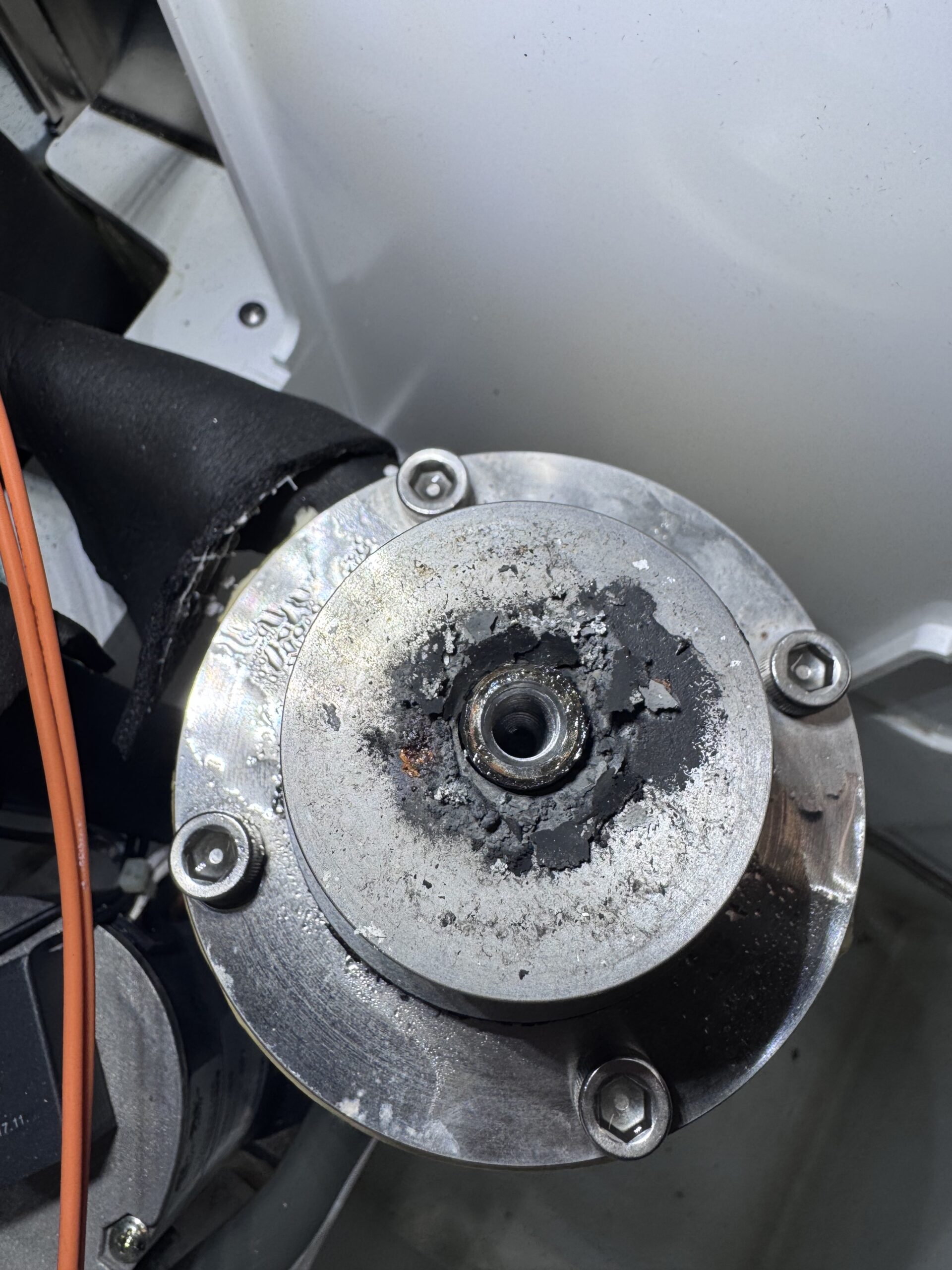
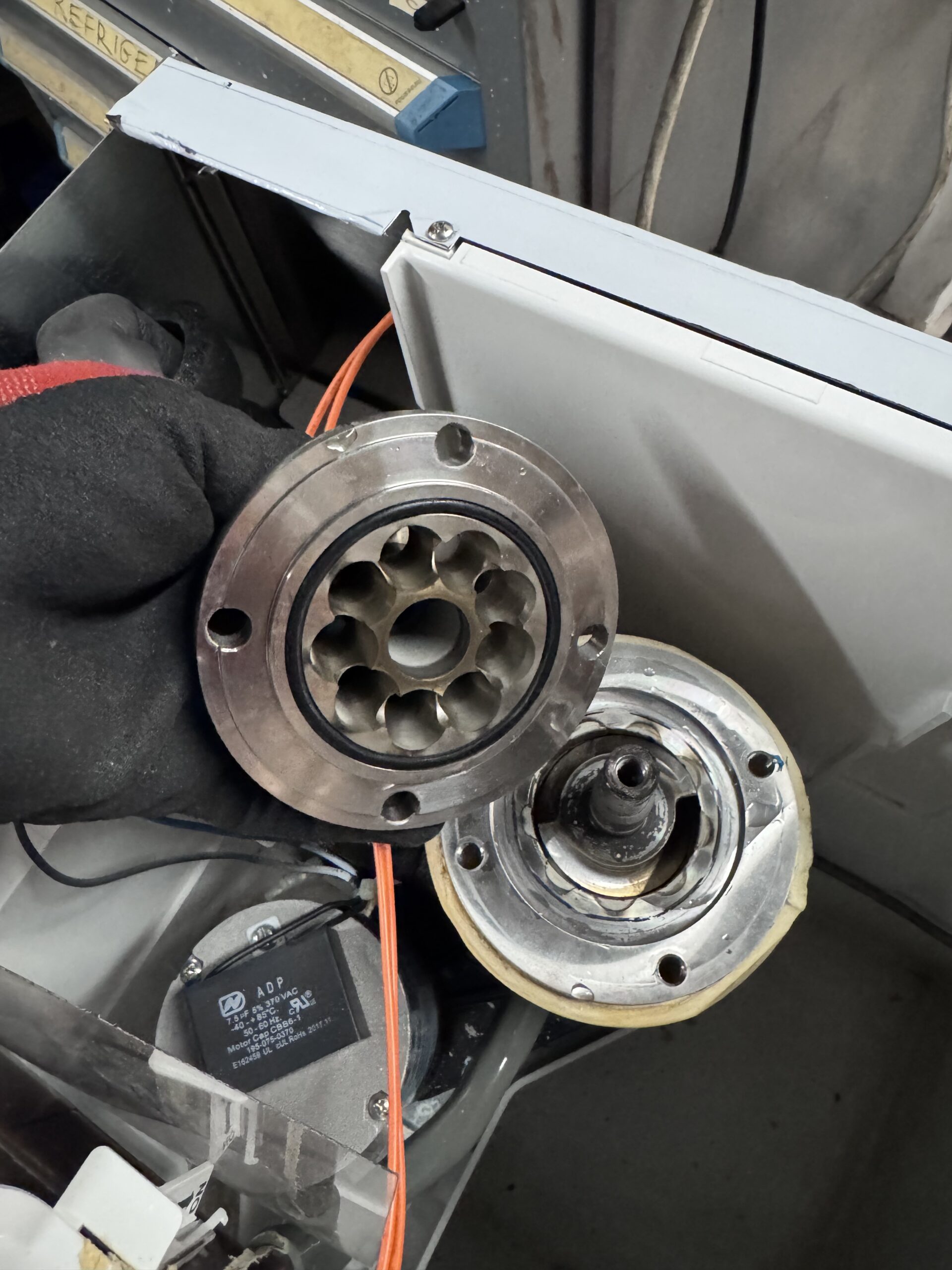
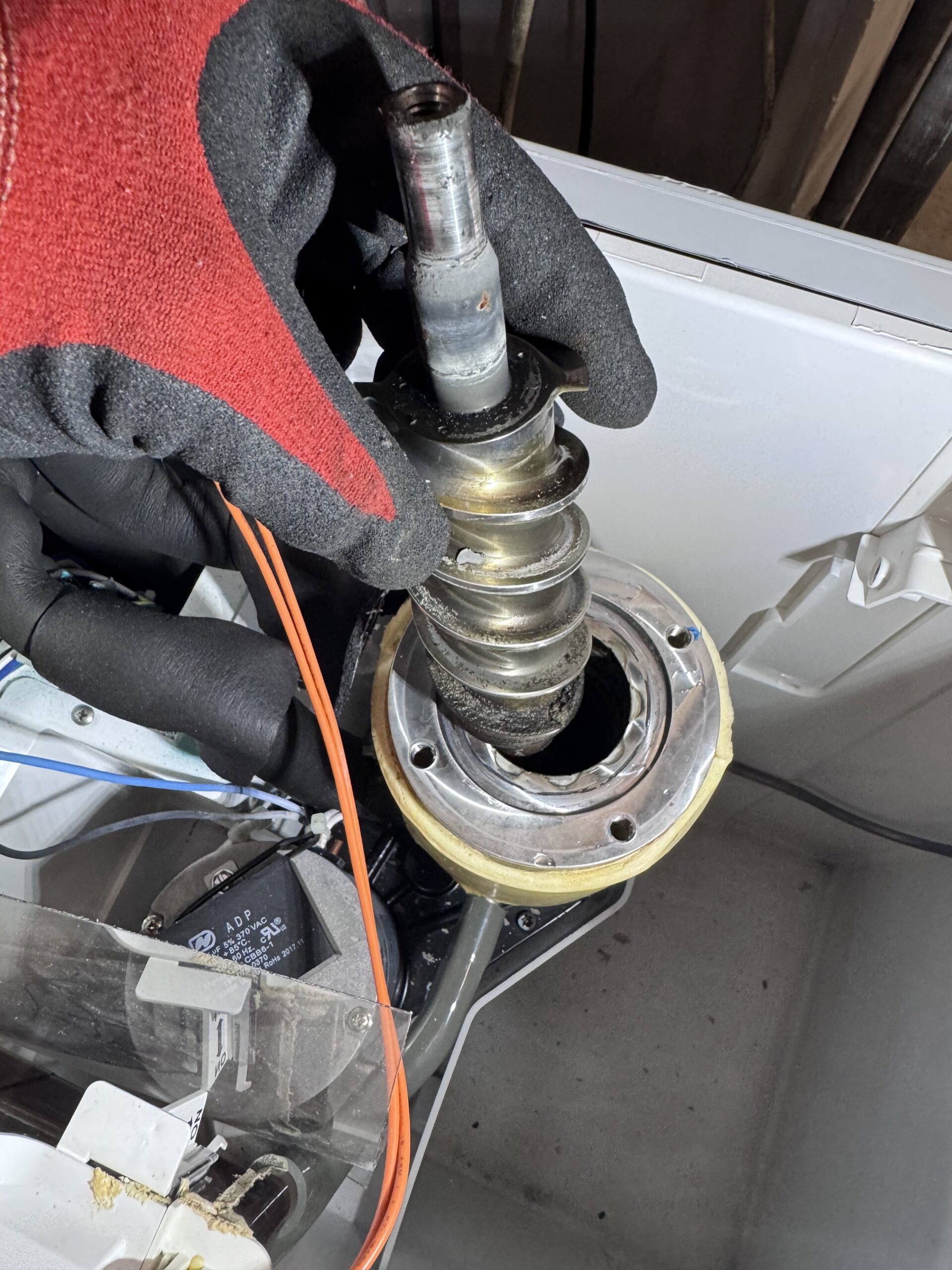
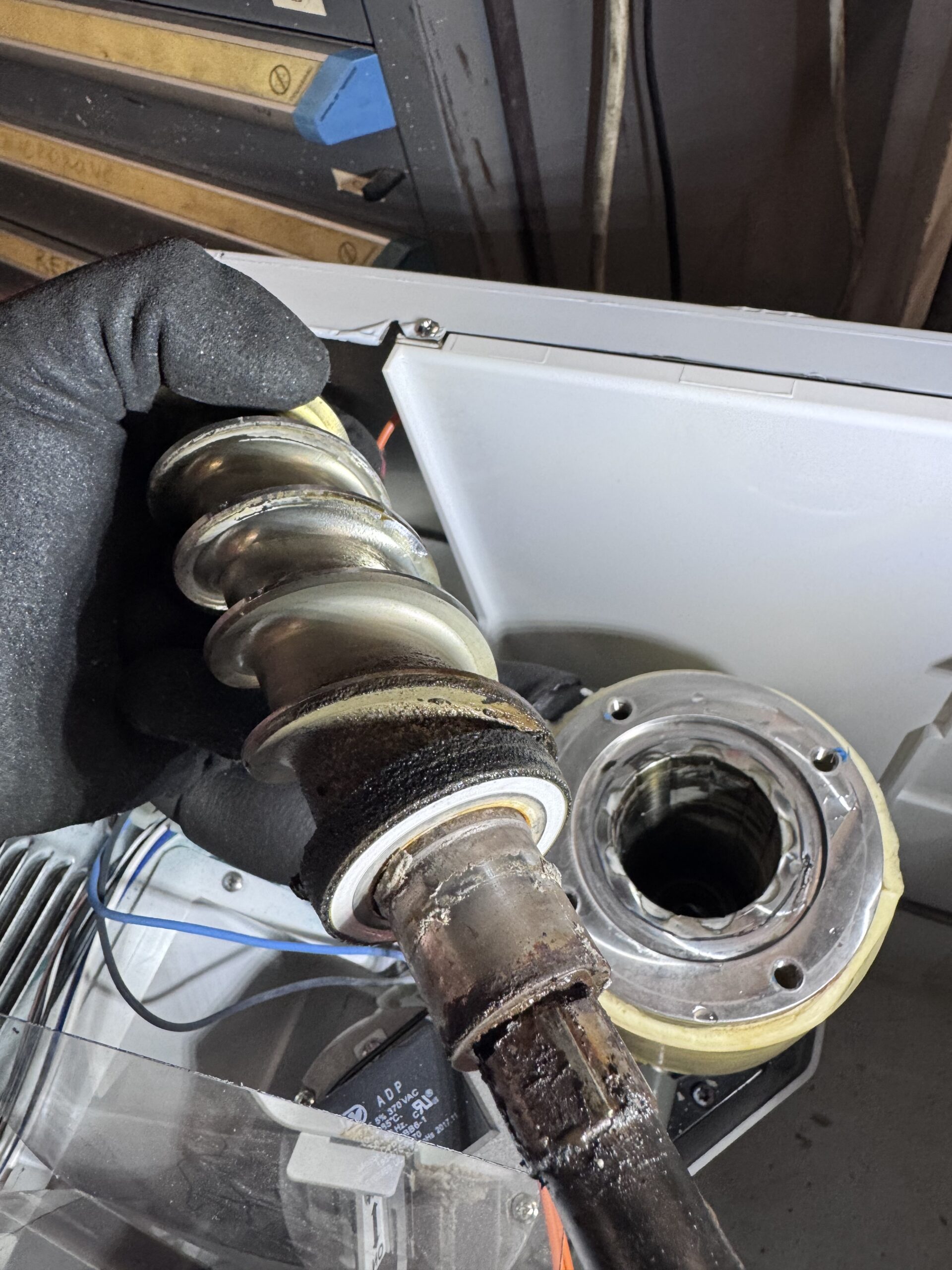
The graphite bearing was disintegrated — just black powder and metal fragments around the shaft. We pulled the auger out and found deep scratches along its entire length.
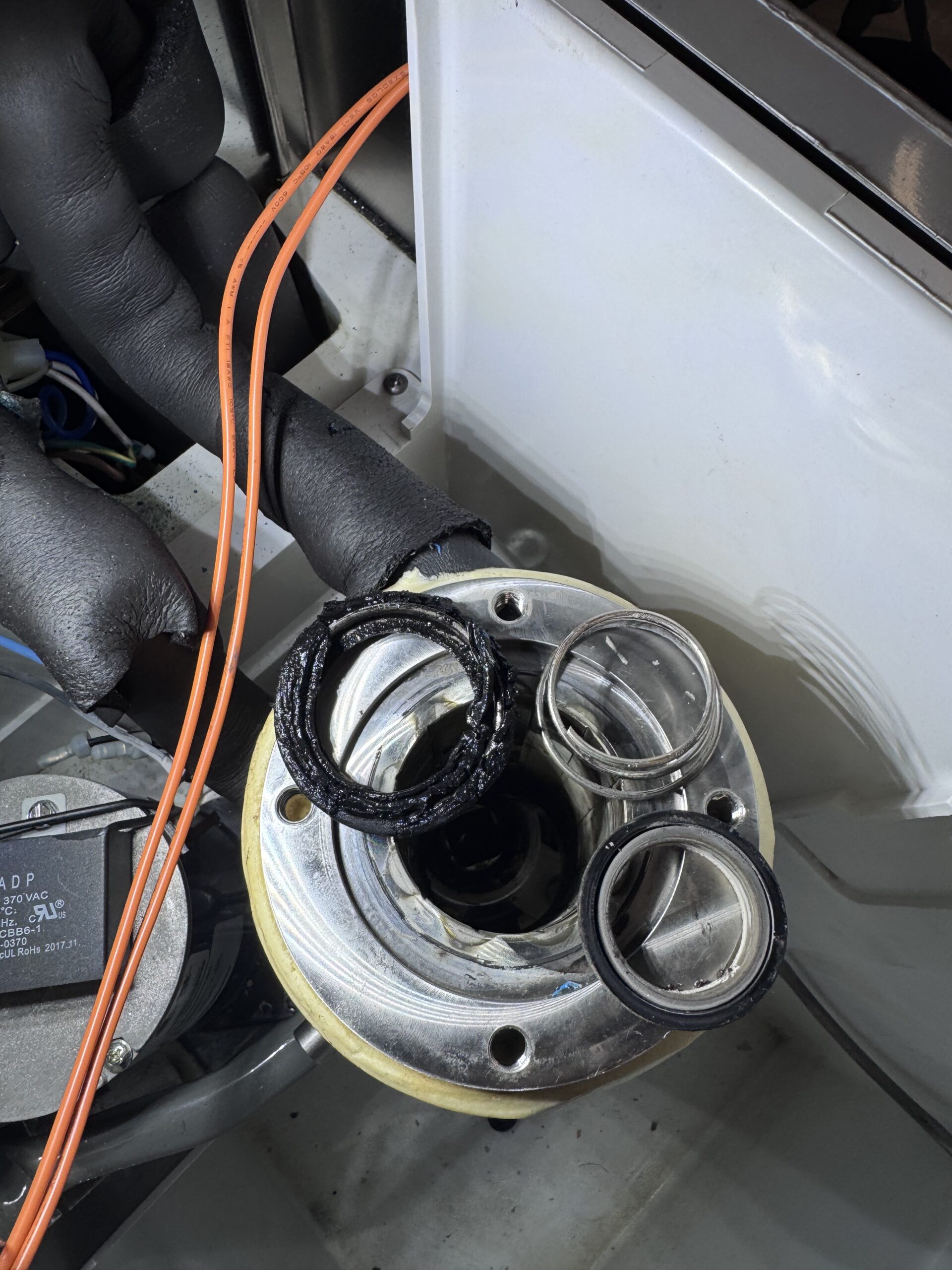
But the worst part was at the bottom. The ceramic water shaft seal (part #02-4599-21) had completely disintegrated. This two-piece mechanical seal keeps water inside the evaporator. When it fails, every drop of water that enters the evaporator runs straight through to the gearmotor.
What Years of Scale Buildup Looks Like
The lower end of the auger shaft showed heavy calcium and mineral scale — clear evidence of years without proper descaling. The remnants of the destroyed water seal were still stuck to the shaft.
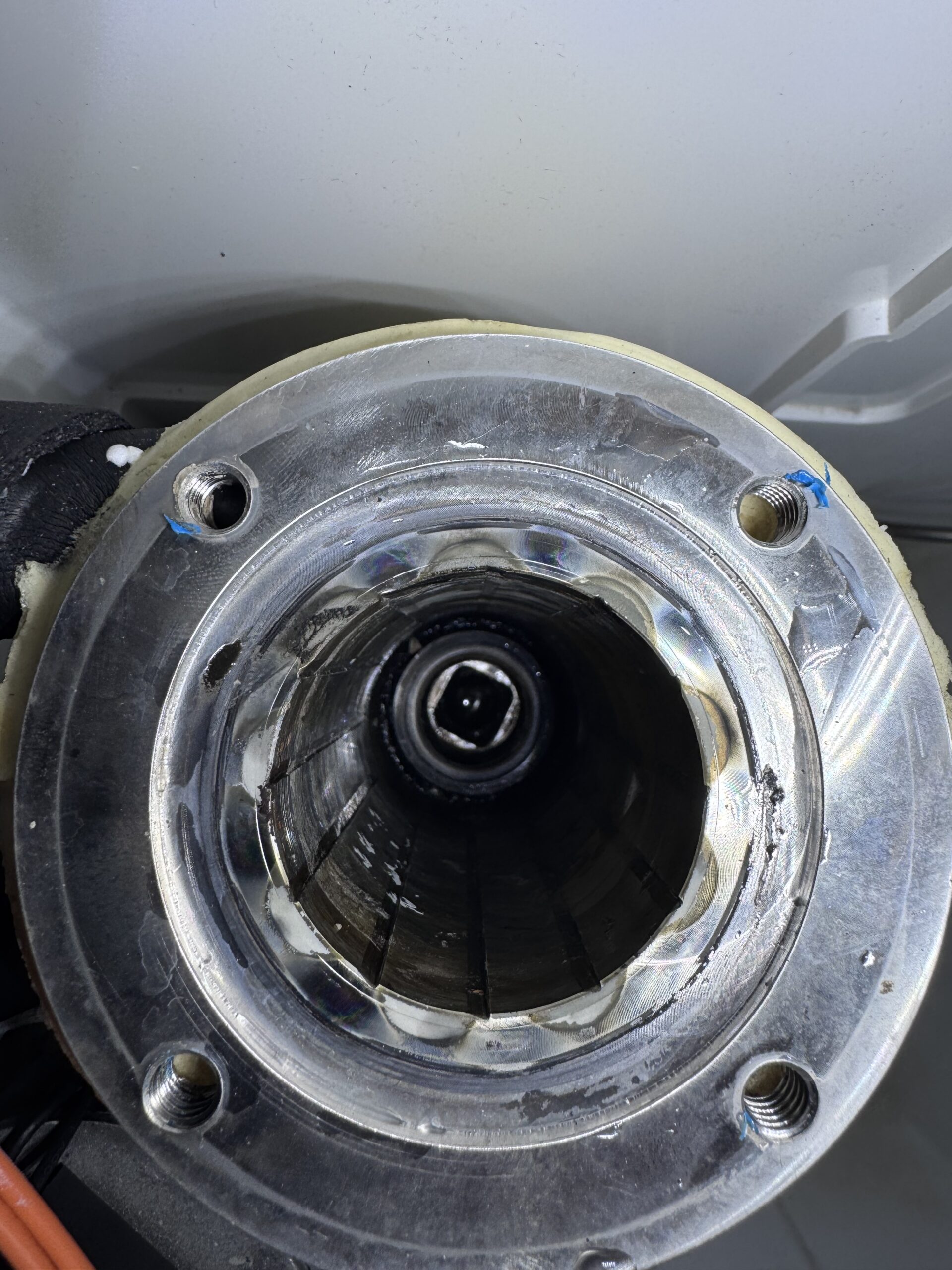
Inside the evaporator, the rifled grooves were scratched and damaged. Those grooves are precision-machined and critical for ice formation. An evaporator in this condition cannot form ice correctly.
The Verdict — and the Customer’s Decision
The machine needed a new auger, a new evaporator, a new water seal, a new graphite bearing, and potentially a new gearmotor if water had contaminated the oil. The total repair cost matched — or exceeded — the price of a new machine.
She bought a new machine.
None of this had to happen. With professional maintenance every 6 months — proper cleaning as we describe in our Houston Scotsman cleaning guide — and an annual check of the graphite bearing, this machine would still be running today.
What “Maintenance” Actually Means — It’s Not Just Pressing CLEAN
Here’s the most common misconception I encounter: people think “maintenance” means pressing the CLEAN button. It doesn’t.
The CLEAN cycle runs descaling solution through the water system. That matters. Mineral scale buildup reduces ice production and increases load on the auger drive, which accelerates bearing wear. But the CLEAN cycle does nothing for the mechanical components.
What the CLEAN Cycle Doesn’t Touch
- The graphite sleeve bearing — needs physical inspection and periodic replacement
- The ceramic water seal — can crack from side-loading caused by a worn bearing
- The condenser air filter — needs cleaning or replacement to prevent overheating
- The gear oil — must be checked for water contamination if any seal leakage occurs
- The auger and evaporator surfaces — need visual inspection for scoring and heavy scale
The Clogged Filter Nobody Ever Cleans
Look at this condenser filter from the same machine:
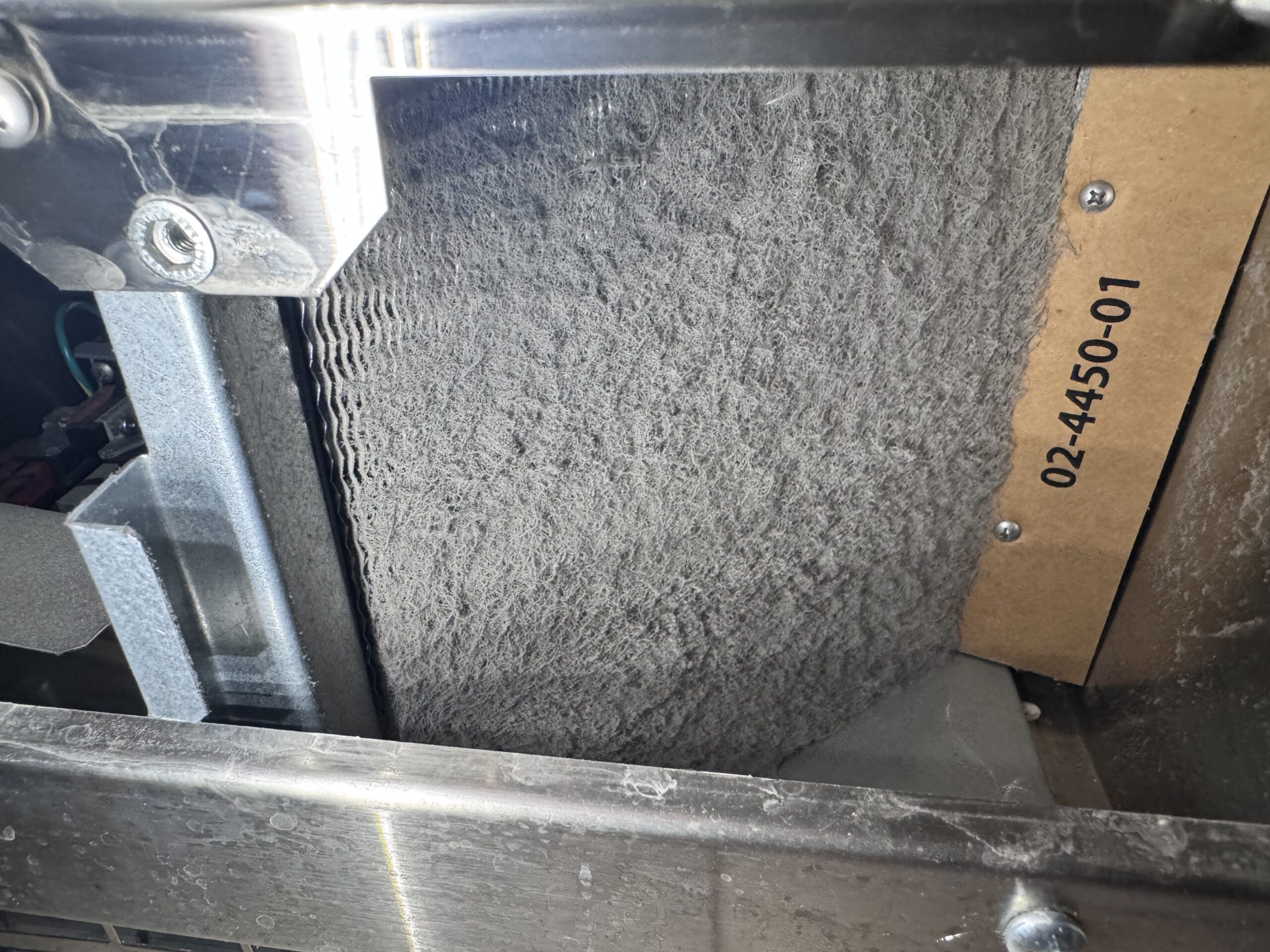
A clogged condenser coil restricts airflow. The refrigeration system overheats. The compressor runs harder. The auger motor works overtime. And all that extra mechanical stress lands on — you guessed it — the graphite bearing.
In Houston’s climate, with summer temperatures regularly hitting 95–100°F, condenser maintenance is not optional. It’s essential.
Scotsman Knew About the Problem — That’s Why the SRN110 Changed the Design
When Scotsman introduced the SRN110 as the successor to the SCN60, engineers replaced the graphite sleeve bearing with a sealed ball bearing assembly.
Ball bearings provide positive radial support regardless of wear state. They don’t produce abrasive debris when they reach end of life. They give clear warning signs — noise and vibration — before total failure. This change directly addresses the failure mode I’ve described throughout this article.
You can review the official Scotsman SRN110 service manual to see the updated bearing design. In my view, this is the most meaningful reliability improvement Scotsman made in the new model.
The SCN60 is not a bad machine. It can last many years with proper care. But the graphite bearing is a known wear item. Treat it that way — inspect and replace it on a schedule, not when the noise starts.
The Warning Signs Most People Miss
By the time your SCN60 makes unusual sounds, the bearing has already failed. Here’s how the progression typically unfolds:
Stage 1: Reduced Ice Production (No Noise)
The machine produces slightly less ice than usual. No obvious sounds. Most owners attribute this to water quality or temperature and ignore it.
Stage 2: Faint Grinding on Startup
A subtle scraping sound appears, especially when the machine first starts. Ice may have a slightly gray color or off taste — that’s graphite particles mixing with your ice.
Stage 3: Loud Grinding and Visible Debris
The grinding becomes loud. Black debris appears in the ice bin. Ice production drops significantly. Water may begin leaking under the machine as the water seal fails.
Stage 4: Machine Stops
The machine errors out or the gearmotor overloads. At this point water has usually reached the gear oil. The repair cost now equals or exceeds the machine’s replacement value.
Gray or black ice is your most distinctive early warning sign. If you ever notice dark-colored nuggets from your Scotsman, call a technician immediately. Don’t wait for more symptoms.
What Our Maintenance Visit Includes
When our team at HomeFixApplianceRepair services a Scotsman SCN60 in Houston, here’s what we do:
- Full descaling cycle with Scotsman-approved cleaner — not just a water rinse
- Condenser filter cleaning or replacement — essential in Houston’s heat
- Graphite bearing inspection — we measure shaft play and check for wear before it becomes a problem
- Ceramic water seal inspection — checking the seal faces for chipping, cracking, or carbon buildup
- Auger and evaporator visual inspection — looking for scoring and contact marks
- Gearmotor check — listening for abnormal noise, checking for oil contamination
- Full operational test — verifying ice production rate, ice quality, and cycle times
Finding bearing wear during a maintenance visit costs a fraction of replacing the auger, evaporator, and water seal after the bearing destroys them.
Why Houston Makes This Even More Critical
Houston has hard water. The mineral content in many local water supplies is high. Those minerals deposit as scale on the evaporator walls, the auger shaft, the water shed, and the spray bar. Scale acts as an abrasive. It increases load on the gearmotor. It impairs ice formation. And it accelerates graphite bearing wear.
Add Houston’s extreme summer heat to the equation. Then add the SCN60’s wear-prone graphite bearing design. The result: Houston SCN60 owners face more aggressive wear conditions than owners in cooler, softer-water cities.
We recommend professional maintenance every 6 months for Scotsman ice machines in the greater Houston area. If your water is particularly hard, or your machine sits in a hot garage or outdoor kitchen, make it every 4 months.
Don’t Wait for Problems — Call Us First
The Scotsman SCN60 can give you many years of reliable service. The newer Scotsman SRN110 builds on that foundation with a more durable ball bearing design. But regardless of which model you own, the rule is the same: ice machines are not set-and-forget appliances. They need regular professional attention.
Our technicians at HomeFixApplianceRepair specialize in Scotsman ice machine repair and maintenance throughout Houston and the surrounding area. We know these machines inside and out. We’ve seen every failure mode. We know what to look for before the sounds start — and how to stop the chain reaction of damage before a $150 bearing replacement becomes a $1,500 rebuild.
Whether you need a Scotsman SCN60 repair in Houston, a routine maintenance service, or honest advice about repair versus replacement, visit our Scotsman service page or give us a call. We’ll give you a straight answer — not just the one that maximizes our invoice.
Because the best repair is the one you never need.
All photos in this article come from actual Scotsman SCN60 repair jobs performed by HomeFixApplianceRepair technicians in the Houston area. All damage shown results from deferred or absent maintenance.


3 Responses
Man, I wish I knew this earlier… We’ve had our Scotsman for like 2 years and use it EVERY day. Never heard from the manufacturer that it needs deep cleaning every 6 months. Now it makes sense why it started getting noisy 😑
Thank you for a detailed summary of the consequences of a failed sleeve bearing and steps on how to protect your machine.
Do you recommend replacing the SCN60 sleeve bearing with another graphite sleeve bearing, or with an aftermarket bronze bearing such as those available on eBay/Amazon?
I would still recommend sticking with the original Scotsman graphite sleeve bearing. It’s what the machine was designed to use, and I prefer OEM parts in this application rather than aftermarket bronze bearings.