

In the heavy Houston humidity, a dryer that won’t get hot is often an airflow crisis masquerading as a mechanical failure. Dealing with a dryer not heating Houston laundry can instantly disrupt your daily routine. You’re left with damp piles of clothes that won’t air-dry in this climate and the growing fear of a potential fire hazard. It’s a stressful situation that requires a fast, practical solution.
We know you want your laundry dry today without overpaying for unnecessary service. This 2026 troubleshooting checklist will help you identify exactly why your appliance is blowing cold air. You’ll learn how to spot simple fixes you can handle yourself and when it’s time to call in a local specialist. We’ll preview common part failures like thermostats and heating elements, explain the 50 percent rule for repairs, and help you ensure your appliance is safe to operate again.
Key Takeaways
- Rule out simple power issues and incorrect settings that mimic major mechanical failures.
- See how local humidity creates “wet lint” blockages, a leading cause of a dryer not heating Houston homes.
- Identify the specific symptoms of broken heating elements and failing gas valve solenoids before they lead to a breakdown.
- Learn to distinguish between gas and electric power issues, from burnt terminal strips to heavy-duty plug failures.
- Understand the value of professional same-day service in preventing mold growth and ensuring your appliance is safe to use.
The Essential ‘Dryer Not Heating’ Checklist for Houston Homeowners
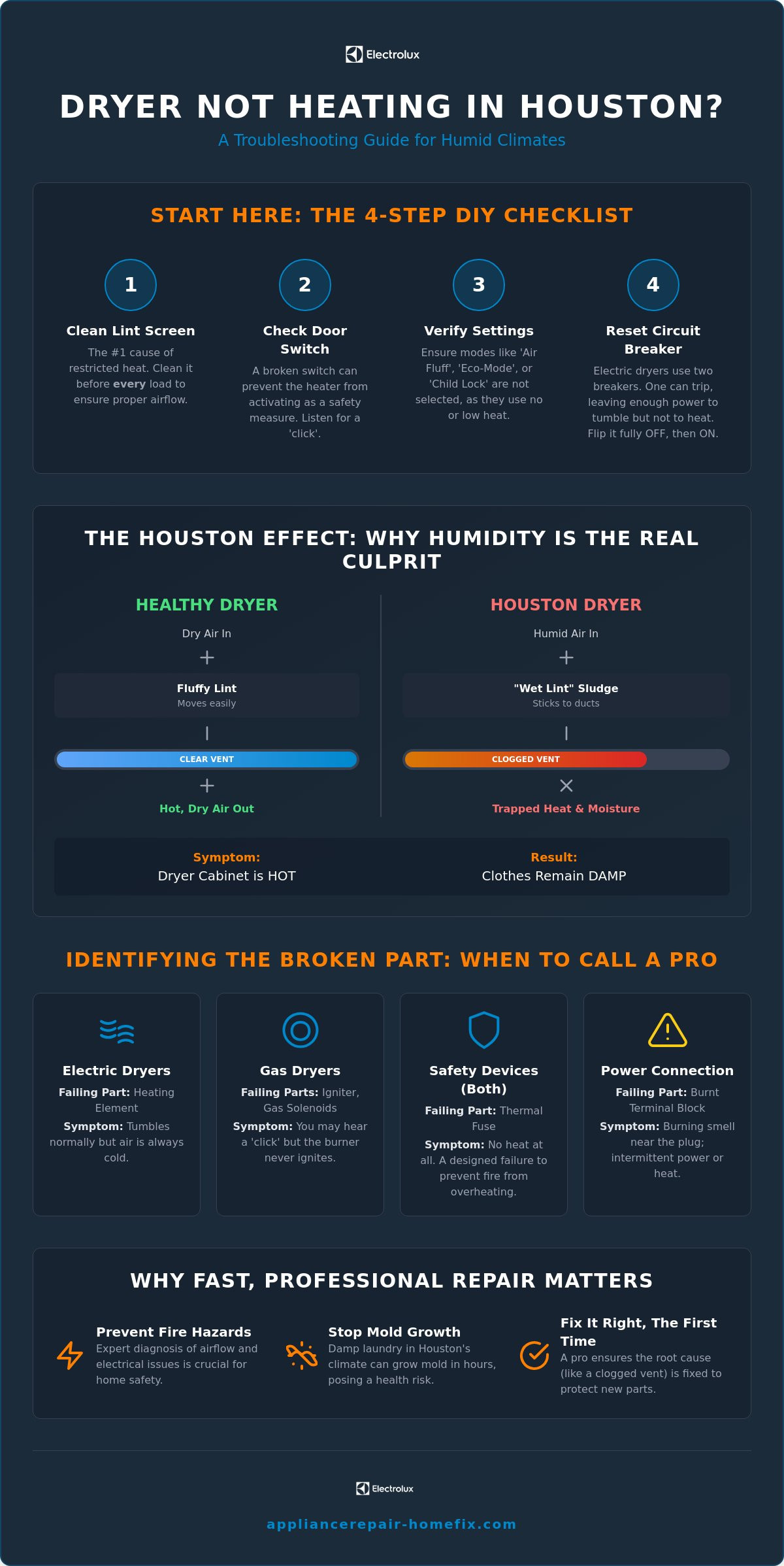
Finding a pile of damp clothes after a full cycle is frustrating. Before you assume the worst, run through a basic diagnostic. Many cases of a dryer not heating Houston homes result from simple, external factors rather than a total machine failure. Start with the lint screen. A clogged screen is the most common cause of restricted heat. If air cannot move, the dryer’s internal sensors will often throttle the temperature or shut down the heater to prevent a fire. Clean the screen thoroughly before every single load.
Next, test the door switch. This small plastic peg tells the machine it’s safe to operate. If the switch is bent or broken, the dryer might tumble in some models, but it won’t allow the gas burner to ignite or the electric coils to glow. Press the switch with your finger; you should hear a distinct click. If you don’t, the component likely needs replacement. Understanding how clothes dryers work helps you see that these safety interlocks are designed to protect your home from overheating.
Power Supply and Breaker Issues
Electric dryers require a significant amount of power. They run on a 240v circuit, which consists of two separate 120v “legs” of electricity. It’s common in older Houston homes for one side of the breaker to trip while the other remains active. This creates a “half-tripped” state where the dryer has enough power to tumble the drum and light up the display, but not enough to engage the heating element. Always flip your dryer’s circuit breaker all the way to “Off” and then back to “On” to ensure both legs are engaged.
Never use an extension cord for a high-voltage dryer. These appliances draw more current than standard household cords can handle safely. Using one can lead to voltage drops that prevent heating or, worse, cause an electrical fire. If your dryer isn’t reaching the outlet, you need a professional to relocate the plug or install a longer, factory-certified power cord. If you’ve reset the breaker and still have no heat, you may need a professional dryer repair specialist to inspect the terminal block for burnt wires.
User Errors and Settings Missteps
Modern appliances come with complex control panels that make accidental setting changes easy. Check your display for “Eco-Mode” or “Energy Saver” settings. These modes often use lower heat and longer tumble times to save electricity, which can make it feel like the dryer isn’t heating properly during a humid Houston afternoon. Also, verify that the child lock or start-delay features aren’t active, as these can prevent the heating cycle from initiating correctly.
The ‘Air Fluff’ setting bypasses the heating element entirely to circulate room-temperature air through the drum. Ensure you’ve selected a high-heat cycle like “Heavy Duty” or “Towels” when testing for heat issues. If the dryer remains cold on every setting, the problem is likely a blown thermal fuse or a failed igniter. These components require a more technical approach to fix safely.
Why Houston Humidity and Airflow Are Your Dryer’s Worst Enemies
Houston’s climate presents a unique challenge for home appliances. When local humidity levels exceed 90 percent, the air entering your dryer is already saturated. As the machine heats this air to evaporate water from your clothes, the resulting exhaust becomes incredibly thick. In drier states, lint stays fluffy and moves easily through the vent. In Houston, this lint absorbs ambient moisture and turns into a heavy, wet sludge. This “wet lint” sticks to the walls of your ductwork, narrowing the passage and eventually causing a complete blockage.
If you find your dryer not heating Houston laundry properly, check the temperature of the machine’s exterior. A common sign of a vent blockage is a dryer cabinet that feels dangerously hot to the touch while the clothes inside remain soaking wet. This happens because the heat is trapped inside the drum with nowhere to go. Without proper exhaust, the moisture cannot escape. Professional vent cleaning is a necessary companion to any repair to prevent the same part from failing again next week.
The Science of Evaporation in Humid Climates
High ambient humidity naturally slows the drying process. The air can only hold so much water; even if your internal components are working perfectly. Houston’s heavy rains also cause exterior vent flaps to rust or become stuck shut. Check your exterior vent regularly for debris or “mud dauber” nests that thrive in our local environment. Understanding how dryer heating elements work clarifies that without a clear path for air, your heating element will eventually burn out from the back-pressure of heat.
The Thermal Fuse: Your Dryer’s Last Line of Defense
The thermal fuse is a small safety device designed to break the electrical circuit if the internal temperature exceeds safe limits. When a vent is blocked, the heat spikes and the fuse “blows” to prevent a house fire. If your dryer runs and tumbles but never produces heat, a blown thermal fuse is a likely culprit. Never bypass this fuse with a jumper wire. It’s your last line of defense against a disaster. Dealing with a dryer not heating Houston homes often requires a professional dryer repair technician to ensure the vent is clear before replacing the fuse.
Mechanical Failures: Heating Elements, Igniters, and Solenoids
Internal mechanical failures are the next logical step if your airflow is unrestricted. In a busy Houston household, the internal components of your dryer work under constant stress. Heat causes metal to expand and contract; eventually, these parts simply snap or burn out. Most mechanical issues with a dryer not heating Houston homes involve the heating element in electric models or the ignition system in gas units. These components have finite lifespans and typically require replacement rather than repair.
Electric Heating Element Breakdown
The heating element is a long, coiled wire made of nickel and chrome. It functions much like the coils in a toaster. Over years of use, the wire can become brittle and break. You might see a visible gap in the coil or a dark burn mark where it shorted against the metal housing. If the coil touches the side of the heater box, it can ground out. This sometimes causes the dryer to stay hot even when the cycle ends, which is a significant fire risk.
A multimeter test is the only way to be 100 percent certain of the failure. Set your meter to the lowest ohms setting and touch the probes to the element terminals. If the display shows “OL” or no change, the circuit is broken. Replacing these coils requires partial disassembly of the machine. For a safe and fast resolution, you should book a dryer repair near me to have a technician swap the element and inspect the surrounding wiring for heat damage.
Gas Dryer Ignition System
Gas dryers use a specific sequence to create heat. First, the igniter glows white-hot. Once it reaches a specific temperature, the radiant sensor triggers the gas valve solenoids to open. This releases gas, which the igniter then lights. If your igniter is cracked or weak, it may glow orange but never get hot enough to open the valve. This is the most common failure point in gas-powered dryers.
Gas valve solenoids also fail in a very specific way. Your dryer might start with heat for five or ten minutes, then go cold for the rest of the cycle. This happens because the solenoid coils are failing; they work when cold but lose their magnetic strength once they heat up. Working with gas lines in residential Houston homes requires extreme caution. Always shut off the gas supply before attempting a repair. If you smell gas or aren’t confident in your ability to seal the lines, call a professional immediately.
Finally, consider the high-limit thermostat. This part monitors the temperature inside the heater box. If it detects a dangerous spike, it cuts power to the element or burner. While it is a safety device, it can fail “open,” meaning it prevents the dryer from heating even when temperatures are safe. A technician can quickly test this with a meter to see if it’s the source of your cold laundry.
Electric vs. Gas Dryer Troubleshooting in Houston
Before you dive into deep repairs, you must know what powers your appliance. A dryer not heating Houston laundry might look the same on the outside, but the internals differ wildly. Check behind the unit. A thick, heavy cord with a large three or four-prong plug indicates an electric model. If you see a standard thin power cord paired with a flexible yellow or stainless steel pipe, you have a gas unit. Identifying this correctly is the first step in a safe diagnostic process.
The repair vs. replacement decision in the 2026 market often comes down to the “50 percent rule.” If the repair cost exceeds half the price of a new unit, and your dryer is more than five years old, replacement is usually the smarter financial move. In Houston, the average cost for a professional dryer repair currently ranges between $261 and $272. However, major repairs like motor replacements can reach up to $400. Keeping these numbers in mind helps you decide whether to fix the current machine or head to the showroom.
Troubleshooting Electric Models
Electric dryers rely on a steady flow of 240v power to activate the heating element. If the dryer tumbles but stays cold, check the terminal block where the power cord connects to the machine. It’s common to find melted wires or burnt plastic here; especially in high-performance brands like LG and Whirlpool. These burnt connections prevent the high voltage from reaching the heater, even if the rest of the dryer seems to have power. If you see any signs of scorching, the block and the cord both need immediate replacement.
Troubleshooting Gas Models
Gas dryers are more complex and generally more expensive to service. Average gas dryer repairs in Texas range from $150 to $500 because they require specialized components and licensed handling. Start with the basics. Ensure the gas supply valve is in the “on” position; it should be parallel to the pipe. If it’s perpendicular, the gas is cut off. You should also listen for the “click” of the solenoids. If the igniter glows but the flame never starts, the solenoids or the flame sensor are likely faulty.
Safety is paramount with gas appliances. If you smell a “rotten egg” odor, do not turn on any lights or use your phone near the unit. Evacuate your home immediately and call your gas provider from a safe distance. For non-emergency mechanical issues, a professional technician can safely test the ignition sequence and clear any clogged burner tubes. If you’re ready to get your laundry moving again, schedule your diagnostic visit with a local specialist today.
Fast Dryer Repair in Houston: When to Call HomeFix
Dealing with a dryer not heating Houston laundry is more than a minor inconvenience; it’s a race against mold. In our local 90 percent humidity, damp clothes can develop a sour, mildewed smell within just a few hours. Air-drying is rarely an option here. HomeFix provides same-day and next-day service to stop the laundry pile-up before it becomes a household crisis. We arrive ready to work, equipped with the tools and common parts needed to restore heat in a single visit.
Our diagnostic process is designed to be transparent and fair. We charge an $89 diagnostic fee to find the exact cause of your dryer’s failure. Whether it’s a blown thermal fuse or a grounded heating element, we’ll provide a clear, upfront quote for the fix. If you choose to move forward with the repair, we apply that entire $89 fee toward your final bill. This ensures you aren’t paying twice for the same visit. We believe in honest service without hidden surcharges or surprise fees.
We serve a wide radius across the metro area, from Katy to Memorial and surrounding suburbs. You get long-term protection with every repair we perform. We provide a 1-year parts warranty and a 3-month labor guarantee. If the same issue returns, we’ll make it right. Our goal is to be your dependable local specialist for years to come, not just for a one-time fix.
The HomeFix Difference: Local Expertise
Our technicians are certified for both gas and electric units. They undergo specific training for high-end and premium brands like KitchenAid, Whirlpool, and LG. We understand the nuances of these complex machines, from digital control boards to gas ignition sequences. We value your time above all else. That’s why we offer a 3-hour arrival window to respect your schedule. You won’t have to wait around all day for a technician to show up; we keep our appointments so you can get back to your life.
Booking Your Repair Today
Don’t let a dryer not heating Houston home stop your productivity. Use our online scheduling tool to book your appointment 24/7. It’s fast, easy, and allows you to pick the time that works best for you. Before we arrive, try to have a few details ready for our team:
- The brand name and approximate age of your dryer.
- The model number, usually found just inside the door or on the back panel.
- A brief description of what happened when the heat stopped.
Having this information helps us arrive prepared with the specific parts your unit might need. We carry a wide inventory of thermostats, fuses, and igniters for major brands. Our priority is a quick turnaround and a safe appliance. Don’t let wet laundry pile up another day. Get your dryer heating again today with a professional touch.
Restore Your Laundry Routine Today
A dryer not heating Houston laundry shouldn’t derail your entire week. You now know how to rule out simple breaker trips and why our local humidity makes vent maintenance a top priority. Whether your appliance has a burnt electric coil or a failing gas valve, identifying the issue is the first step toward a safer home. You don’t have to manage complex mechanical repairs or gas line diagnostics on your own. Professional help is just a click away.
HomeFix is your dependable local specialist for fast, transparent appliance service. Our certified gas and electric technicians serve Houston, Katy, and Sugar Land with a focus on speed and accuracy. Every repair comes with a 1-year parts warranty to give you total peace of mind. Schedule your same-day dryer repair in Houston now to get your appliance back in top shape. We’ll help you get those clothes dry and your household back on track today.
Frequently Asked Questions
Why is my dryer running but not getting hot?
A dryer that tumbles without heat usually has a blown thermal fuse, a broken heating element, or a failed gas igniter. The motor operates the drum independently of the heating system. If you’ve confirmed the settings aren’t on “Air Fluff,” an internal component has likely failed and disconnected the heat source. This is a common issue for a dryer not heating Houston laundry during high-use seasons.
Is it worth repairing a 10-year-old dryer in Houston?
Apply the 50 percent rule to decide. If the repair cost exceeds half the price of a new unit, replacement is the better investment for a machine at the end of its 10 to 13-year lifespan. Minor repairs under $150 are often worth it to extend the life of the appliance. However, major failures like a motor or control board on an old unit may not be cost-effective.
How much does it cost to fix a dryer that won’t heat?
The average dryer repair in Houston falls between $261 and $272 according to 2026 market data. Minor repairs like replacing a thermal fuse generally cost between $80 and $150. More complex issues involving the motor or gas valves can range from $300 to $400. We apply your diagnostic fee directly to the final cost of your repair.
Can a clogged vent cause a dryer to stop heating?
Yes, restricted airflow is the leading cause of heater failure. When lint blockages trap heat inside the machine, the internal temperature spikes dangerously. This triggers the thermal fuse to blow as a safety precaution, which instantly cuts power to the heating element or burner. You must clear the vent before replacing the fuse or the new part will blow immediately.
How do I know if my dryer thermal fuse is blown?
You can identify a blown fuse if the dryer tumbles normally but stays completely cold throughout the cycle. Use a multimeter to test the fuse for continuity. If the meter shows no continuity, the circuit is broken and the fuse must be replaced. Once this safety device blows, it cannot be reset; it requires a new part to restore heat.
Do you offer same-day dryer repair in Katy or Sugar Land?
We provide same-day or next-day service for homeowners in Katy, Sugar Land, and the Memorial area. Our technicians offer a 3-hour arrival window to ensure we respect your schedule. We carry common thermostats, igniters, and fuses to solve your dryer not heating Houston problems in a single visit whenever possible.
Why does my dryer take two cycles to dry my clothes?
Taking multiple cycles to dry is almost always an airflow problem. Houston’s 90 percent humidity causes lint to become damp and heavy, which makes it stick to the walls of your dryer vent. This creates a thick sludge that prevents moist air from leaving the drum. Clean your entire vent line from the wall to the exterior cap to restore efficiency.
Is a gas dryer more expensive to fix than an electric one?
Gas dryer repairs are typically more expensive, averaging between $150 and $500 in Texas. These units involve more complex ignition systems, including solenoids, flame sensors, and igniters. Electric dryer repairs are usually more straightforward, with average costs ranging from $100 to $350. Gas units also require specialized handling to ensure all fuel line connections are leak-free and safe.


