A failed appliance can throw off the whole day: food warms in the refrigerator, laundry piles up, or dinner plans stall. A video tutorial may look like a quick fix, but the wrong repair can cause more damage or create a safety risk. When weighing DIY vs professional appliance repair Fulshear, start with basic, low-risk checks and leave uncertain or complex faults to a trained technician.
Check the settings, confirm the appliance is plugged in, and look for an obvious blockage before booking service. These steps can rule out a simple issue without opening the appliance or working near electrical, gas, heating, or water components. Online instructions may not match your model, and a symptom alone rarely identifies the cause.
This guide explains which checks are reasonable at home, which warning signs call for professional help, and what to expect from a repair visit. HomeFix technicians diagnose appliances on-site and provide a written estimate before work begins, so you can review the recommended repair before deciding how to proceed.
Key Takeaways
- Use this DIY vs professional appliance repair Fulshear guide to weigh safety, repair complexity, tools, and time before choosing your next step.
- Stop if troubleshooting involves exposed wiring, gas, heat, water near electrical parts, or internal components you can’t safely access.
- Compare common refrigerator, washer, dryer, and dishwasher symptoms with safe checks and clear stop points.
- Record the model number, error codes, when the symptom occurs, and any recent changes to give the technician useful information.
- HomeFix’s repair visit includes on-site diagnosis and a written estimate before approved repair work begins.
DIY vs. Professional Appliance Repair in Fulshear: What Each Option Can Handle
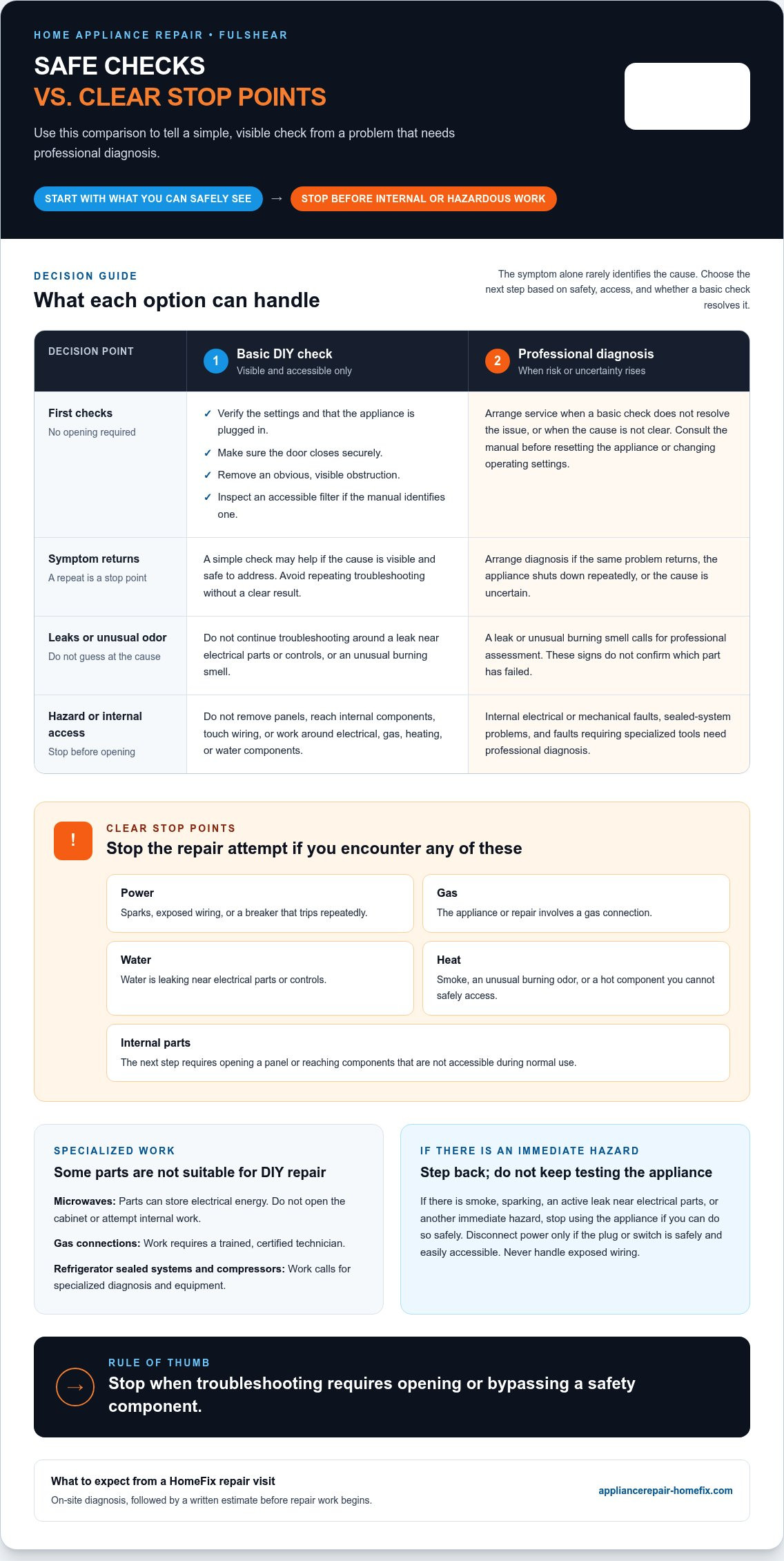
When an appliance stops working, Fulshear homeowners have a practical choice: try a basic check or arrange a professional diagnosis. DIY checks can help when the issue is simple and visible. Professional repair makes more sense when the symptom returns, the cause isn’t clear, or the next step could expose you to electrical, gas, heat, or water hazards.
A refrigerator that isn’t cooling has a clear symptom, but not necessarily an obvious cause. Settings, airflow, and internal components may all be involved. A home appliance combines mechanical and electrical parts, so different faults can produce similar symptoms. A technician can inspect the unit and determine whether the problem is visible or requires tools and testing.
Basic DIY check: Verify the settings, make sure the door closes securely, clear visible obstructions, and inspect an accessible filter if the manual identifies one. These checks don’t require opening the appliance.
Professional diagnosis: Arrange service if a symptom recurs, the appliance shuts down repeatedly, a leak appears, or you notice an unusual burning smell. Internal electrical or mechanical faults and sealed-system problems require more than an outside check.
Risk and time: A quick check may resolve a setting or blockage issue. Repeating troubleshooting without a clear result can waste time or worsen the problem. Stop if the next step involves removing panels, reaching internal parts, or handling wiring.
Which appliance checks are reasonable to try yourself?
Keep the first check simple. Confirm the appliance has the intended settings, look for visible obstructions, check that doors are fully closed, and inspect only filters designed for normal user access. Consult the manual before resetting the appliance or changing operating settings. Don’t open panels or touch wiring to investigate further.
When does professional appliance diagnosis make more sense?
Arrange a diagnosis if the same problem returns after a basic check, the unit leaks, it shuts down repeatedly, or there’s an unusual burning smell. These signs don’t identify a failed part, but they do make continued DIY troubleshooting a poor next step. HomeFix diagnoses appliances on-site and provides a written estimate before repair work begins. For brand-specific service, learn more about Whirlpool appliance repair.
Use this comparison to decide when to stop:
- Try a basic check: Review settings, inspect an accessible filter, remove a visible obstruction, or make sure the door is fully closed.
- Arrange professional repair: Get help for recurring symptoms, leaks, burning smells, repeated shutdowns, or any fault requiring internal access, electrical testing, or specialized tools.
The right choice in DIY vs professional appliance repair Fulshear depends less on the symptom’s name than on whether you can check it safely and identify a simple explanation. If you can’t, stop and leave the diagnosis to a trained technician.
DIY Appliance Repair Safety in Fulshear: Know When to Stop
Stop the repair attempt if you encounter any of these conditions:
- Power: You see sparks or exposed wiring, or a breaker trips repeatedly.
- Gas: The appliance or repair involves a gas connection.
- Water: Water is leaking near electrical parts or controls.
- Heat: There’s smoke, an unusual burning odor, or a hot component you can’t safely access.
- Internal parts: The next step requires opening a panel or reaching components you can’t access during normal use.
Disconnect power only if the plug or switch is safely and easily accessible. Never handle exposed wiring. If there’s smoke, sparking, an active leak near electrical parts, or another immediate hazard, stop using the appliance if you can do so safely. Don’t keep running it to see whether the problem clears. A warning sign doesn’t confirm what failed, but it does mean continued use or guesswork could make the situation worse.
Rule of thumb: Stop when troubleshooting requires opening or bypassing a safety component.
Which warning signs should end a DIY repair attempt?
Repeated breaker trips, burning smells, smoke, sparks, and water near electrical parts all call for professional assessment. Don’t guess at the cause based on one symptom. A shutdown or unusual odor can have different explanations, and identifying the fault may require testing beyond a visual check. For the DIY vs professional appliance repair Fulshear decision, treat these signs as a clear point to stop and arrange a diagnosis.
Why are some appliance parts unsuitable for DIY repair?
Some components can remain hazardous even after an appliance is unplugged. Microwave parts, for example, can store electrical energy, so don’t open the cabinet or attempt internal work. Gas connections also require a trained, certified technician. Refrigerator sealed-system and compressor work calls for specialized diagnosis and equipment, not trial-and-error troubleshooting.
Appliance designs and requirements can vary. The U.S. Department of Energy’s Appliance and Equipment Standards Program provides information about appliance and equipment standards. For homeowners, the practical takeaway is to avoid modifying internal parts or bypassing safety features as a workaround.
When a warning sign appears, step back and note what happened, including when it started and whether the appliance was running. HomeFix provides on-site diagnostics and a written estimate before repair work begins. If the issue has reached that point, schedule an appliance diagnosis instead of continuing a risky repair attempt.
DIY or Professional Repair in Fulshear? Compare Common Appliance Problems
Use the symptom to decide what to check, not to guess which part has failed. A refrigerator that feels warm, for example, could have a settings issue or a fault that needs testing. For DIY vs professional appliance repair Fulshear, keep home checks visible and reversible. Stop if the symptom persists or the next step involves internal parts.
| Appliance and symptom | Safe check | Stop and arrange repair if |
|---|---|---|
| Refrigerator isn’t keeping food cold | Confirm the temperature setting and check that the doors close securely. | Cooling remains poor, the issue returns, or you hear unusual internal noises. |
| Washer shakes, won’t drain, or stops mid-cycle | Check that the load is balanced. Inspect only an accessible drain area described in the manual. | It repeatedly fails, water remains, or checking further requires opening a panel. |
| Dryer takes longer to dry or stops | Clean the accessible lint filter and confirm the selected settings. | Overheating, a burning odor, or persistent lack of heat occurs. |
| Dishwasher leaves standing water or leaks | Inspect and clean the accessible filter according to the manual. | It continues leaking or won’t drain after that basic check. |
| Oven or range won’t heat as expected | Verify the selected mode and temperature setting. | The problem continues or may involve gas, electrical parts, or internal components. |
Refrigerator, washer, and dryer problems: safe first checks
Limit checks to areas designed for normal user access. A balanced washer load or clean dryer lint filter may address a straightforward operating issue, but repeated failures call for a diagnosis rather than another cycle. If cooling trouble persists, visit the refrigerator repair page to learn about service. HomeFix also handles washer repair and dryer repair.
Dishwasher, oven, and range problems: when to call
For a dishwasher, stop if the leak continues or water won’t drain after you check the accessible filter. For an oven or range, stick to the controls and settings. Leave suspected gas or electrical faults to a technician. Don’t treat a symptom as a confirmed diagnosis, since different faults can look alike.
Before deciding what to do next, note the appliance model and age, any displayed error code, and whether the symptom has happened more than once. This context helps a technician assess the problem without relying on guesswork.
Troubleshooting vs. Booking Repair in Fulshear
Use a short process to decide whether another check is useful or it’s time to book a repair. In the DIY vs professional appliance repair Fulshear decision, don’t repeat the same step if the symptom returns or gets worse.
- Identify the symptom. Describe what the appliance is doing or not doing without guessing which part has failed.
- Try one safe check. Review the settings or another accessible item described in the appliance manual.
- Note the result. Record whether anything changed and whether the symptom appeared again.
- Reassess. If the problem persists, worsens, or involves a safety concern, stop using the appliance when continued operation could create more risk and arrange a professional diagnosis.
Basic maintenance covers accessible, routine checks; diagnosis and internal repair require a technician to inspect and test the appliance. Repeated resets aren’t a substitute for finding the cause. Stop troubleshooting if a check calls for opening the unit or reaching internal components.
What information should you gather before a repair visit?
Gather details that help explain the issue without taking the appliance apart:
- Brand and model number, plus any visible error code.
- When the issue began and whether it happens during a particular part of a cycle or at a certain time.
- What you noticed, such as unusual sounds, leaks, or temperature changes.
- Which safe checks you tried and what happened afterward.
- Whether the appliance is safe to operate or has been switched off.
Specific observations are more useful than a guessed diagnosis. For example, note that a washer stopped during a cycle or that a refrigerator’s temperature changed rather than concluding that a particular part has failed.
How does a professional repair visit reduce uncertainty?
HomeFix schedules residential appliance service, then a technician diagnoses the appliance on-site. You receive a written estimate before repair work begins, so you can review the recommended work before approving it. HomeFix offers flexible scheduling and three-hour appointment windows to help you plan for the visit.
HomeFix serves Fulshear and the Greater Houston area, including Houston, Katy, The Woodlands, Sugar Land, Cypress, and Pearland. For nearby service-area information, see the Katy appliance service area. Share your notes when arranging a visit, especially if the appliance has been switched off or the symptom is recurring. That gives the technician useful context for the on-site assessment.
Professional Appliance Repair in Fulshear: What to Expect from HomeFix
When a basic check doesn’t solve the problem or troubleshooting raises a safety concern, professional diagnosis is the practical next step. HomeFix is an independent appliance repair company serving residential customers in Fulshear and Greater Houston. The visit follows a clear sequence, so you know what happens before repair work begins.
- Schedule the visit. Share the appliance type and symptoms you’ve noticed.
- Meet the technician. HomeFix offers three-hour appointment windows, and the technician assesses the appliance at your home.
- Review the diagnosis. The technician investigates the issue on-site. A symptom doesn’t confirm its cause, so diagnosis helps identify what may be behind it.
- Review the written estimate. HomeFix provides the estimate before work begins.
- Approve the repair. Work proceeds after you approve the estimate.
HomeFix technicians are certified and receive ongoing brand-specific training. Most replacement parts carry a one-year warranty, and labor is covered by a three-month warranty. The recommended repair and any parts needed depend on the diagnosis, so the written estimate gives you a chance to review the proposed work before it starts.
What makes HomeFix a practical next step for Fulshear homeowners?
Flexible scheduling makes it easier to plan the visit. HomeFix offers same-day or next-day service, with three-hour appointment windows. Most calls are completed within 24 hours. A written estimate before work begins gives you a clear decision point, while the labor and parts warranties set out coverage after the repair.
For the DIY vs professional appliance repair Fulshear decision, book professional service when a safe check fails, a symptom returns, or the next step involves internal parts or a potential hazard. You don’t need to identify the failed component yourself. Share the symptoms and any error codes, then let the technician assess the appliance.
How can you schedule professional appliance repair?
Book online or call HomeFix when your appliance needs professional diagnosis. The three-hour appointment window gives you an arrival range, and the on-site assessment determines the repair recommendation. You’ll receive a written estimate before work begins and decide whether to approve it.
Schedule appliance repair with HomeFix
Choose the Safe Next Step for Your Appliance
Keep DIY checks to visible, low-risk issues such as settings or an accessible filter. Stop if troubleshooting involves wiring, gas, water near electrical parts, or internal components. If the symptom keeps returning or you can’t identify a safe next step, professional diagnosis can help protect your appliance and your time.
When weighing DIY vs professional appliance repair Fulshear, the key is knowing when a basic check has reached its limit. HomeFix technicians receive ongoing brand-specific training, diagnose appliances on-site, and provide a written estimate before repair work begins. Labor is covered by a three-month warranty, and most replacement parts carry a one-year warranty.
Have the issue assessed and review the recommended work before deciding how to proceed.
A clear next step can help get your household routine back on track. Start with a safe check, and bring in a technician when the problem calls for one.
Frequently Asked Questions
Can I repair a refrigerator myself?
You can try basic checks that don’t require opening the refrigerator. Confirm the temperature settings, make sure the doors close securely, and check for visible items blocking airflow. These checks may help clarify the issue, but they don’t confirm its cause or guarantee a fix. Persistent cooling problems, electrical symptoms, or work involving the sealed system call for professional diagnosis. Stop if troubleshooting requires reaching internal parts.
When should I stop trying to fix an appliance myself?
Stop if you notice smoke, sparking, burning smells, gas concerns, repeated breaker trips, or an active leak near electrical components. Also stop when the next step requires opening the appliance or reaching internal parts. Don’t keep using the appliance if operation could worsen a hazard. Switch it off if you can do so safely, then arrange a professional assessment instead of trying more resets or repair steps.
Is it safe to repair a gas stove or oven myself?
Basic checks of the cooking mode or temperature setting are different from repairing a gas or electrical component. Leave work involving gas connections, ignition parts, or internal electrical components to a technician. If you notice a gas odor or suspect a leak, stop using the appliance, avoid disassembly, and arrange a professional assessment. HomeFix technicians are certified for gas and electric appliance repairs.
Can I fix a washer that will not drain without a technician?
You can check that the correct cycle is selected and the load is balanced. If your appliance manual explains how to inspect an accessible drain filter, follow those instructions. Persistent water, repeated cycle failures, or a blockage you can’t safely access calls for professional diagnosis. Don’t force the washer door open or dismantle the unit. Note any error code and when the issue occurs for the technician.
Is professional appliance repair worth it compared with DIY?
It depends on the repair’s complexity, safety risks, required tools, time, and the chance of causing additional damage. A simple, accessible check may be reasonable to try, while internal or uncertain faults can take more skill to diagnose safely. For DIY vs professional appliance repair Fulshear, consider whether you can identify and safely address the problem. HomeFix provides a written estimate before work begins to help you decide.
What happens during a HomeFix appliance repair visit in Fulshear?
A HomeFix technician examines the appliance on-site, works to identify the issue, and provides a written estimate before repair work begins. You can review the recommended work before deciding whether to proceed. HomeFix serves residential customers in Fulshear and Greater Houston, including Houston, Katy, The Woodlands, Sugar Land, Cypress, and Pearland. Flexible scheduling and a three-hour arrival window help you plan for the visit.
How quickly can HomeFix repair an appliance in Fulshear?
HomeFix offers same-day or next-day service, and most calls are completed within 24 hours. Timing depends on scheduling and the diagnosis. HomeFix uses a three-hour arrival window, which gives a range for the technician’s arrival rather than an exact time. Scheduling is available for residential appliance service in Fulshear and Greater Houston.